
World’s First Humanoid Robot Swarm Tackles Complex Factory Tasks at China’s Car Plant
China Deploys World’s First Humanoid Robot Swarm in Geely’s Zeekr Factory, Marking a New Era in Smart Manufacturing and Industrial Automation

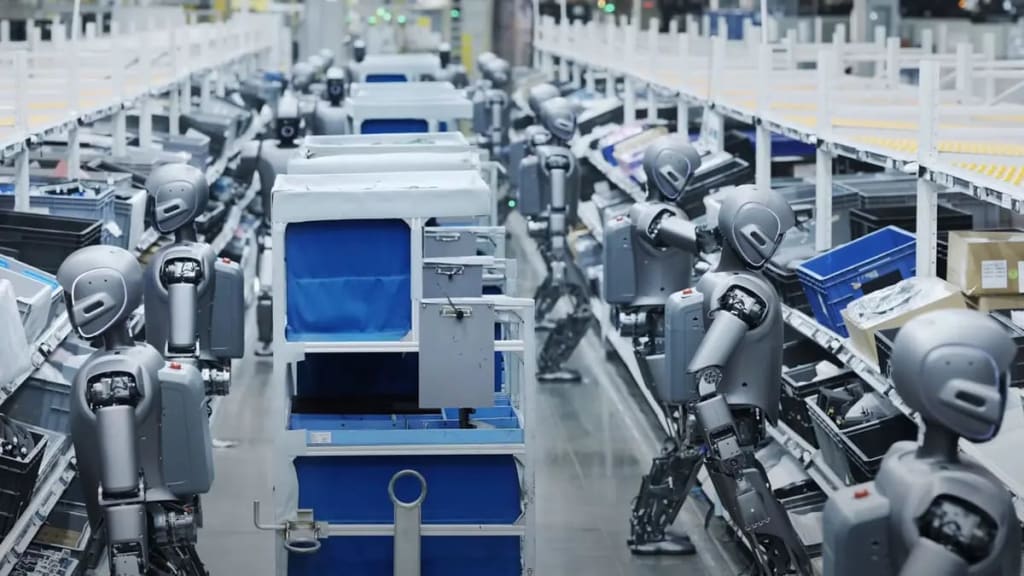
World’s First Humanoid Robot Swarm Tackles Complex Factory Tasks at China’s Car Plant
In a remarkable leap forward for robotics and manufacturing, China has introduced the world’s first working swarm of humanoid robots at an automotive plant. The robots, developed by Chinese tech company UBTECH, are deployed at the Zeekr smart factory in Ningbo, Zhejiang Province, which is owned by Geely, one of China’s leading carmakers. This milestone represents a significant evolution in how automation is used in complex industrial settings.
A Swarm of Humanoid Robots
Unlike traditional robotic arms that are common in factories, UBTECH’s “Walker S” humanoid robots resemble humans in both form and function. Dozens of these robots now work together on the factory floor, performing a range of complicated tasks such as assembling parts, transporting materials, and managing logistics in real time. This marks the first time a swarm of humanoid robots has been deployed in a real production line rather than in isolated test environments.
The real breakthrough lies in the robots’ ability to work as a coordinated swarm. Powered by UBTECH’s proprietary “AI BrainNet” system, the robots are equipped with both shared and individual intelligence. The "super brain" controls task distribution and coordination among robots, while each robot's "mini brain" makes real-time decisions based on its environment.
Smart, Independent, and Collaborative
The humanoid robots are not just programmed for repetitive tasks — they are capable of learning and adapting to new scenarios. Using artificial intelligence and advanced sensory technology, each robot can perceive its surroundings, navigate factory floors, and respond to dynamic production needs. They can also handle delicate and flexible components, making them suitable for high-precision tasks.
By sharing data with one another in real-time, the robots coordinate seamlessly without human intervention. This swarm intelligence ensures that if one robot encounters a problem, others can adjust their behavior to maintain overall productivity. It’s a level of robotic collaboration that has only been theorized until now.
Addressing Labor Shortages and Rising Costs
China, like many industrialized nations, is facing a looming labor shortage, especially in manufacturing. According to government projections, the country may face a shortfall of 30 million workers by 2025. In this context, humanoid robots offer a strategic solution, allowing manufacturers to maintain or even boost productivity despite fewer available workers.
Geely’s adoption of these robots also aligns with a broader national goal to reduce dependency on human labor, improve workplace safety, and increase efficiency through automation and AI.
Transforming the Future of Manufacturing
The implications of this robotic swarm technology go far beyond a single car plant. UBTECH has already partnered with other major manufacturers, including FAW-Volkswagen, to explore wider applications of their humanoid robots in assembly lines and warehousing.
Moreover, the robots are expected to become more advanced over time. With continuous data collection and AI learning, they will acquire new skills faster and operate more efficiently. Future versions may be able to perform even more complex assembly tasks, such as wiring electrical systems or performing quality control inspections.
Government Support and Industrial Ambitions
The Chinese government is fully behind the push toward humanoid robotics. In 2023, China identified humanoid robots as a key sector for national innovation and pledged policy support and funding to accelerate development. The country aims to become the global leader in intelligent manufacturing, and initiatives like the Geely-UBTECH collaboration are seen as important steps toward that goal.
UBTECH’s founder, Zhou Jian, has emphasized that the company’s vision extends far beyond cars. "Humanoid robots will not only serve manufacturing,” he said in a recent interview. “They will change the way humans live, work, and interact with machines."
Challenges Ahead
Despite the impressive progress, challenges remain. Building robots that can operate as reliably as humans in chaotic real-world environments is no small feat. There are also ethical concerns about job displacement, data privacy, and the long-term social impact of humanoid automation.
Still, the promise of smarter, more capable robots is too powerful to ignore. If successful at scale, humanoid robot swarms could revolutionize not just manufacturing, but also logistics, construction, healthcare, and more.
Conclusion
The deployment of a humanoid robot swarm in China’s Zeekr car plant is a historic technological achievement. It shows that intelligent, collaborative robots are not only possible — they are now actively transforming how we build the products of tomorrow. As these systems continue to improve, they will play an increasingly central role in shaping the global economy, workplace dynamics, and the future of human-machine interaction.
About the Creator
Adnan Rasheed
Author & Creator | Writing News , Science Fiction, and Worldwide Update| Digital Product Designer | Sharing life-changing strategies for success.
Keep reading
More stories from Adnan Rasheed and writers in Futurism and other communities.
This Boston Dynamics Robot Has a New Job in Photography
This Boston Dynamics Robot Has a New Job in Photography Boston Dynamics known for its groundbreaking robots like the humanoid Atlas and the four legged Spot has recently introduced a creative twist to its technological marvels. While Spot was originally developed for inspection surveillance and remote operations in dangerous or hard to reach areas it is now entering the world of photography. With cutting edge upgrades and artistic collaboration Spot is showcasing a new side becoming a robot photographer and even an artist.
By Adnan Rasheed9 months ago in Futurism
About Binding Prometheus
I want to start actively advocating on behalf of my own work, and the most valuable part of my canon is, without a doubt, Binding Prometheus, the play I have been working on since 2019 and only finished in 2023 as part of my MA. The play itself is an amalgamation of a million different inspirations. On one end, it evokes the Ancient Greek myth-play, deriving its own title from the earliest extant work of Western drama we have, Aeschylus’s Prometheus Bound. On the other end, it borrows significantly from the sci-fi bulwarks from over the years, namely Mary Shelley’s Frankenstein and Karel Capek’s Rossum’s Universal Robots. The play could be an episode of Black Mirror, I fear. I don’t know. I’ve only ever seen one episode of Black Mirror.
By Steven Christopher McKnight18 days ago in Futurism
Food Service Equipment Market: Smart Kitchens, Operational Efficiency & Industry Trends
According to IMARC Group's latest research publication, global food service equipment market size reached USD 40.1 Billion in 2024. Looking forward, IMARC Group expects the market to reach USD 59.6 Billion by 2033, exhibiting a growth rate (CAGR) of 4.5% during 2025-2033.
By Andrew Sullivan4 days ago in Futurism
A Dart at Dusk
Seconds ago, the sullen sun set on the two of us… my exuberant furry companion and me. A fresh breeze embraces us, delivering welcome relief from the day’s oppressive heat. His typical stumbling and staggering along — apace with a sloth — has turned into trip-trapping, high-stepping, almost skipping along.
By Angie the Archivist 📚🪶5 days ago in Petlife




Comments
There are no comments for this story
Be the first to respond and start the conversation.