
Will Quantum Computing Ever Work? Todd Kassal Explores the Future of Quantum Technology
by Todd J. Kassal


Quantum computing has long been heralded as the next frontier in computational power, promising to revolutionize industries from cryptography to pharmaceuticals. Yet, despite significant investments and research, practical, large-scale quantum computers remain elusive. Todd Kassal, an Illinois-based quantum computing enthusiast and strategic thinker, delves into the current state of quantum computing, examining its challenges, advancements, and the road ahead.
The Promise of Quantum Computing
At its core, quantum computing leverages the principles of quantum mechanics—superposition and entanglement—to process information in ways that classical computers cannot. This enables quantum computers to handle complex computations more efficiently, potentially solving problems that are currently intractable.
Todd Kassal emphasizes the transformative potential of quantum computing, stating that "the ability to simulate molecular interactions at an unprecedented scale could lead to breakthroughs in drug discovery and materials science." He also notes that "quantum algorithms could optimize complex systems, from supply chains to financial models, offering solutions that classical computers struggle to provide."
Current Challenges and Skepticism
Despite the theoretical advantages, practical quantum computing faces significant hurdles. One major challenge is maintaining qubit coherence; qubits are highly sensitive to environmental disturbances, leading to errors in computations. Error correction techniques exist but often require a large overhead, making scalable quantum computing difficult.
Some experts express skepticism about the feasibility of building large-scale, fault-tolerant quantum computers. Physicist Mikhail Dyakonov has argued that controlling the vast number of parameters in a quantum system may be fundamentally unmanageable. Similarly, Gil Kalai has questioned whether quantum supremacy—the point at which quantum computers outperform classical ones—can ever be achieved.
Kassal acknowledges these concerns but remains cautiously optimistic. "While the technical challenges are formidable, the continuous progress in quantum research suggests that these obstacles are not insurmountable," he asserts.
Recent Advancements and Industry Efforts
In recent years, significant strides have been made in quantum computing. Companies like IBM, Google, and Microsoft have developed quantum processors with increasing numbers of qubits and improved error rates. For instance, Microsoft's development of the "Majorana 1" chip, utilizing a new state of matter, aims to create more stable qubits, potentially allowing for the integration of one million qubits on a single chip.
Additionally, Cisco has unveiled a prototype quantum networking chip designed to interconnect smaller quantum computers into larger systems, indicating a focus on quantum networking as a path forward.
These developments suggest that while fully functional quantum computers are not yet a reality, the foundational technologies are rapidly advancing.
The Road Ahead: Preparing for a Quantum Future
Given the current trajectory, experts predict that quantum computers capable of outperforming classical systems in specific tasks may emerge within the next decade. The U.S. National Institute of Standards and Technology (NIST) anticipates that quantum computers will be able to break existing public key encryption methods by 2029, highlighting the need for quantum-resistant cryptographic algorithms.
Kassal advises that industries and governments should begin preparing for the quantum era now. "Investing in quantum research, developing a quantum-ready workforce, and updating security protocols are essential steps to ensure a smooth transition," he recommends.
He also points out that hybrid quantum-classical systems may serve as an intermediate solution, leveraging the strengths of both computing paradigms to tackle complex problems more effectively.
Conclusion: A Balanced Perspective
While quantum computing is not yet ready to fulfill all its promises, the field is progressing steadily. The challenges are significant, but so are the potential rewards. As Todd Kassal aptly summarizes, "Quantum computing is not a question of if, but when. The journey may be long, but the destination holds transformative possibilities for our world."
About the Creator
Todd J. Kassal
Todd J. Kassal is a seasoned Quantum Computing and Project Management professional with over a decade of experience driving innovation at the intersection of cutting-edge technology and strategic execution.
Keep reading
More stories from Todd J. Kassal and writers in Futurism and other communities.
Todd Kassal of Illinois: Bringing Quantum-Inspired Intelligence to CK RubberTrack’s Operations
In the heart of Illinois, CK RubberTrack hums with purpose—delivering durable rubber tracks for heavy construction and agricultural machinery. Behind that production, Project Manager Todd Kassal is quietly redefining how work happens. Instead of overseeing operations through spreadsheets and experience, he’s introducing quantum‑inspired thinking—algorithmic tools modeled on quantum principles—to tackle complex challenges in planning, logistics, production, and product design. And the results are transforming what success looks like in industrial manufacturing.
By Todd J. Kassal6 months ago in Futurism
About Binding Prometheus
I want to start actively advocating on behalf of my own work, and the most valuable part of my canon is, without a doubt, Binding Prometheus, the play I have been working on since 2019 and only finished in 2023 as part of my MA. The play itself is an amalgamation of a million different inspirations. On one end, it evokes the Ancient Greek myth-play, deriving its own title from the earliest extant work of Western drama we have, Aeschylus’s Prometheus Bound. On the other end, it borrows significantly from the sci-fi bulwarks from over the years, namely Mary Shelley’s Frankenstein and Karel Capek’s Rossum’s Universal Robots. The play could be an episode of Black Mirror, I fear. I don’t know. I’ve only ever seen one episode of Black Mirror.
By Steven Christopher McKnight15 days ago in Futurism
United States Chillers Market Size and Forecast 2025–2033
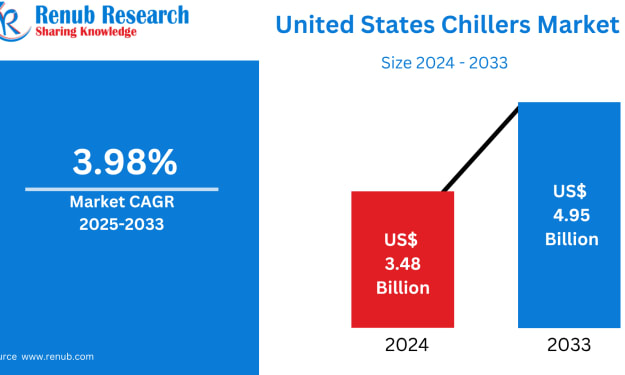
United States Chillers Market at a Glance The United States Chillers Market is projected to reach US$ 4.95 billion by 2033, rising from US$ 3.48 billion in 2024, at a CAGR of 3.98% from 2025 to 2033, according to Renub Research. This steady growth reflects the increasing importance of efficient cooling solutions across commercial buildings, industrial processes, healthcare facilities, and emerging digital infrastructure such as data centers.
By Aaina Oberoi7 days ago in Futurism



Comments