
United States Chillers Market Size and Forecast 2025–2033
Energy Efficiency, Smart HVAC Systems, and Industrial Growth Drive the Next Phase of Cooling Innovation


United States Chillers Market at a Glance
The United States Chillers Market is projected to reach US$ 4.95 billion by 2033, rising from US$ 3.48 billion in 2024, at a CAGR of 3.98% from 2025 to 2033, according to Renub Research. This steady growth reflects the increasing importance of efficient cooling solutions across commercial buildings, industrial processes, healthcare facilities, and emerging digital infrastructure such as data centers.
As the nation continues to prioritize sustainability, automation, and infrastructure modernization, chillers have become an essential backbone of modern HVAC systems. From maintaining indoor comfort in large commercial complexes to enabling precise temperature control in pharmaceutical manufacturing and food processing, chillers are no longer just mechanical equipment—they are strategic assets in energy management and operational efficiency.
United States Chillers Industry Overview
The U.S. Chillers Market is witnessing consistent expansion due to growing applications across commercial, industrial, and residential sectors. Chillers are vital for air conditioning systems, industrial cooling, and process temperature control, offering efficient thermal management in both everyday and mission-critical environments.
Rising construction of office buildings, shopping centers, hospitals, educational institutions, and mixed-use developments has fueled demand for centralized cooling systems. In parallel, the national push toward sustainable buildings and energy-efficient HVAC solutions is accelerating the adoption of advanced chillers with lower environmental impact and improved performance.
Technological advancements are reshaping the market. Innovations such as variable-speed compressors, intelligent control systems, and advanced heat exchangers are enhancing system efficiency while reducing power consumption and operational costs. These technologies allow chillers to respond dynamically to load fluctuations, making them more adaptable to modern building and industrial requirements.
In industrial environments, chillers are indispensable for process cooling in manufacturing, pharmaceuticals, chemicals, and food and beverage production. The need for precise temperature control, product quality assurance, and equipment protection has increased the reliance on advanced chiller systems. At the same time, the shift toward eco-friendly refrigerants and compliance with evolving environmental regulations are driving manufacturers to redesign systems that balance performance with sustainability.
Government initiatives promoting green buildings, energy efficiency standards, and infrastructure modernization further support market expansion. While high initial costs remain a challenge, the long-term benefits of energy savings, lower emissions, and improved reliability continue to strengthen the market outlook.
Key Factors Driving the United States Chillers Market Growth
1. Rising Demand for Energy-Efficient Cooling Systems
Energy conservation and sustainability are central to the growth of the U.S. Chillers Market. With increasing electricity costs and stringent environmental policies, businesses are actively upgrading to chillers that offer higher efficiency and reduced carbon footprints.
The adoption of green building practices, LEED certifications, and eco-friendly refrigerants has accelerated the deployment of next-generation HVAC systems. Advanced compressor designs, smart control algorithms, and improved heat exchange technologies enable modern chillers to deliver superior cooling while consuming less energy. These innovations help organizations lower operating expenses, meet compliance standards, and achieve corporate sustainability goals.
2. Expanding Commercial Infrastructure and Real Estate Development
The continued expansion of commercial real estate across the United States is a major contributor to market growth. New office spaces, shopping malls, hospitals, airports, hotels, and universities require high-capacity, centralized cooling systems to ensure indoor comfort and operational stability.
Additionally, the renovation and retrofitting of older buildings is driving demand for replacement chillers that meet updated energy efficiency and environmental standards. The rapid growth of data centers, fueled by cloud computing, AI, and digital transformation, has also created a high-value market for industrial-grade chillers capable of maintaining temperature stability in mission-critical environments.
3. Technological Advancements and Smart HVAC Integration
The integration of IoT, artificial intelligence, and digital monitoring systems is transforming the chiller landscape. Smart chillers equipped with sensors and automated controls optimize energy usage, reduce downtime, and enable predictive maintenance.
Technologies such as real-time performance analytics, digital twins, and remote monitoring platforms allow facility managers to proactively identify inefficiencies, prevent equipment failures, and enhance system reliability. As industries increasingly digitize operations, demand for intelligent and adaptive chiller systems is rising, reinforcing market growth and accelerating modernization.
Challenges in the United States Chillers Market
High Initial Installation and Maintenance Costs
Despite their long-term advantages, chillers require substantial upfront investment. Advanced systems involve complex components, customized configurations, and professional installation, making them capital-intensive. Energy-efficient and environmentally compliant chillers often come with higher purchase prices, which can discourage adoption—particularly among small and medium-sized enterprises.
Ongoing maintenance costs, refrigerant management, and the need for skilled technicians further increase total ownership expenses. While lifecycle savings often justify the investment, budget constraints can delay purchasing decisions in cost-sensitive sectors.
Stringent Environmental and Energy Regulations
Environmental regulations governing refrigerant usage, emissions, and energy efficiency pose compliance challenges for manufacturers and end users. The phase-out of high global warming potential (GWP) refrigerants requires system redesigns and investment in alternative technologies.
Meeting evolving energy standards adds technical complexity and increases production costs. Smaller manufacturers may face difficulties adapting quickly, potentially impacting competitiveness. Although these regulations promote sustainability and innovation in the long run, they can create short-term transitional challenges for the market.
United States Chillers Market Overview by States
The U.S. Chillers Market demonstrates strong regional demand, particularly in states with large industrial bases, dense commercial infrastructure, and climate-driven cooling needs.
California Chillers Market
California remains a leader in energy efficiency, sustainability, and green building initiatives. Strong demand exists across commercial spaces, healthcare facilities, industrial plants, and data centers. Strict environmental regulations promote the adoption of low-emission refrigerants and high-efficiency cooling systems.
The state’s thriving technology and healthcare sectors rely on precision cooling for operations, while ongoing infrastructure modernization and LEED-certified construction further boost demand. With continued emphasis on renewable energy integration and eco-friendly HVAC solutions, California is expected to maintain steady market growth.
Texas Chillers Market
Texas benefits from an expanding industrial base, booming commercial construction, and consistently high cooling demand due to its climate. Industries such as oil and gas, manufacturing, chemicals, and food processing rely heavily on chillers for process cooling.
Rapid growth in data centers, healthcare facilities, and educational institutions has also fueled adoption of high-capacity, energy-efficient chillers. As the state continues to modernize its HVAC infrastructure and invest in large-scale projects, Texas is set to remain a major contributor to national market expansion.
New York Chillers Market
New York’s dense urban environment and high-rise infrastructure drive sustained demand for centralized cooling systems. Expansion in offices, hotels, retail complexes, and residential developments has increased the need for reliable and efficient HVAC solutions.
Retrofitting aging buildings to comply with stringent energy codes has further accelerated chiller installations. Growth in healthcare facilities and data centers also supports demand for advanced temperature control systems. As smart building adoption and sustainability initiatives continue, New York’s chiller market is poised for long-term growth.
Florida Chillers Market
Florida’s warm, humid climate ensures consistent demand for cooling systems across commercial, hospitality, healthcare, and residential sectors. The state’s expanding tourism industry, with large resorts and entertainment complexes, heavily depends on centralized HVAC solutions.
Emphasis on energy-efficient building standards and rising investments in smart HVAC technologies are shaping market dynamics. Industrial applications, including food processing and marine operations, also contribute to growth. With ongoing infrastructure development, Florida remains a key market for advanced chiller systems.
Recent Developments in the U.S. Chillers Market
In May 2025, Modine announced an investment of over US$ 38 million to expand its data center chiller manufacturing capabilities. This move highlights the growing importance of high-performance cooling solutions for digital infrastructure and reflects the broader industry trend toward specialized, energy-efficient systems for mission-critical applications.
Market Segmentation
By Product
Water-Cooled Chillers
Air-Cooled Chillers
By Compressor Type
Screw
Centrifugal
Absorption
Scroll
Reciprocating
By End User
Chemicals and Petrochemicals
Food and Beverages
Medical and Healthcare
Others
By States
California, Texas, New York, Florida, Illinois, Pennsylvania, Ohio, Georgia, New Jersey, Washington, North Carolina, Massachusetts, Virginia, Michigan, Maryland, Colorado, Tennessee, Indiana, Arizona, Minnesota, Wisconsin, Missouri, Connecticut, South Carolina, Oregon, Louisiana, Alabama, Kentucky, and Rest of the United States.
Competitive Landscape
The United States Chillers Market is highly competitive, with major global and regional manufacturers focusing on innovation, energy efficiency, and digital integration. Key players include:
Mitsubishi Electric Corporation
Daikin Industries Ltd.
Dimplex Thermal Solutions
LG Electronics
Johnson Controls International Plc.
Polyscience Inc.
Smardt Chiller Group
Thermax Ltd.
Trane Technologies Plc.
These companies compete through product innovation, strategic partnerships, geographic expansion, and sustainability initiatives. Many are investing in smart technologies, advanced compressor systems, and environmentally responsible refrigerants to strengthen their market positions.
Strategic Outlook
The future of the U.S. Chillers Market will be shaped by three key forces: energy efficiency mandates, digital transformation, and infrastructure expansion. As businesses and governments prioritize sustainability, demand for next-generation cooling systems that reduce energy consumption and environmental impact will intensify.
Growth in data centers, healthcare infrastructure, advanced manufacturing, and commercial construction will continue to create new opportunities. At the same time, innovations in AI-based monitoring, predictive maintenance, and smart building integration will redefine performance standards.
Although challenges related to costs and regulatory compliance persist, long-term benefits in operational savings, reliability, and environmental responsibility make chillers an indispensable component of modern infrastructure.
Final Thoughts
The United States Chillers Market, projected to grow from US$ 3.48 billion in 2024 to US$ 4.95 billion by 2033, reflects the nation’s commitment to efficiency, sustainability, and technological advancement. From skyscrapers in New York and data centers in Texas to healthcare facilities in California and resorts in Florida, chillers are at the heart of temperature control across industries.
As energy-efficient technologies, smart HVAC systems, and digital monitoring become standard, the market is set to evolve beyond traditional cooling solutions into a critical enabler of sustainable infrastructure. Despite short-term challenges, the long-term trajectory remains positive—making the U.S. Chillers Market a compelling space for innovation, investment, and growth in the decade ahead.
About the Creator
Keep reading
More stories from Aaina Oberoi and writers in Futurism and other communities.
United States Tissue Paper Market Size and Forecast 2025–2033
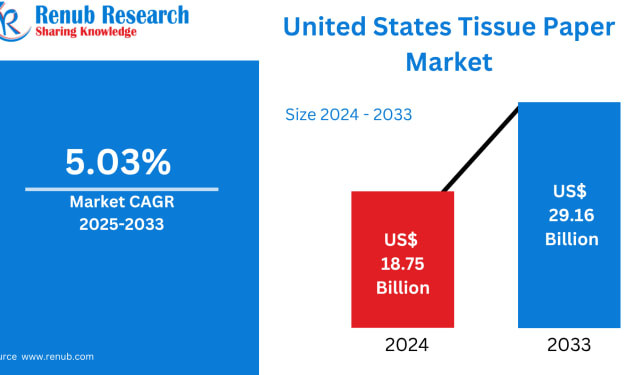
United States Tissue Paper Market Outlook The United States Tissue Paper Market is expected to reach US$ 29.16 billion by 2033, growing from US$ 18.75 billion in 2024, at a compound annual growth rate (CAGR) of 5.03% from 2025 to 2033. This steady expansion reflects increasing hygiene awareness, rising demand for disposable products across households and institutions, and strong innovation in eco-friendly and premium tissue paper offerings. As lifestyles become more convenience-oriented and sustainability becomes a key purchasing factor, tissue paper products are evolving from basic commodities into branded, value-added essentials.
By Aaina Oberoia day ago in Futurism
About Binding Prometheus
I want to start actively advocating on behalf of my own work, and the most valuable part of my canon is, without a doubt, Binding Prometheus, the play I have been working on since 2019 and only finished in 2023 as part of my MA. The play itself is an amalgamation of a million different inspirations. On one end, it evokes the Ancient Greek myth-play, deriving its own title from the earliest extant work of Western drama we have, Aeschylus’s Prometheus Bound. On the other end, it borrows significantly from the sci-fi bulwarks from over the years, namely Mary Shelley’s Frankenstein and Karel Capek’s Rossum’s Universal Robots. The play could be an episode of Black Mirror, I fear. I don’t know. I’ve only ever seen one episode of Black Mirror.
By Steven Christopher McKnight10 days ago in Futurism
GCC Ceramic Tiles Market: Construction Boom, Design Innovation & Demand Outlook
According to IMARC Group's latest research publication, GCC ceramic tiles market size reached USD 10.3 Billion in 2024. The market is projected to reach USD 15.3 Billion by 2033, exhibiting a growth rate (CAGR) of 4.27% during 2025-2033.
By Abhay Rajput5 days ago in Futurism


Comments
There are no comments for this story
Be the first to respond and start the conversation.