
Will Cybernetization Become Mandatory for Life Beyond Earth?
Space


As humanity looks beyond Earth and seriously considers long-term life in space, a once speculative question is becoming increasingly practical: can the human body, in its natural biological form, survive beyond our planet without fundamental modification? Or will cybernetization—deep integration of technology into the human body—become not just an advantage, but a necessity for living outside Earth?
This is no longer a topic reserved for science fiction. Advances in neuroscience, biotechnology, artificial organs, and human–machine interfaces are converging with the realities of space exploration. Together, they suggest that the future of extraterrestrial life may depend less on rockets and more on how far we are willing to redesign ourselves.
Space Is Not Built for Humans
Life on Earth evolved under very specific conditions: stable gravity, a protective atmosphere, a strong magnetic field, and a biosphere that supports our physiology. Space, by contrast, is profoundly hostile to unmodified human biology. Cosmic radiation damages DNA and increases cancer risk. Microgravity causes muscle atrophy, bone density loss, cardiovascular changes, and vision impairment. Isolation and confinement strain mental health in ways that grow more severe over time.
Even with advanced spacecraft shielding and artificial habitats, these challenges cannot be fully eliminated. The farther humans travel from Earth—and the longer they stay—the more fragile the biological body becomes. At some point, simply recreating Earth-like conditions becomes inefficient, risky, and extremely expensive.
This is where cybernetization enters the discussion not as enhancement, but as adaptation.
What Cybernetization Really Means
Cybernetization does not necessarily mean replacing humans with machines. At its core, it refers to the integration of technological systems into the human body to extend, stabilize, or protect biological functions. In the context of space, this could take many forms.
Neural implants could help astronauts interface directly with spacecraft systems, reducing reaction times and cognitive overload. Artificial organs—lungs, kidneys, or blood filtration systems—could be designed to function efficiently in high-radiation environments. Reinforced skeletal structures or internal exoskeletons could counteract the effects of low gravity. Sensory enhancements might allow humans to perceive radiation levels, pressure changes, or structural stress instinctively rather than through instruments.
In more advanced scenarios, cybernetic systems could regulate metabolism, optimize oxygen usage, or manage sleep cycles during long missions. Humans would not cease to be biological—but biology would no longer operate alone.
The Limits of the “Unmodified” Human
Short-term space missions, such as orbital flights or even journeys to Mars, may remain possible with minimal cybernetic intervention. However, true life beyond Earth implies something far more demanding: permanent settlements, multi-decade missions, or even interstellar travel.
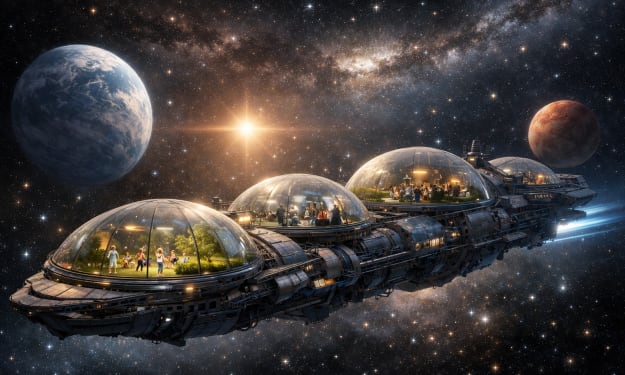
In these scenarios, maintaining perfectly Earth-like environments becomes impractical. A generation ship traveling for centuries cannot rely solely on fragile biological systems that evolved for a planet left far behind. In such cases, adapting humans to space may be more sustainable than adapting space to humans.
Cybernetization could reduce dependency on massive life-support infrastructures, lower failure risks, and increase mission resilience. Over time, the absence of such modifications may be viewed not as purity, but as a liability.
Psychological Survival in Space
Physical survival is only part of the equation. Long-term isolation, confined habitats, delayed communication with Earth, and the absence of natural environments place enormous stress on the human psyche.
Cybernetic solutions may become critical here as well. Neural implants could help regulate emotional responses, manage anxiety, stabilize sleep, and prevent cognitive decline. Enhanced memory systems or AI-assisted cognition might help individuals cope with complex tasks and prolonged monotony.
Critics often argue that such interventions threaten human identity. Yet humanity has always used technology to stabilize the mind—from education and medicine to psychotherapy and pharmaceuticals. In space, refusing psychological augmentation may be less ethical than embracing it, especially when mental instability could endanger entire communities.
Mandatory or Conditional?
It is unlikely that cybernetization will become mandatory for all humans. Instead, it may become mandatory for specific forms of off-world existence.
Just as deep-sea divers and fighter pilots must meet strict physical and technological requirements, future space settlers may need cybernetic certification. Working in asteroid mines, living on rotating habitats, or traveling beyond the solar system may require specific implants or modifications—not by force, but as a condition of participation.
This would naturally lead to a divergence within humanity. Earth-based populations might remain largely biological, while space-adapted humans gradually become something different: not machines, but a technologically integrated branch of our species.
A New Phase of Human Evolution
If humanity becomes a multi-planetary or interstellar species, biological uniformity is unlikely to survive. Cybernetized humans may represent a new evolutionary pathway—sometimes described as Homo sapiens technologicus.
In this view, cybernetization is not the loss of humanity, but its continuation by other means. Evolution has always favored adaptation over tradition. Space does not reward nostalgia; it rewards resilience, efficiency, and stability.
The real question, then, is not whether cybernetization will become mandatory for life beyond Earth, but how much modification we are willing to accept as part of being human. As the boundaries of our environment expand, so too must the boundaries of our definition of humanity.
In the end, surviving the cosmos may require us to do what humans have always done best: change ourselves to meet the universe as it truly is, not as we wish it to be.
About the Creator
Keep reading
More stories from Holianyk Ihor and writers in Futurism and other communities.
How the Concept of Time Will Change for Interstellar Generations
For humans living in the 21st century, time seems like one of the most constant and self-evident aspects of existence. We measure it in seconds, hours, days, and years; we divide it into historical epochs; and we experience it relative to the span of a human life. Yet, when humanity ventures beyond the Solar System, this familiar notion of time begins to shift. Interstellar travel, stretching over decades, centuries, or even millennia, will inevitably transform the way we perceive time—not just physically, but socially, culturally, and psychologically.
By Holianyk Ihor2 months ago in Futurism
Polybutadiene Rubber Market Trends: Green Tires, Low Rolling Resistance & Industry Outlook to 2034
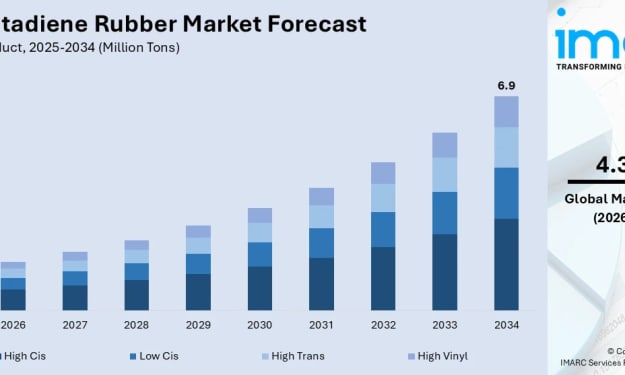
Rising demand from the automotive sector, particularly for high-performance tires, and the increasing use of synthetic rubber in industrial goods are propelling the polybutadiene rubber market. Supported by advancements in polymerization technology and a shift toward sustainable, low-rolling-resistance materials, the industry continues to expand across key manufacturing hubs. According to IMARC Group’s latest data, the global polybutadiene rubber market size reached 4.7 Million Tons in 2025. Looking forward, IMARC Group estimates the market to reach 6.9 Million Tons by 2034, exhibiting a CAGR of 4.31% during 2026-2034.
By Andrew Sullivan4 days ago in Futurism


Comments
There are no comments for this story
Be the first to respond and start the conversation.