
How the Concept of Time Will Change for Interstellar Generations
Space


For humans living in the 21st century, time seems like one of the most constant and self-evident aspects of existence. We measure it in seconds, hours, days, and years; we divide it into historical epochs; and we experience it relative to the span of a human life. Yet, when humanity ventures beyond the Solar System, this familiar notion of time begins to shift. Interstellar travel, stretching over decades, centuries, or even millennia, will inevitably transform the way we perceive time—not just physically, but socially, culturally, and psychologically.
Time as a Measure of Distance
On Earth, time is intimately tied to the day-night cycle, seasonal changes, and biological rhythms. Even astronauts aboard orbital stations maintain an artificial 24-hour schedule. Interstellar spacecraft, however, will operate in environments devoid of natural temporal cues. A journey to the nearest star at sub-light speeds may take decades, while reaching more distant systems could span multiple human lifetimes.
In this context, distance becomes inseparable from time. “Far away” no longer simply describes light-years or kilometers—it comes to signify the number of generations who will live and die before a destination is reached. Time itself becomes the primary navigational measure, replacing conventional maps and charts as the ultimate framework for understanding the voyage.
Generational Time Instead of Individual Time
One of the most profound changes will be a shift in focus from individual lifespan to generational continuity. On Earth, a hundred years is an abstract concept for most people. For an interstellar society, it becomes a practical planning horizon. Decisions will be made not for the benefit of a single individual, but for multiple generations ahead.
This introduces a new concept: generational time. The history of a spacecraft will not be measured in years alone, but in waves of births, changes of crew, and phases of cultural evolution. People will see themselves not as finite units, but as links in a long temporal chain, their lives nested within a continuum that stretches far beyond personal experience.
Slowing of Historical Perception
Back on Earth, historical and technological change accelerates rapidly; revolutions and innovations may occur within a single lifetime. Aboard a generational starship, change will inevitably slow. Limited resources, confined environments, and the need for social stability will favor gradual evolution over rapid upheaval.
Ironically, this slow passage of time may make existence feel “slower.” Traditions, norms, and rituals could persist for centuries, giving the crew a sense of continuity and stability. The past becomes more immediate, the future less radically different from the present, and the entire society develops a distinctive, measured pace of life.
From Linear to Cyclical Time
Human civilization on Earth tends to think of time as linear: history progresses, technology advances, society moves forward. Interstellar generations, living within closed ecosystems, may develop a more cyclical understanding of time. Life aboard the ship will revolve around recurring stages: birth, education, service, and aging, all structured around the ongoing maintenance of the vessel itself.
Calendars may be based not on planetary orbits but on cycles of ecological management, system upgrades, and shifts in governance. Time, in this model, ceases to be a relentless arrow and becomes a repeating wheel—a rhythm that structures both individual lives and the collective memory of the community.
Relativistic Time Discrepancies Between Generations
If humanity eventually achieves near-light-speed travel, another profound effect emerges: relativistic time dilation. Decades experienced by the ship’s inhabitants could correspond to centuries—or even millennia—passing on Earth.
This creates a remarkable phenomenon: generations born aboard the ship will live in what is, from Earth’s perspective, the distant past. The home planet becomes a mythic “ancient world,” and synchronizing time between civilizations loses practical meaning. Cultural and temporal gaps will rival, or even exceed, physical distances, creating a divergence that is both scientific and existential.
Ethics and Responsibility Across Time
As the perception of time stretches and generations overlap, ethical frameworks must adapt. Decisions made by the first crew will directly affect lives yet unborn. Responsibility extends not only across space but also across time, and mistakes become inherited burdens.
Questions of benefit, sacrifice, and progress acquire temporal dimensions. A new kind of ethics emerges—one that is oriented not to the immediate present but to the long-term wellbeing of distant descendants, demanding foresight, prudence, and moral courage on a scale previously unimaginable.
A New Temporal Identity for Humanity
Ultimately, interstellar generations will cultivate a different kind of human identity. People will define themselves not by age or occupation, but by their place within the temporal structure of the mission. Phrases like “I am third-generation after launch” or “I was born in the mid-journey era” will carry more significance than traditional markers of identity.
Time ceases to be the backdrop of life; it becomes the environment itself, as essential to survival as air or water. Generational stars will learn to inhabit not merely space, but the vast corridors of time.
Conclusion
Interstellar expansion will transform not only human technology and biology but the very architecture of consciousness. Time will evolve into a multidimensional, complex framework that encompasses physics, culture, memory, and moral responsibility. Humanity will no longer live “in the moment” but across centuries and millennia, experiencing existence as an enduring temporal continuum.
In reaching for the stars, we will take our first steps not just in space, but in long-duration time itself—a profound evolution of human perception, identity, and civilization. Interstellar generations will teach us that time, like the universe, is far larger, stranger, and more beautiful than we have ever imagined.
About the Creator
Keep reading
More stories from Holianyk Ihor and writers in Futurism and other communities.
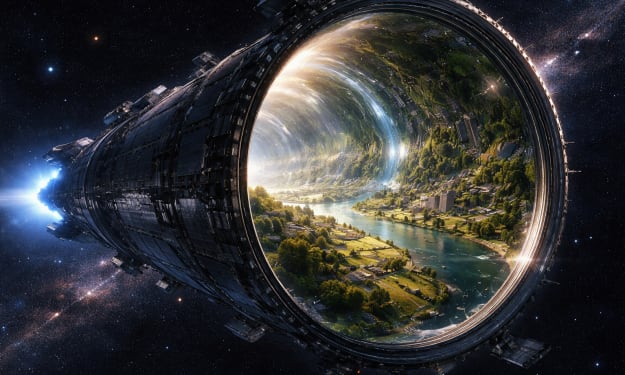
Space Arks — Cities Sailing Through the Centuries
The concept of space arks—massive, self-sustaining cities journeying through the cosmos for centuries or even millennia—has long captivated the imagination of science fiction enthusiasts. Today, however, it is increasingly considered a plausible scenario for humanity’s interstellar expansion. Unlike small spacecraft carrying just a few dozen astronauts, these arks are envisioned as entire civilizations capable of thriving for generations, often without ever setting eyes on Earth again.
By Holianyk Ihor3 months ago in Futurism
Australia Pro AV Market: Hybrid Work Demand, Digital Signage & Smart AV Technologies
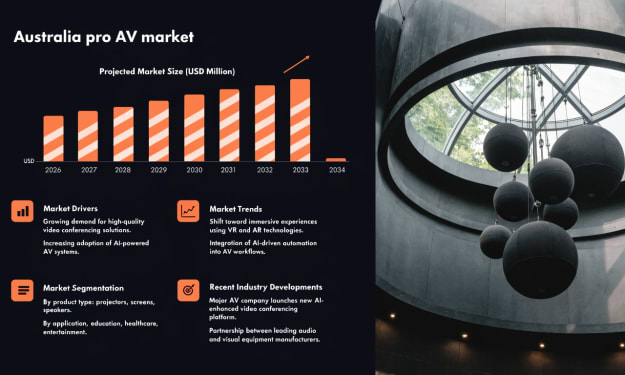
According to IMARC Group, the Australia pro AV market reached a value of USD 93.9 Million in 2025 and is projected to reach USD 133.6 Million by 2034, growing at a compound annual growth rate (CAGR) of 3.88% during 2026–2034. The market is expanding as organizations increasingly adopt advanced audiovisual solutions to support communication, collaboration and digital engagement. Hybrid work environments are encouraging businesses to invest in video conferencing systems, smart displays and integrated collaboration platforms that connect remote and in-office teams. At the same time, industries such as retail, hospitality and tourism are investing in digital signage to improve customer engagement and brand communication. As companies focus on creating interactive and technology-driven environments, professional AV solutions are becoming essential tools for modern workplaces, entertainment venues and commercial spaces across Australia.
By Kevin Cooper43 minutes ago in Futurism
Why Your TikTok DMs Aren't Private (And Why the Platform Says That's a Good Thing)
Introduction: The Privacy Paradox In the current landscape of digital communication, end-to-end encryption (E2EE) has moved from a niche privacy feature to a baseline consumer expectation. Silicon Valley giants are largely in a race to lock down user data, ensuring that not even the platforms themselves can peer into private conversations. Yet, TikTok—the world’s most scrutinized social media app—is pointedly marching in the opposite direction.
By Tech Horizons3 days ago in Futurism


Comments
There are no comments for this story
Be the first to respond and start the conversation.