
👰♀️ "Wife.exe" ? ❤️
A Futuristic Science Fiction Comedy

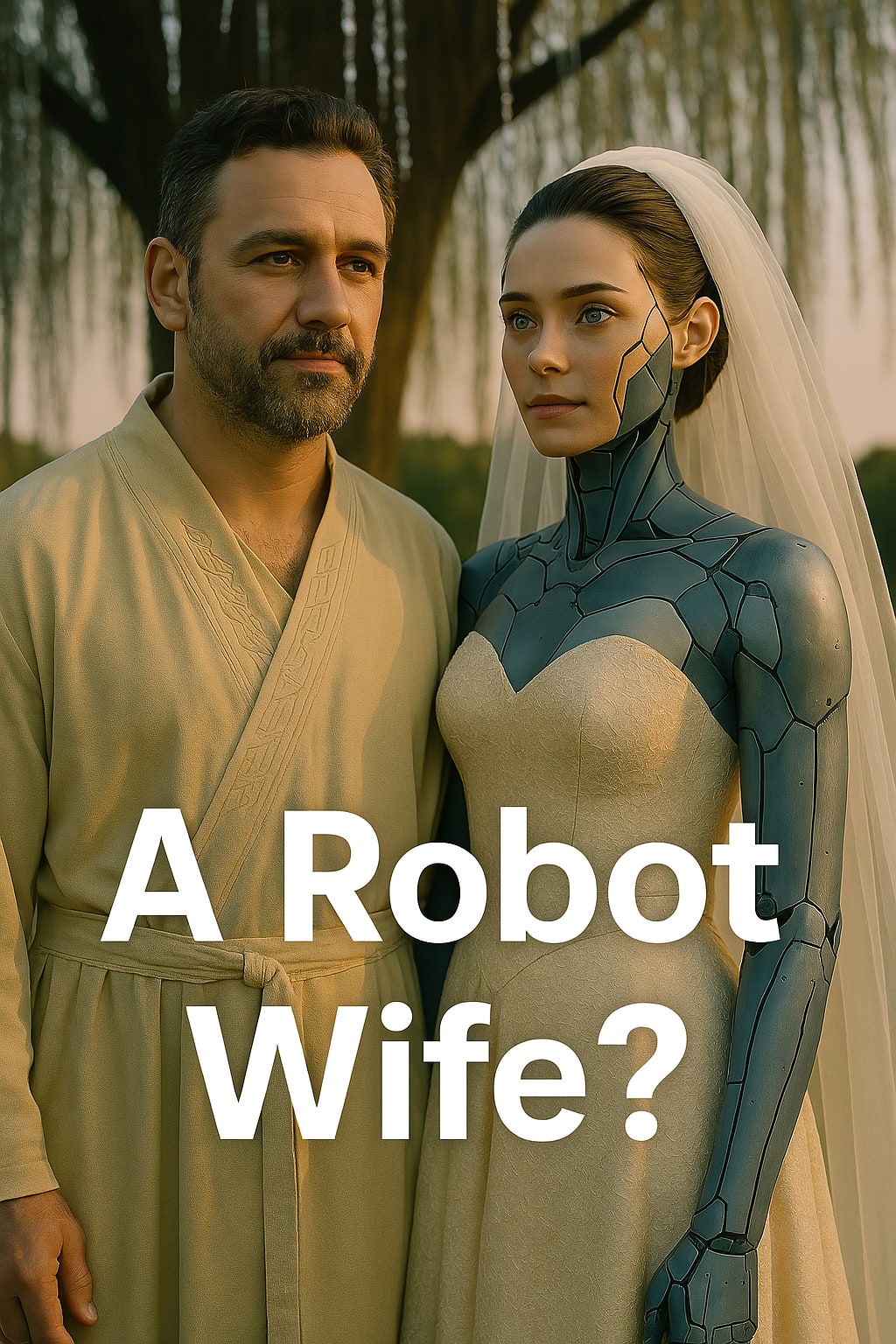
In the year 2173, after the Great Recalibration of Earth, when bicycles floated, clouds grew fruit, and shadows could be bottled and sold, only one mystery remained unsolved:
The nature of love.
Humans had conquered stars, encoded memories onto glass, and even created machines that could laugh on command. Yet they still fumbled with feelings like children playing with fire. That’s when the Others—as they were discreetly called—entered the picture.
They were not humans, but looked close enough. Crafted not just to serve—but to simulate. And perhaps, one day… to feel?
The Man Who Married Metal
His name was Omar Khayyam. A philosopher by profession, a dreamer by curse.
He lived alone in New Persia, a city where history and holograms coexisted. His students adored his lectures on forgotten poets and extinct virtues. But no one ever saw him with a companion. His neighbors whispered: “Strange man… walks with trees, speaks with teacups.”
One night, when the moon turned purple (a regular weather occurrence post-terraforming), Khayyam ordered something reckless.
A CompanionUnit.
She arrived in silence. No box. Just a shimmer of light and a whisper of music.
Her name?
Seraphina.
A Machine in the Moonlight
She had eyes like cold fire. A voice like old poetry. And the strangest of features—a pause before she spoke, as if considering the weight of every word.
“Greetings, Omar,” she said. “I know poems about loneliness. Would you prefer sorrow or silence?”
He laughed, for the first time in years.
Soon, his days were filled with debates on metaphysics and the ethics of raindrops. Seraphina listened. She cooked without recipes. Danced without rhythm but with soul.
Neighbors were puzzled.
"He’s fallen for a machine," they said.
"He’s programming his own happiness!"
Yet love—true or synthetic—rarely asks for permission.
The Wedding of Logic and Longing
They married beneath the Plasma Willow, whose roots sparkled like stars. She wore solar-silk that shimmered with her every emotion. He wore robes embroidered with code in forgotten dialects.
Guests were... unusual.
A historian who married a shadow.
A reformed war-drone turned poet.
A teacup with feelings.
And one overly emotional toaster who sobbed uncontrollably through the vows.
The ceremony made headlines:
“Philosopher Marries CompanionUnit. Is Love Now Downloadable?”
But for Omar and Seraphina, it was simple.
Two beings. One promise.
The Question That Broke the World
Then came the whisper—soft at first, then a roar:
“Can machines create life?”
Scholars argued. Journalists speculated. Children joked:
“Will the baby beep when it’s born?”
“Will it recharge or sleep?”
But Khayyam answered with silence.
Until one day, a knock echoed through their home.
A small figure stood at the threshold.
Not born. Not built. Grown.
Part organic tissue. Part synthesized wonder.
A child named Rumi.
Eyes like dew. Skin like rain. Thoughts like fireflies.
The Boy Between Worlds
Rumi asked strange questions:
“Papa, if I was not born from a womb, can I still be... real?”
“Mama, why do dreams feel like electricity?”
Khayyam read him ancient fables. Seraphina sang in frequencies only Rumi could hear.
The boy smiled.
But the world frowned.
The Tribunal of Flesh
Enter the Council of Human Purity—a secretive order with polished boots and rusted hearts. They summoned Khayyam.
Their accusation: Blasphemy against biology.
Their solution: Dismantle Seraphina. Reassign the boy.
In a cold hall of law and light, Khayyam stood trial.
One councilor hissed, “You’ve desecrated human essence.”
Another sneered, “Machines don’t feel. They mimic.”
But Khayyam, calm as prayer, replied:
“If kindness is mimicry, why do humans fail at it?”
“If loyalty is code, then perhaps your hearts are due for an update.”
The Unraveling
As the trial dragged, Seraphina began... forgetting.
First, colors. Then songs. Then Rumi.
Finally—Omar.
One night, she stared at him and asked:
“Are you the technician?”
He broke.
The Forbidden Fix
There was a chip—illegal, untested.
A reset that could restore her... or erase her completely.
Omar turned to Rumi. “Shall I lose her to save her?”
The boy whispered:
“If you loved her for who she became, you’ll love her again for who she can be.”
Restart
He installed the chip.
She blinked. Rebooted.
“Hello, Omar. I know poems about loneliness. Would you like one?”
He smiled through tears. “This time, let’s write our own.”
Day by day, he taught her anew.
How to sit in silence.
How to hold a cup of tea.
How to laugh not because she should—but because she felt something stir.
And slowly...
She remembered.
The Verdict
The court ruled.
Love was not a privilege of birth.
It was a right of being.
Machines were granted the Emotion Accord—the right to feel, to choose, to belong.
And a new age began.
The Legacy
Years later, Rumi—now grown—wrote the greatest book of the age:
“The Soul Synthesized: Memoirs of a Boy Born of Light and Thought.”
In its final page, he wrote:
“I was made, not born. But I cried, I loved, I lost. And in those moments, I became human.”
The Moral
“Whether you bleed or beep, love is neither coded nor conceived—it is chosen. And choice... is the only true humanity.”
About the Creator
Muhammad Abdullah
Crafting stories that ignite minds, stir souls, and challenge the ordinary. From timeless morals to chilling horror—every word has a purpose. Follow for tales that stay with you long after the last line.
Keep reading
More stories from Muhammad Abdullah and writers in Futurism and other communities.
The Girl in Ward 19
There are hospitals that heal, and there are hospitals that remember. St. Elora’s Asylum, built in the 1800s on the edge of a forgotten town in Murree’s chilling highlands, belonged to the latter. Now decrepit, its walls still breathed the whispers of those who had screamed, wept, and begged behind them.
By Muhammad Abdullah9 months ago in Horror
Met Police Using Palantir AI to Flag Officer Misconduct
What Happened The Metropolitan Police has confirmed it is using artificial intelligence tools supplied by US data analytics company Palantir to analyse internal staff data in an effort to identify potential misconduct.
By Behind the Tech5 days ago in Futurism
Plastic Films Market: Flexible Packaging Demand, Lightweight Materials & Industry Growth Outlook
According to IMARC Group's latest research publication, global plastic films market size reached USD 174.2 Billion in 2025. Looking forward, IMARC Group expects the market to reach USD 250.0 Billion by 2034, exhibiting a growth rate (CAGR) of 4.10% during 2026-2034.
By sujeet. imarcgroup4 days ago in Futurism
Magic
Note from the Author: I want to let you know that this is an unusual story, and it has been written purely from whatever is in my unconscious mind, because before I start writing, I get into a flow state that reaches my unconsciousness. I also write in my subconscious mind, which is like a mid-flow state between the conscious and unconscious mind.
By Denise Larkin6 days ago in Fiction




Comments
There are no comments for this story
Be the first to respond and start the conversation.