
Met Police Using Palantir AI to Flag Officer Misconduct
Police Federation Warns of “Automated Suspicion” as Scotland Yard Confirms Pilot

What Happened
The Metropolitan Police has confirmed it is using artificial intelligence tools supplied by US data analytics company Palantir to analyse internal staff data in an effort to identify potential misconduct.
The force, which employs around 46,000 officers and staff, said the time-limited pilot brings together data from multiple internal systems — including sickness records, absences, and overtime patterns — to detect behavioural trends that may correlate with professional standards issues.
Previously, Scotland Yard had declined to confirm or deny whether it used Palantir technology. It has now acknowledged that Palantir’s AI systems are helping surface patterns, though it stressed that human officers ultimately review cases and make any decisions.
The move comes as the Met continues efforts to rebuild trust after a series of scandals, including vetting failures and cultural misconduct issues.
What Is Analysis
1. From Data Correlation to “Automated Suspicion”
The Police Federation of England and Wales, which represents rank-and-file officers, criticised the initiative, describing it as “automated suspicion.”
Their concern centers on algorithmic profiling:
High sickness levels
Increased absences
Elevated overtime
While the Met says these indicators correlate with standards failings in some cases, the Federation warns that such metrics could also reflect workload pressures, stress, or staffing shortages — not misconduct.
The risk lies in how predictive signals are interpreted.
Correlation does not equal causation.
Patterns in employment data may highlight vulnerability or burnout as easily as wrongdoing.
2. Governance and Transparency
Palantir has become a major contractor across UK public services, including:
A £330m NHS federated data platform deal
A £240m Ministry of Defence contract
Police investigative analytics systems
Its growing footprint has prompted questions about oversight. Liberal Democrat MP Martin Wrigley asked: “Who is watching Palantir?”
Because such systems operate by integrating vast datasets, concerns focus on:
Algorithmic bias
Employee rights
Transparency of model logic
Accountability if flags are incorrect
Unlike traditional supervision, AI-based pattern recognition may operate invisibly to those being assessed.
3. Cultural Reform vs. Surveillance Expansion
The Met argues that identifying behavioural red flags earlier could improve standards and prevent future misconduct scandals.
Following high-profile cases — including the murder of Sarah Everard by a serving officer — institutional reform has become politically urgent.
However, critics argue that:
Cultural change requires leadership and supervision, not only analytics
Automated flagging risks damaging morale
Data-driven monitoring could shift workplace dynamics toward suspicion
The balance between preventative oversight and intrusive surveillance remains contested.
4. Broader Policy Context
The Labour government’s recent policing white paper commits over £115m across three years to support AI adoption across all 43 forces in England and Wales.
This suggests AI deployment in policing will expand rather than contract.
Palantir’s spokesperson framed its technology as improving public services across multiple sectors, including healthcare and defence.
Yet policing introduces unique sensitivities because it involves both public trust and employee rights.
The Bigger Picture
The Met’s pilot reflects a wider transformation in institutional governance: predictive analytics are increasingly used not only to investigate crimes but to monitor internal behaviour.
This shift raises fundamental questions:
Should employment risk assessment be automated?
How transparent must predictive systems be?
What safeguards protect against misinterpretation?
How are flagged individuals informed or reviewed?
AI tools can identify anomalies at scale — something human supervisors cannot easily do across tens of thousands of staff.
But predictive systems are only as fair as their design, data quality, and governance frameworks.
The controversy illustrates a deeper tension at the heart of AI adoption in public institutions:
Efficiency and early detection promise improved standards.
Opacity and automation risk eroding trust.
As AI spreads through policing, healthcare, and defence, scrutiny may increasingly focus not just on what these systems detect — but on who controls them, how they operate, and who is accountable when they get it wrong.
About the Creator
Keep reading
More stories from Behind the Tech and writers in Futurism and other communities.
Concern Grows Over “Chatbot Overdependence” in Relationships
What Happened A reader wrote to advice columnist Annalisa Barbieri expressing concern that her boyfriend’s heavy reliance on AI — particularly ChatGPT — may be affecting his ability to think independently.
By Behind the Techabout 8 hours ago in Futurism
Apple’s 2026 Gamble: Why the Foldable iPhone is Arriving Sooner—and Riskier—Than Expected
For years, the prospect of a foldable iPhone has been the industry’s most persistent "ghost in the machine"—a device perpetually two years away, floating in a limbo of patent filings and supply chain rumors. Market observers long assumed Apple would maintain its characteristic "wait-and-perfect" stance, delaying entry until folding displays reached a level of durability and seamlessness that mirrors a static glass sheet. However, recent data regarding manufacturing schedules suggests an aggressive shift in strategy, indicating that Apple has moved past the stage of cautious experimentation.
By Mohammad Hamid2 days ago in Futurism
Australia Craft Spirits Market: Consumer Demand, Product Innovation & Premiumization
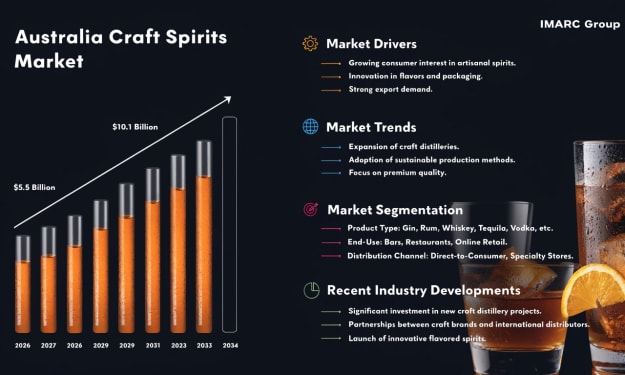
According to IMARC Group, the Australia craft spirits market reached USD 736.3 Million in 2025 and is projected to surge to USD 4,858.0 Million by 2034, exhibiting a remarkable compound annual growth rate (CAGR) of 22.62% during 2026–2034. This exceptional expansion highlights the transformation of the premium alcoholic beverages segment across Australia. Craft spirits—produced by independent distilleries emphasizing small-batch production, authenticity and artisanal techniques—are increasingly favored by consumers seeking quality, provenance and unique flavor profiles. As lifestyle-driven consumption and experiential engagement gain importance, the craft spirits ecosystem is redefining Australia’s premium beverage landscape.
By Kevin Cooper5 days ago in Futurism



Comments
There are no comments for this story
Be the first to respond and start the conversation.