
Why Your Shadow on the Moon Will Be the Strangest One of Your Life
Space

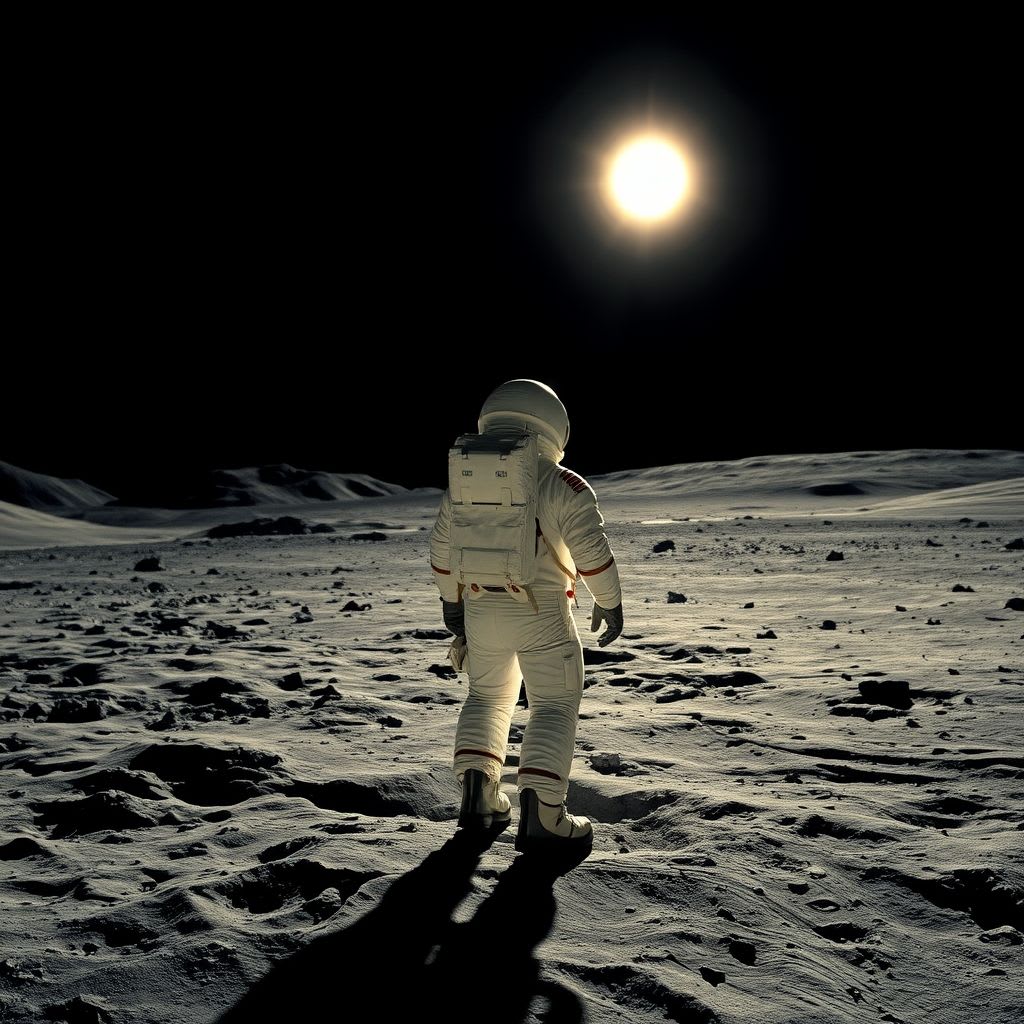
Imagine standing on the Moon’s dusty, gray surface, suited up in your bulky spacesuit, surrounded by absolute silence. Above you, a pitch-black sky stretches out endlessly. The Sun blazes down, not through a blue sky, but in raw, direct brilliance. You take a step and suddenly notice your shadow. But it’s… bizarre. Unlike anything you’ve ever seen on Earth.
Why is your lunar shadow so strange? Because the Moon is a completely alien stage for light and shadow and it plays by rules that defy everyday experience.
A World Without Air Means a World Without Scattered Light
On Earth, sunlight is filtered through the atmosphere. Air molecules scatter the light, giving us soft blue skies and gentle, fuzzy shadows. Even at noon, your shadow isn’t pitch-black or sharply defined light bounces off nearby surfaces and fills in the edges.
But the Moon has no atmosphere. No air. No scattering. Light travels in straight, uninterrupted lines. This creates razor-sharp, inky-dark shadows, as if sliced out of reality with a blade. There are no gradients. No soft borders. The contrast between shadow and sunlight is brutal and immediate.
That alone would make your shadow look strange—but it gets weirder.
Selfie on the Moon: A Shadow that Stretches and Warps
On the Moon, the Sun often hangs low in the sky especially during landings scheduled near lunar dawn or dusk. This means your shadow won’t just be short and tidy like it is at midday on Earth.
Instead, your shadow could stretch out for dozens of meters, warping and bending across craters, rocks, and slopes. If you’re standing on a ridge or near a slope, your shadow may slide down the terrain like liquid darkness. One moment it might appear gigantic, like a towering alien. The next, it could be eerily thin and elongated, like something from a sci-fi nightmare.
A Halo Around Your Head: The Glorious “Glory” Effect
As if a creepy, towering shadow wasn’t enough, you might notice something even more surreal: a soft halo around your head’s shadow. This is a real optical phenomenon known as a “Glory”.
It happens when sunlight reflects off microscopic dust particles suspended above the lunar surface, possibly levitating due to electrostatic forces. On Earth, you might spot a similar effect from an airplane window a circular rainbow surrounding the plane’s shadow on the clouds.
But on the Moon, with its stark lighting and pitch-dark background, the glow is more mysterious and ghostly, like a magical aura following your every step.
Moon Dust: Not Just Dirty, But Dramatic
Lunar dust is nothing like Earth’s soil. It’s jagged, glassy, and unforgiving. Because of its unique structure, it reflects and refracts light in unpredictable ways.
This means your shadow won’t just be dark it could look like a black hole carved into the landscape, devouring light. Move just slightly, and the illusion shifts the shadow jerks, flickers, and stabs across the surface. Apollo astronauts have even said they felt like their shadows were alive, pacing them, always watching. It’s not just a shadow. It’s an experience.
Strange Illusions and a Twisted Sense of Space
Without atmospheric cues and familiar lighting, your sense of distance and depth on the Moon gets warped. Your shadow might look like it’s touching a nearby rock but that rock could be ten meters away.
These shadows can also create wild optical illusions: floating objects, distorted shapes, and ghost-like flickers. The Moon’s uneven terrain and extreme lighting angles combine to trick your brain, especially in the eerie silence and isolation of the lunar surface.
The Strangest Shadow Is Your Own
So, why is your shadow on the Moon the weirdest you’ll ever see? Because it's:
- Pitch-black and razor-sharp, like a cartoon cutout;
- Enormous or tiny, depending on the Sun’s position;
- Wrapped in a glowing halo, like something out of a fantasy film;
- Deceptively misleading, capable of distorting size, shape, and space;
- And because it follows you across a landscape where nothing looks familiar a dreamlike world where physics seems to bend.
Conclusion: Shadows on the Edge of the Known
The Moon isn’t just a silent rock in the sky. It’s a stage for one of the most dramatic light-and-shadow shows in the universe. One day, as humanity returns to the Moon or even builds lunar bases, more people will stand where the Apollo astronauts once did and they’ll look down.
What they’ll see isn’t just a shadow. It’s a message:
“You are on another world. You are an explorer.”
And in that moment, your shadow may be the strangest and most unforgettable companion you’ll ever have.
About the Creator
Keep reading
More stories from Holianyk Ihor and writers in Futurism and other communities.
What If Earth Is the Only Habitable Planet?
Loneliness Among the Stars and the Uniqueness of Our Blue World When we gaze into the night sky, the stars seem endless millions of tiny lights twinkling like cosmic invitations. Each one is a distant sun, many with planets orbiting them. In recent decades, astronomers have discovered thousands of exoplanets, and quite a few lie in the so-called "habitable zone" the not-too-hot, not-too-cold region where liquid water could exist.
By Holianyk Ihor6 months ago in Futurism
About Binding Prometheus
I want to start actively advocating on behalf of my own work, and the most valuable part of my canon is, without a doubt, Binding Prometheus, the play I have been working on since 2019 and only finished in 2023 as part of my MA. The play itself is an amalgamation of a million different inspirations. On one end, it evokes the Ancient Greek myth-play, deriving its own title from the earliest extant work of Western drama we have, Aeschylus’s Prometheus Bound. On the other end, it borrows significantly from the sci-fi bulwarks from over the years, namely Mary Shelley’s Frankenstein and Karel Capek’s Rossum’s Universal Robots. The play could be an episode of Black Mirror, I fear. I don’t know. I’ve only ever seen one episode of Black Mirror.
By Steven Christopher McKnight17 days ago in Futurism
Aquaculture Market Size and Forecast 2025
Aquaculture Market Overview Aquaculture, also known as aquafarming, refers to the controlled cultivation of aquatic organisms such as fish, crustaceans, mollusks, seaweed, and aquatic plants. Conducted across diverse environments including freshwater ponds, coastal lagoons, offshore cages, and recirculating land-based systems, aquaculture has become one of the fastest-growing food production sectors globally. It plays a critical role in meeting the rising demand for protein-rich food while reducing pressure on overexploited wild fisheries.
By jaiklin Fanandish2 days ago in Futurism


Comments
There are no comments for this story
Be the first to respond and start the conversation.