
Why Your "Good" Code Is Confusing Your AI Co-Pilot
Beyond MVC: A New Blueprint for AI-Assisted Software Development


Introduction
In the age of AI-assisted programming, we must fundamentally rethink our best practices for code organization. Traditional software engineering principles—like code reuse, inheritance, and polymorphism—were designed to help human developers manage and maintain complex codebases. However, when an AI becomes our coding partner, these same principles can become liabilities, not assets.
This article introduces a feature-centric file organization method that dramatically improves the efficiency and accuracy of AI-driven coding through clear, unambiguous file naming and structure.
The Core Philosophy
1. Start with a Feature Manifest
Before writing a single line of code with your AI, first create a feature manifest table:

Crucially: This table isn't just documentation; it's the navigation map for the entire development process.
2. Organize Files by Feature ID
Abandon traditional layered architectures (e.g., controller, service, model) and instead use the Feature ID as the primary unit of organization:

3. The Development Workflow
When you need to implement or modify a feature:
Step 1: Consult the Feature Manifest to find the corresponding Feature ID.
Step 2: Navigate to the directory named after that Feature ID.
Step 3: Perform all code operations exclusively within that directory.
Example Dialogue:
Human: Please modify the user registration feature to add email validation.
AI: Certainly. I will modify feature F001 (User Registration). Let me first examine the contents of the `F001/` directory...
Why This Method Excels with AI
1. Eliminating Search Ambiguity
The Pitfall of Traditional Architectures:

When an AI searches for a term like "validate," it may find multiple, unrelated results, leading to confusion and incorrect modifications.
The Clarity of the New Architecture:

2. Enforcing Clear Boundaries
Each feature exists as a self-contained unit of code. The AI doesn't need to understand complex inheritance chains or polymorphic calls to know what a piece of code does.
3. Scoping the Context Precisely
When tasked with a modification, the AI's operational context is limited to a single feature directory. This drastically reduces the risk of it accidentally altering code from another, unrelated feature.
Handling Inter-Feature Dependencies
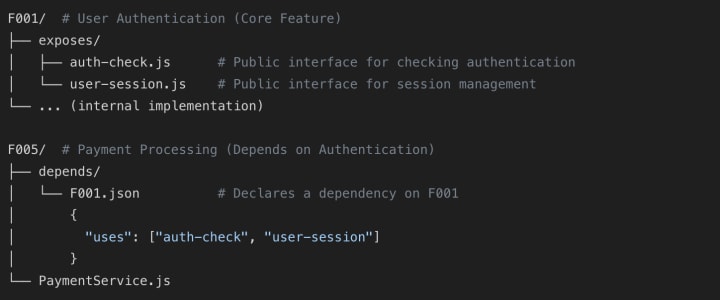
Explicit Dependency Management
When feature B needs to use a capability from feature A, we declare it explicitly.
Benefits of This Approach
Transparency: Anyone (human or AI) can immediately see the dependency graph between features.
Maintainability: When modifying a core feature, you can quickly identify all other features that depend on it.
Testability: Each feature can be tested in isolation by mocking its declared dependencies.
Implementation Guide
1. Create a Detailed Feature Manifest

2. Example of a Feature Directory Structure

3. Best Practices for AI Collaboration
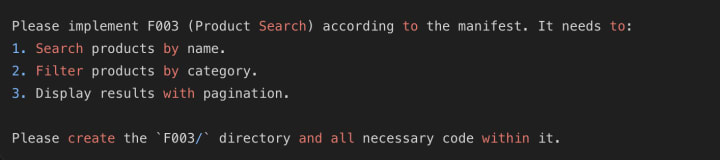
Requesting a New Feature:
Requesting a Modification:

Overturning Traditional Dogma
1. Abandoning the DRY Principle?
Yes, in this architecture, we intentionally sacrifice some code reuse. The reasons are pragmatic:
AI's Cognitive Load: The cost for an AI to find, understand, and safely use a piece of reusable code can be higher than the cost of rewriting it.
The Ripple Effect: Modifying a shared, reusable component can create a complex and unpredictable ripple effect across multiple features.
Targeted Precision: Self-contained code allows the AI to locate and modify logic with surgical precision.
2. Sidestepping Inheritance and Polymorphism?
Traditional design patterns were built for human abstraction. For an AI, they often:
Add layers of abstraction that obscure the direct logic.
Make it difficult to trace the actual execution flow at runtime.
Generate multiple potential targets for a search query, creating ambiguity.
A Practical Comparison
AI Collaboration in a Traditional Architecture

AI Collaboration in the New Architecture

Conclusion
In the era of AI-powered development, we must redefine what constitutes "good code organization." A feature-driven file structure, while it may seem "less elegant" by traditional standards, delivers tangible benefits:
Boosts AI Efficiency: Drastically reduces the time spent on searching and comprehension.
Lowers Error Rates: Clear boundaries prevent unintended side effects.
Simplifies Collaboration: The Feature ID becomes a shared, unambiguous language for both humans and AI.
This isn't a technological regression; it's an evolution in thinking to match our new tools. Just as we no longer write web applications in assembly, we need new principles for organizing code in the age of AI.
Remember: The best architecture is the one that makes your AI co-pilot the most effective.
About the Creator
Elena Vance
Exploring the hidden depths of the human psyche. I write about the complexities of modern relationships, emotional resilience, and the quiet battles we fight within ourselves. Dedicated to finding clarity in the chaos of the heart.
Keep reading
More stories from Elena Vance and writers in Futurism and other communities.
How I Made My $99 Apple Developer Fee Back By Shipping 20+ AI-Built Apps in 3 Months
Three months ago, I did what I do every year: I paid Apple my $99 developer fee. That ~¥700 charge is the annual ticket to the App Store, a fee we all pay with a mix of hope and dread.
By Elena Vance 5 months ago in Futurism
Block Cuts 40% of Workforce, Citing AI — CEO Jack Dorsey Says Most Companies Will Follow
What Happened Block, the financial technology company founded by Jack Dorsey, announced it is laying off roughly 40% of its workforce, cutting more than 4,000 employees and reducing total headcount to just under 6,000.
By Behind the Tech5 days ago in Futurism




Comments
There are no comments for this story
Be the first to respond and start the conversation.