
Why We’ll Never See the Far Side of the Moon from Earth
Space

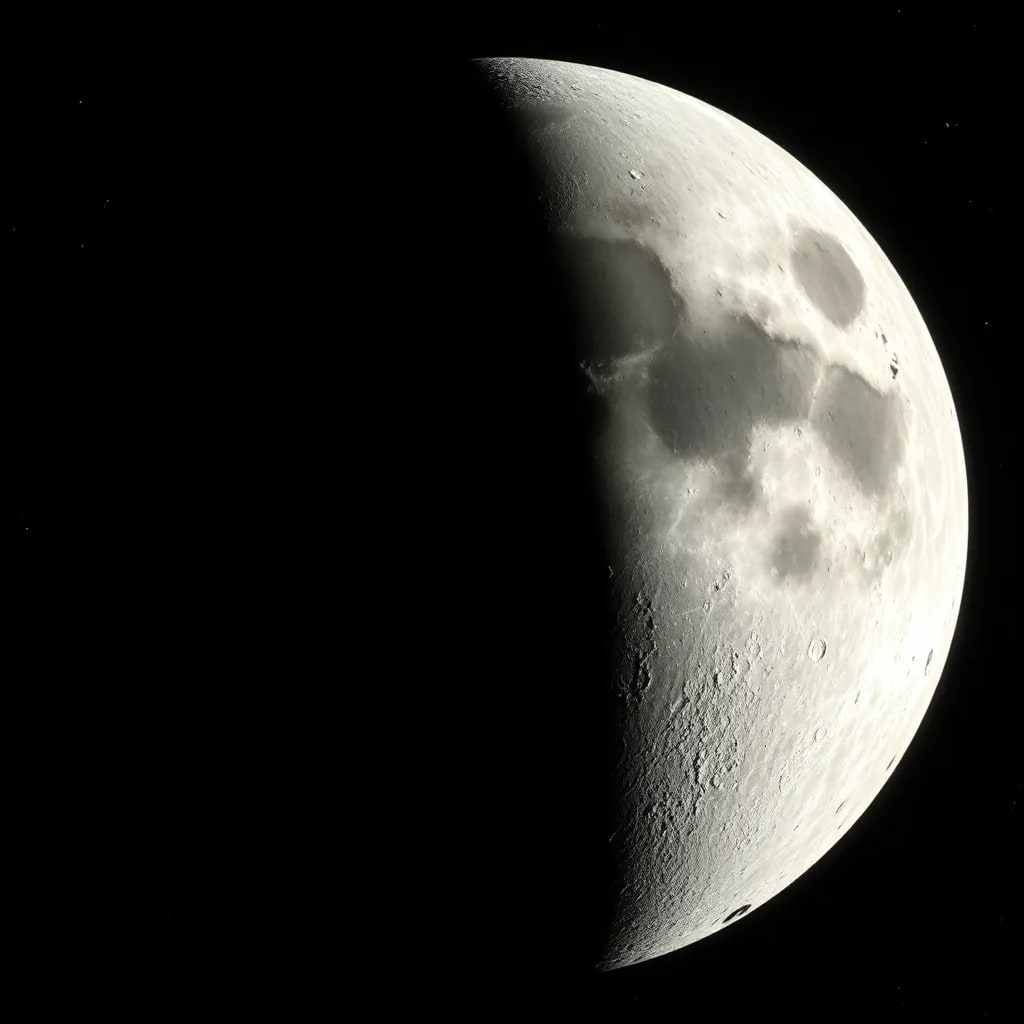
The Mysterious Shadow of Our Nighttime Companion
Every time we look up at the Moon whether it's full, crescent, or just a delicate sliver—we’re always greeted by the same familiar features: the same craters, the same dark "seas," and bright highlands. But why? If the Moon is orbiting Earth, shouldn't we eventually see all of its surface? What lies on the hidden side, and why is it forever out of view from Earth?
The Lunar Mystery: Synchronous Rotation
The answer lies in a fascinating phenomenon called synchronous rotation. The Moon rotates on its axis in exactly the same time it takes to orbit Earth: roughly 27.3 days. This means that one side of the Moon is always facing us, while the other side what we often call the “far side” remains hidden from direct view.
It might sound like a cosmic coincidence, but it's actually the result of billions of years of gravitational interaction. Long ago, the Moon spun much faster. However, Earth’s gravitational pull created tidal forces that gradually slowed the Moon's rotation. Eventually, a balance was achieved: one rotation per orbit. It's as if the Moon became locked in a slow, graceful bow toward Earth, never turning its face away.
What’s on the Far Side?
Despite being invisible from Earth, the far side of the Moon isn’t actually "dark" at least not in the literal sense. It receives just as much sunlight as the side we see. The term "dark side" is a misnomer, rooted more in mystery than in science.
The veil was first lifted in 1959, when the Soviet spacecraft Luna 3 sent back the very first images of this hidden hemisphere. What scientists saw was astonishing: the far side looked dramatically different. It was rougher, more cratered, and had far fewer dark basalt plains (called lunar "maria") than the side familiar to us.
This asymmetry still puzzles scientists. One theory suggests that it’s related to the Moon’s internal composition and the way heat was distributed as it cooled billions of years ago. Another idea points to ancient impacts that may have shaped one side more violently than the other.
Wait Does the Moon Even Rotate?
Here’s the twist: yes, it does rotate just not in a way we easily notice. Because its rotation and orbit are perfectly synchronized, it appears stationary to us. If its rotation were even slightly faster or slower, we’d eventually glimpse more of its surface.
However, thanks to a phenomenon known as libration, we do get a sneak peek beyond the 50% mark. Libration is a gentle wobble in the Moon’s orientation caused by the eccentric shape of its orbit and the tilt of its axis. Over time, this wobble lets us see about 59% of the lunar surface from Earth, though never all at once.
Will We Ever Set Foot on the Far Side?
Even if we can’t see it from Earth, the far side is very real and increasingly within reach. In 2019, China’s Chang’e-4 mission made history by landing the first spacecraft on the far side of the Moon. Because direct communication is blocked by the Moon’s bulk, the mission also deployed a relay satellite to transmit data back to Earth.
Why explore this hidden face? Its unique environment shielded from Earth’s constant electromagnetic noise makes it an ideal place for radio astronomy, as well as future scientific bases or telescopes. Some even speculate that the far side could be the perfect spot for long-term lunar observatories or deep-space communication hubs.
Conclusion: A Familiar Stranger
The reason we never see the Moon’s far side from Earth is rooted in the elegant physics of synchronous rotation. Locked into a precise rhythm by Earth’s gravity, the Moon has shown us only one face for billions of years.
And yet, even in this familiar companion, there remain secrets. The far side is not just a scientific curiosity it’s a reminder of how much we still don’t know about the universe right on our cosmic doorstep. With advancing space missions and growing international interest, this unseen landscape may soon become one of the most explored parts of our solar system.
Until then, the Moon continues its quiet orbit, holding one half of its story just out of sight.
About the Creator
Keep reading
More stories from Holianyk Ihor and writers in Futurism and other communities.
Earth’s Light Tail: Why Our Planet Leaves a Trail in Space
A ghostly ribbon of light that stretches beyond the Moon From our everyday perspective, Earth appears as a solid sphere spinning quietly in the void of space. But take a step back several hundred thousand kilometers back and the picture changes. To the keen eyes of astronomers and space telescopes, Earth isn’t just floating silently through space; it’s leaving a shimmering trail behind. This isn’t science fiction or artistic metaphor it’s a real phenomenon known as Earth’s light tail, and it tells a surprising story about our planet.
By Holianyk Ihor6 months ago in Futurism
About Binding Prometheus
I want to start actively advocating on behalf of my own work, and the most valuable part of my canon is, without a doubt, Binding Prometheus, the play I have been working on since 2019 and only finished in 2023 as part of my MA. The play itself is an amalgamation of a million different inspirations. On one end, it evokes the Ancient Greek myth-play, deriving its own title from the earliest extant work of Western drama we have, Aeschylus’s Prometheus Bound. On the other end, it borrows significantly from the sci-fi bulwarks from over the years, namely Mary Shelley’s Frankenstein and Karel Capek’s Rossum’s Universal Robots. The play could be an episode of Black Mirror, I fear. I don’t know. I’ve only ever seen one episode of Black Mirror.
By Steven Christopher McKnight16 days ago in Futurism
Flexible Packaging Market Size and Forecast 2024–2033
Introduction The global packaging industry is undergoing a fundamental transformation as businesses, regulators, and consumers demand lighter, more sustainable, and more functional solutions. At the heart of this transformation lies flexible packaging—a category that has moved far beyond its early reputation for basic plastic wraps and bags. Today, flexible packaging is synonymous with innovation, sustainability, branding potential, and operational efficiency across industries.
By Aaina Oberoi3 days ago in Futurism


Comments
There are no comments for this story
Be the first to respond and start the conversation.