
Why Space Robots Will Never Fully Replace Humans
Space

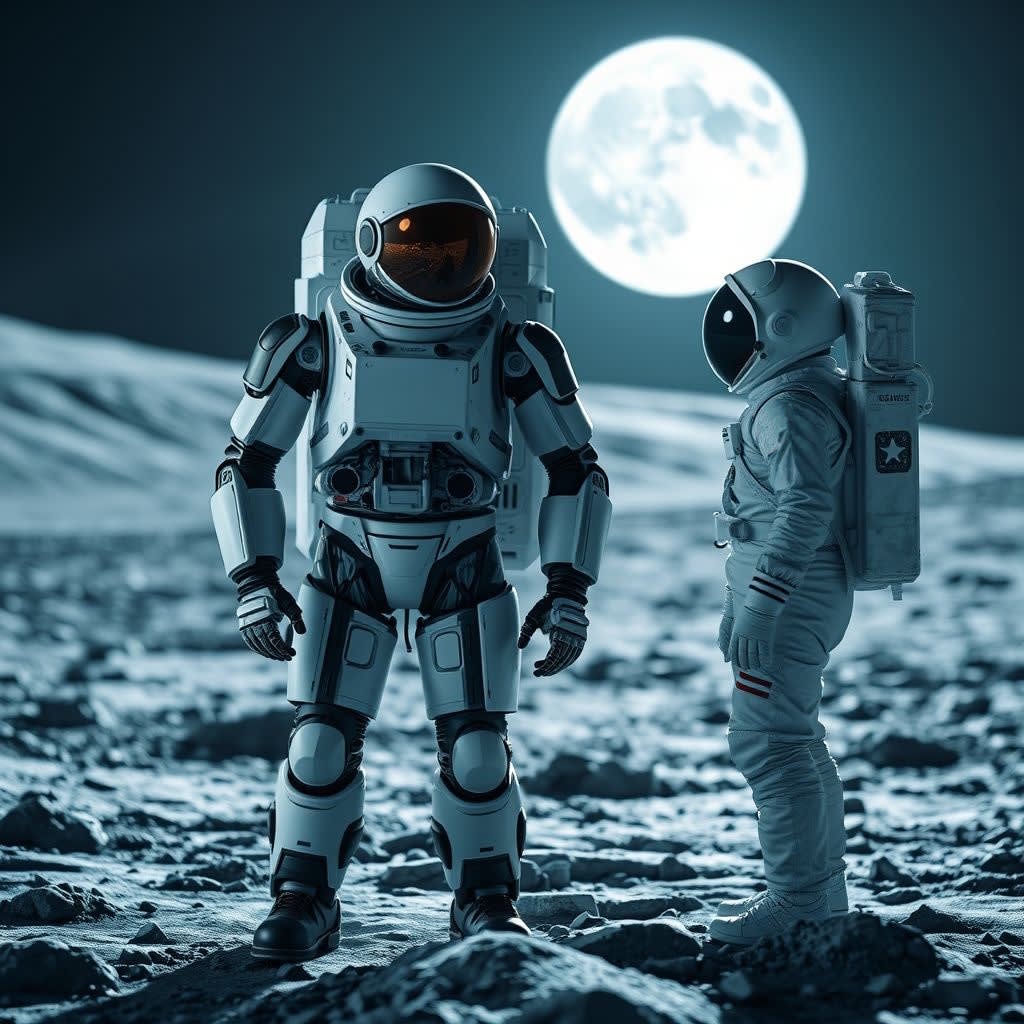
When we imagine the future of space exploration, it’s easy to picture an army of tireless robots efficient, precise, and immune to the challenges of deep space. Already, machines like Mars rovers roam alien landscapes, satellites scan distant galaxies, and robotic landers touch down on asteroids. But despite the growing sophistication of these robotic marvels, there are compelling reasons why they will never truly replace human beings in space.
1. Human Intuition and Creativity Are Beyond Algorithms
No matter how advanced, robots follow algorithms, pre-programmed instructions, and predefined mission parameters. They are exceptional at repetitive tasks and data collection, but when the unexpected occurs and it often does in space only a human can improvise on the fly.
Consider the famous Apollo 13 mission. A catastrophic malfunction turned a lunar landing into a desperate rescue. The crew’s survival depended not on technology alone, but on their quick thinking, creative problem-solving, and ability to work with limited tools. A robot, in that situation, would’ve awaited Earth-based instructions possibly too late.
2. Humans Learn on the Fly
Artificial intelligence takes time to train. Even today’s most advanced models require immense datasets, extensive testing, and controlled environments. By contrast, a human on the surface of another planet can adapt in real time adjusting methods, noticing subtle details, and responding dynamically to changing conditions.
An astronaut can learn from touch, smell, instinct, and environmental context things that are incredibly difficult for robots to sense or interpret. This kind of flexible, sensory-driven learning remains uniquely human.
3. Our Senses Are Still Superior
Robots “see” through cameras and “feel” with sensors, but their sensory systems are limited and prone to error. A geologist on Mars, for instance, might pick up a rock, notice a faint odor, texture, or layering all subtle signs that a robot could overlook. Some discoveries arise not from logic, but from gut feeling or observation made by chance.
Intuition isn’t magic it’s the product of experience and subconscious processing. But it's exactly this human sense of the unexpected that drives some of the most important breakthroughs.
4. Flexibility and Versatility Can’t Be Programmed
Even the most advanced robots are purpose-built. The Perseverance rover is a technological marvel but it’s still limited to its instruments and mobility range. Humans, on the other hand, can adapt to different tasks, shift priorities, repair broken systems, and make judgment calls on the fly.
Need to rewire a system? Build a shelter? Investigate an anomaly that wasn’t in the mission script? A human can do all of that. Robots struggle outside the box they were built for humans thrive in it.
5. Presence Matters — Emotionally and Culturally
There’s something profound about seeing another human walk on alien soil. It's not just a scientific milestone it’s an emotional, cultural, even philosophical event. When Neil Armstrong stepped onto the Moon, it wasn't a robot transmitting data it was a person representing all of humanity.
A future livestream of a human stepping onto Mars would inspire billions. It would be the culmination of generations of dreams. Robots cannot inspire the same way. They cannot dream, tell stories, or symbolize the human spirit.
But Robots Still Have Their Place
This isn’t to say robots aren’t crucial they absolutely are. Robots will continue to lead the way into dangerous or unexplored territory. They'll scout terrain, perform routine tasks, construct habitats, and even protect us from hazards. They are our proxies our extensions in the harshest environments.
In many ways, robots are the perfect partners for human explorers. But they are still tools, not pioneers. They don’t give meaning to discovery. They don’t gaze at the stars and wonder. We do.
Final Thoughts: Why We Belong in the Stars
As long as humanity exists, so will the drive to explore, to question, to go further. That drive is not mechanical it’s emotional, intellectual, and deeply human. Robots can help us get there, but they cannot walk the journey for us.
- They can perform tasks, but not fulfill our purpose.
- They are instruments.
- We are explorers.
- And the cosmos is waiting for us.
About the Creator
Keep reading
More stories from Holianyk Ihor and writers in Futurism and other communities.
Rare Metals from the Stars: What Elements Exist Only in Meteorites?
When we gaze at the night sky, a deep sense of wonder takes over. The stars, the planets, the endless void of space it all feels mysterious and unreachable. But every so often, space reaches back. It hurls pieces of itself toward Earth in the form of meteorites. These rocky or metallic visitors aren’t just celestial curiosities they’re treasure chests carrying exotic materials rarely, or never, found in Earth’s crust. Some of the metals discovered in meteorites are so rare and unusual that scientists refer to them as “cosmic anomalies.” So, which metals (and metal-like compounds) exist only in meteorites?
By Holianyk Ihor6 months ago in Futurism
About Binding Prometheus
I want to start actively advocating on behalf of my own work, and the most valuable part of my canon is, without a doubt, Binding Prometheus, the play I have been working on since 2019 and only finished in 2023 as part of my MA. The play itself is an amalgamation of a million different inspirations. On one end, it evokes the Ancient Greek myth-play, deriving its own title from the earliest extant work of Western drama we have, Aeschylus’s Prometheus Bound. On the other end, it borrows significantly from the sci-fi bulwarks from over the years, namely Mary Shelley’s Frankenstein and Karel Capek’s Rossum’s Universal Robots. The play could be an episode of Black Mirror, I fear. I don’t know. I’ve only ever seen one episode of Black Mirror.
By Steven Christopher McKnight14 days ago in Futurism
Superfood Market Outlook 2025–2033
Introduction The global food industry is undergoing a fundamental transformation. Consumers are no longer satisfied with simply eating for hunger—they are eating for longevity, immunity, performance, and sustainability. At the center of this shift stands the superfood market, a category defined by nutrient-dense foods such as chia seeds, spirulina, quinoa, acai berries, turmeric, and a wide range of plant-based powders, blends, and extracts.
By Marthan Sir3 days ago in Futurism


Comments (1)
Nice🕊️🕊️💫