
Rare Metals from the Stars: What Elements Exist Only in Meteorites?
Space

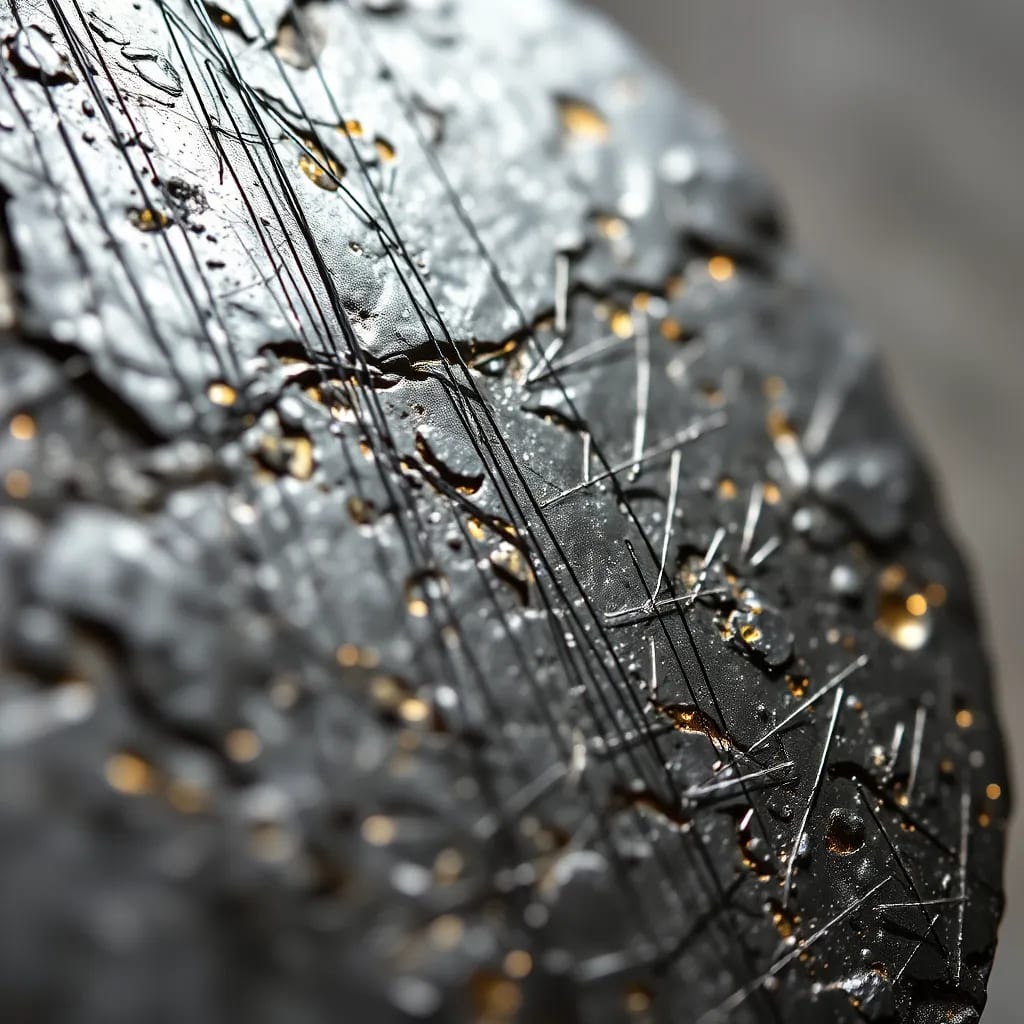
When we gaze at the night sky, a deep sense of wonder takes over. The stars, the planets, the endless void of space it all feels mysterious and unreachable. But every so often, space reaches back. It hurls pieces of itself toward Earth in the form of meteorites. These rocky or metallic visitors aren’t just celestial curiosities they’re treasure chests carrying exotic materials rarely, or never, found in Earth’s crust. Some of the metals discovered in meteorites are so rare and unusual that scientists refer to them as “cosmic anomalies.” So, which metals (and metal-like compounds) exist only in meteorites?
1. Widmanstätten Patterns: Time-Frozen Cosmic Alloys
While not a standalone metal, the Widmanstätten pattern is perhaps one of the most iconic signs of extraterrestrial origin. These intricate, interlocking crystal structures are made of two iron-nickel alloys kamacite and taenite that form only under extreme conditions: an ultra-slow cooling process that can take millions of years inside a large asteroid’s core.
These patterns simply cannot be replicated on Earth. Our planet cools far too quickly, and gravity doesn’t allow for the kind of large, stable metallic bodies needed to form them. The Widmanstätten pattern is essentially a fingerprint of the stars evidence that the metal came from deep space, not any earthly forge.
2. Schreibersite: A Metal That May Have Sparked Life
Next is schreibersite, a rare iron-nickel phosphide that has become a hot topic in astrobiology. Found primarily in iron meteorites, schreibersite contains phosphorus in a chemically reactive form a form that may have been essential for forming the first organic molecules on early Earth.
Some researchers believe that meteorite impacts in the distant past seeded our planet’s oceans with schreibersite, jump-starting the chemistry of life. On Earth, schreibersite is virtually non-existent in natural geological settings. In space, it’s surprisingly common another clue that life as we know it may have extraterrestrial roots.
3. Taenite: A Mirror from the Void
Taenite is a metallic alloy composed of iron and a high concentration of nickel up to 65%. On Earth, this alloy is unstable and typically decomposes or transforms due to our planet’s heat and pressure. But in meteorites, especially those known as octahedrites, taenite remains remarkably stable thanks to thousands of years of slow cosmic cooling in a vacuum.
Taenite is incredibly dense, resistant to corrosion, and has a metallic sheen that can resemble polished chrome. It's the kind of material that science fiction might imagine for spacecraft hulls and it comes to us, quite literally, from space.
4. Akashevite: A Cosmic Mystery from Russia
Discovered in the Akashevo meteorite in Russia, akashevite is a mineral made up of iron, nickel, phosphorus, and several rare trace elements. What makes it special is that it hasn’t been found naturally on Earth only in meteorite samples.
Like schreibersite, akashevite belongs to a group of iron-nickel phosphides thought to play a role in the chemical evolution of early planetary environments. Minerals like this hint at the complex chemistry unfolding across the cosmos, hidden inside asteroids and meteors.
5. Hutchinsonite: A Potential Interstellar Stowaway?
Hutchinsonite is a toxic sulfide of thallium, lead, and arsenic. It’s known to exist in extremely rare geological environments on Earth but some researchers believe it might also arrive via carbonaceous chondrite meteorites, which are rich in volatile and exotic elements.
Though not definitively proven to be of extraterrestrial origin in any known sample, hutchinsonite’s rarity and chemistry suggest that unusual variants of it could, in theory, travel across space. This raises bigger questions: What other rare or unknown compounds are hiding in meteorites that we’ve yet to discover?
Why Does It Matter?
These metals and minerals aren’t just scientific curiosities they’re windows into the deep history of the universe. They show us what conditions exist in asteroids, how matter behaves in zero gravity over eons, and how elements combine outside the familiar processes of Earth’s geology.
Some of these materials may even hold the keys to our future. Meteorite metals like taenite and schreibersite could inspire advanced materials for industry or help us understand the chemistry that led to life itself. Already, companies are exploring asteroid mining, hoping to harvest rare metals directly from space.
Final Thoughts
Meteorites are far more than space rocks they are cosmic archives, carrying within them exotic metals and compounds unlike anything we can create or find naturally on Earth. Schreibersite, taenite, akashevite each of these tells a story, not just of their own formation, but of the universe’s broader chemical narrative.
The next time a meteor streaks across the sky, remember: it might not just be a flash of light. It could be a message from beyond, holding elements that don’t belong to Earth perhaps even a metal that reshapes what we know about matter, or life, or the universe itself.
About the Creator
Keep reading
More stories from Holianyk Ihor and writers in Futurism and other communities.
The Cosmic-Scale Paradox: How Infinity Shapes Our Perception of Reality
When we gaze up at the night sky, a sense of wonder often mixes with a quiet unease. The universe is vast breathtakingly silent, dazzlingly beautiful, and perhaps… infinite. This idea of infinity is not just a scientific curiosity. It’s a profound philosophical paradox that challenges our very perception of what is real, what is possible, and what it means to exist.
By Holianyk Ihor6 months ago in Futurism
About Binding Prometheus
I want to start actively advocating on behalf of my own work, and the most valuable part of my canon is, without a doubt, Binding Prometheus, the play I have been working on since 2019 and only finished in 2023 as part of my MA. The play itself is an amalgamation of a million different inspirations. On one end, it evokes the Ancient Greek myth-play, deriving its own title from the earliest extant work of Western drama we have, Aeschylus’s Prometheus Bound. On the other end, it borrows significantly from the sci-fi bulwarks from over the years, namely Mary Shelley’s Frankenstein and Karel Capek’s Rossum’s Universal Robots. The play could be an episode of Black Mirror, I fear. I don’t know. I’ve only ever seen one episode of Black Mirror.
By Steven Christopher McKnight14 days ago in Futurism
Crowdfunding Market Companies Analysis 2025–2033
Introduction: A New Age of Democratized Capital The global crowdfunding industry has emerged as one of the most transformative forces in modern finance. By enabling individuals, entrepreneurs, and organizations to raise funds directly from a distributed pool of contributors, crowdfunding bypasses traditional intermediaries such as banks, venture capital firms, and institutional lenders. Over the last decade, this model has evolved from small community fundraisers into a multi-billion-dollar ecosystem that supports innovation, social impact, creative ventures, and business growth.
By Marthan Sir3 days ago in Futurism



Comments
There are no comments for this story
Be the first to respond and start the conversation.