
Where Tomorrow Breathes
A world where connection might just be the key to survival.

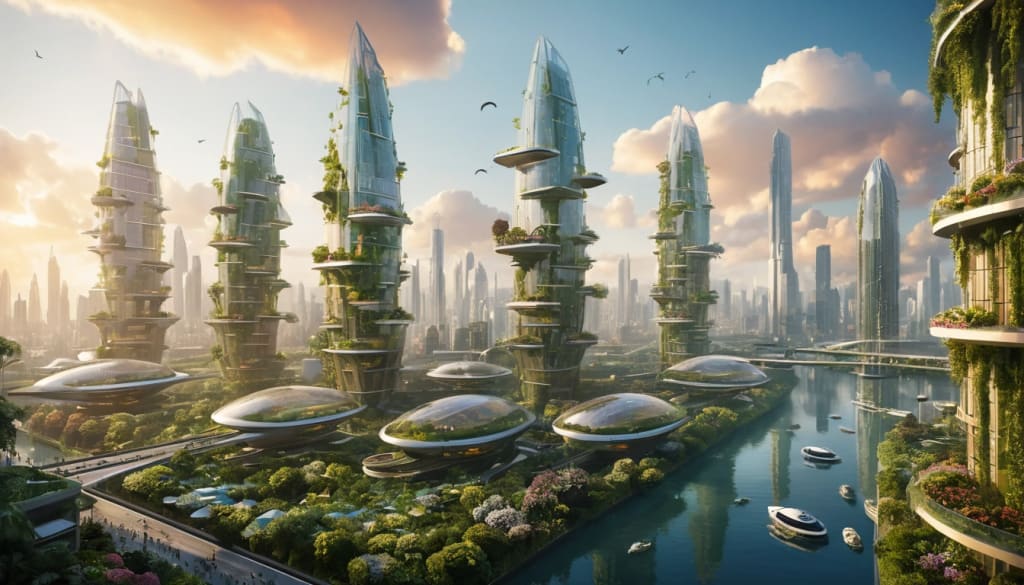
By the year 2050, the world had learned to breathe anew. Not through lungs, but through innovation—a delicate symbiosis of technology and nature. Floating cities dotted the skies above once-submerged coastlines, and deserts bloomed with engineered flora that turned sand into soil. Yet, in the vibrant metropolis of Aeropolis, where skyscrapers shimmered like prisms against the clouds, humanity grappled with a question that technology could not answer: What does it mean to be truly connected?
The Arrival
Emara stepped off the mag-lev pod, her senses overwhelmed by the orchestra of Aeropolis—drones whirring through the air, holograms advertising bioluminescent art galleries, and crowds moving in choreographed flows. A behavioural psychologist by trade, she had been summoned by the Global Ethics Council for a groundbreaking initiative: to test humanity’s readiness for the Coalescence.
The Coalescence was not merely a technological innovation; it was a leap into uncharted territory. A neural network capable of connecting human consciousness, enabling people to experience collective thought, empathy, and memory. Its proponents called it the next evolutionary step. Its detractors whispered of dystopian unity, of individuality dissolved.
Emara’s task was monumental. In her hands lay the responsibility of designing the first simulation—a controlled environment where volunteers would experience the Coalescence without full integration. If humanity could not find harmony in the simulation, the project would be shelved. Permanently.
________________________________________
The Simulation
The room was sterile, bathed in soft blues and silvers. Six volunteers sat in a circle, their neural bands glowing faintly. Among them were an artist, a soldier, a scientist, a historian, a farmer, and a child. Emara chose diversity deliberately, believing it crucial to reflect the mosaic of human experience.
“When the simulation begins,” Emara explained, “you will share fragments of your most vivid memories. You will feel each other’s joy, sorrow, and fears. The goal is not to solve a problem but to understand. To see if connection breeds compassion.”
With a nod, she activated the system. The room dissolved into light.
________________________________________
Shared Consciousness
They stood in a field of golden wheat, under a cerulean sky streaked with contrails. The farmer’s memory. The child laughed, running through the stalks, her hands grazing the tips. But the sky darkened, and a storm loomed. The soldier flinched; his battlefield emerged, bullets ripping through the wheat. The artist knelt, painting the scene as it shifted, her brush strokes an attempt to freeze the chaos.
One by one, their lives unfolded. The scientist’s triumph in decoding a genetic anomaly. The historian’s grief at seeing ancient ruins crumble. The farmer’s quiet pride in reviving barren land. The child’s wonder at her first snowfall. These weren’t just memories; they were emotional imprints. The group felt the pain of failure, the warmth of love, and the weight of fear—as if the experiences were their own.
But it wasn’t seamless. Misunderstandings flared. The soldier recoiled at the historian’s assertion that wars were inevitable cycles. The farmer’s disdain for the scientist’s lab-grown crops clashed with the artist’s admiration for their symmetry. The child, untouched by cynicism, cried at the discord, her tears forming a river that swept them into the next memory.
________________________________________
The Turning Point
They found themselves in a vast library, with endless shelves stretching into infinity. A voice, neither human nor mechanical, resonated: "What binds you is greater than what divides you. Look closer."
The group hesitated, then began to explore. The farmer and the scientist discovered a shared goal: sustenance for future generations. The soldier and the artist recognized that their expressions of struggle—one through the defence, the other through creation—were two sides of the same coin. Even the child, with her unjaded heart, became the bridge, asking questions that disarmed and united.
When they emerged from the simulation, silence hung heavy. Tears shimmered in the artist’s eyes. The soldier, uncharacteristically, laughed softly. The child hugged the farmer, whispering, “Your wheat is beautiful.”
________________________________________
The Aftermath
Weeks later, Emara stood before the Ethics Council. “The Coalescence is not a solution,” she began. “It is a tool. It amplifies what exists within us—our fears, and our biases, but also our capacity for empathy and collaboration. The question is not whether humanity is ready for it, but whether we’re ready to confront ourselves.”
Her words rippled across the council chamber, leaving them in deep contemplation. The Coalescence was approved for limited use, with strict guidelines. Aeropolis would be its testing ground, a city where tomorrow would breathe.
________________________________________
Epilogue
In a quiet corner of Aeropolis, the farmer and the scientist worked side by side in a vertical garden, merging biology with technology. The artist unveiled a new series, of paintings infused with the memories she had shared. The soldier began writing—poems, of all things. The child, now a symbol of hope, inspired initiatives to teach empathy in schools.
And Emara? She walked the bustling streets, watching humanity take its first tentative steps into a future neither utopia nor dystopia, but something beautifully, messily in between. A world where connection might just be the key to survival.
About the Creator
Raymond Bentum
Engineer by trade, storyteller at heart. I craft tales that blend creativity, nature, and human experience, aiming to inspire and connect. My stories aim to connect and captivate. Join me in exploring worlds seen and unseen.
Keep reading
More stories from Raymond Bentum and writers in Futurism and other communities.
The Year We Touched the Stars
In 2050, humanity finally found itself at the crossroads of innovation and hope. The world, once fractured by politics, climate change, and distrust, had slowly knitted itself back together through shared dreams of survival and progress. At the heart of this transformation was the Global Initiative for Equitable Futures (GIEF), a coalition of nations, innovators, and everyday people who believed in building a future worth living for.
By Raymond Bentumabout a year ago in Futurism
Stablecoins Powering the Next Financial Revolution
In a world where digital transformation is accelerating faster than ever, financial systems are undergoing a quiet but powerful revolution. Businesses, startups, and institutions are searching for ways to move money faster, reduce costs, and eliminate the delays of traditional banking. The answer to this growing demand lies in an innovation that combines the reliability of traditional currencies with the speed of blockchain technology—stablecoins.
By Ritu Singh6 days ago in Futurism
The Vanishing Star in Andromeda: The Birth of a Black Hole Without a Supernova
For decades, astronomers believed that the death of a massive star was always accompanied by one of the most spectacular events in the universe: a supernova explosion. These cosmic blasts can briefly outshine entire galaxies and scatter heavy elements across interstellar space. However, recent observations suggest that not all massive stars end their lives in such dramatic fashion. Some may simply disappear.
By Holianyk Ihor6 days ago in Futurism


Comments
There are no comments for this story
Be the first to respond and start the conversation.