
The Year We Touched the Stars
Imagine a world years to come with mysterious innovations but hope.

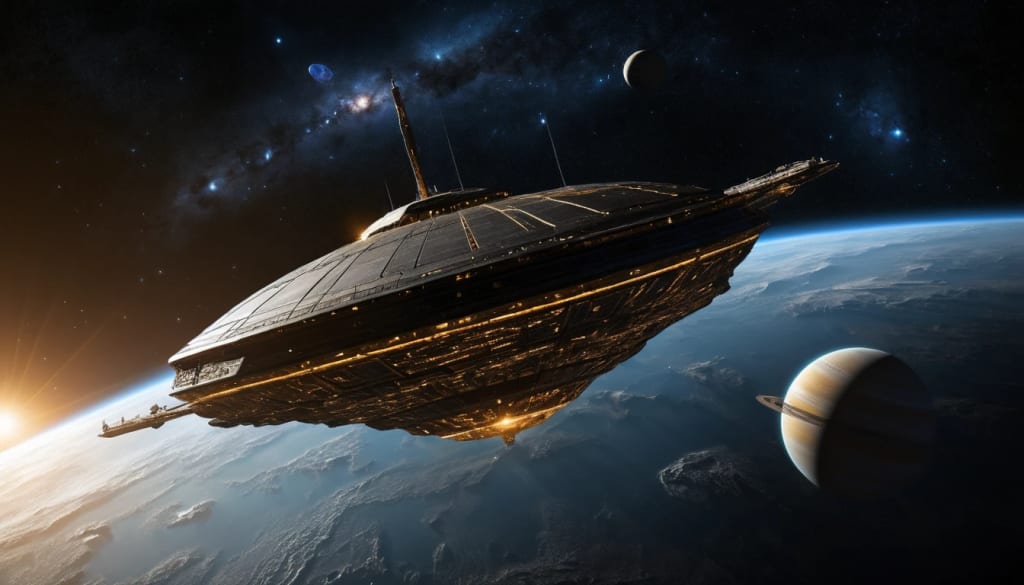
In 2050, humanity finally found itself at the crossroads of innovation and hope. The world, once fractured by politics, climate change, and distrust, had slowly knitted itself back together through shared dreams of survival and progress. At the heart of this transformation was the Global Initiative for Equitable Futures (GIEF), a coalition of nations, innovators, and everyday people who believed in building a future worth living for.
Among them was Amara Dey, a 26-year-old systems engineer from Nairobi, working on a project that promised to reshape the human experience: the Stellar Nexus. The Nexus wasn’t just another spacecraft; it was humanity’s first interstellar habitat, a vessel designed to carry a million souls beyond the solar system to Proxima Centauri b. More than a mission of exploration, it was a statement: Earth could no longer be the sole cradle of humanity.
Amara was a child of the Decade of Ash—the 2030s when wildfires, floods, and food scarcity pushed societies to the brink. She grew up watching her parents toil as climate resilience workers, patching levees and replanting forests. It was in their dusty workshop that Amara first touched the stars, not with her hands but through her imagination. Her father, a storyteller at heart, would conjure tales of otherworldly civilizations, weaving them into bedtime stories of survival and wonder. Those stories planted seeds of hope in her—and now, she was making them real.
But the journey to Proxima wasn’t without controversy. Critics labelled the Stellar Nexus as escapism for the privileged, a billion-dollar lifeboat while billions on Earth still suffered. Others feared that abandoning Earth meant abandoning hope for its restoration. Amara understood their anger; she’d felt it too. Yet, she believed the project could be a beacon—proof that humanity could innovate its way out of despair.
In the shimmering Nexus Assembly Center, a colossal dome of glass and graphene, Amara stood before the prototype. Its golden hull glowed under artificial sunlight. Around her, engineers, scientists, and architects worked in the symphony, their languages—Swahili, Mandarin, English, and Hindi—blending into a mosaic of collaboration. Yet, as the launch date neared, the weight of doubt pressed against her optimism.
It was during one of those nights, deep in the quiet hum of the assembly centre, that Amara met Lei Wong. Lei was a data linguist from Singapore, tasked with developing the Nexus’s onboard AI, Janus. Lei had a habit of posing big questions during late shifts: What will we say to the universe if we’re not alone? How do you teach an AI to dream? Amara often brushed him off, focused on structural stress points and reactor calibrations. But one night, his question stuck: What does success look like to you?
Amara hesitated, her mind flickering to her father’s stories. “Success is... leaving Earth better than we found it. Not abandoning it. This isn’t about running away; it’s about proving we can survive anywhere. It’s hope made tangible.”
Lei smiled. “Hope is good. But maybe it’s also about humility. About learning from our mistakes before we carry them to the stars.”
Their conversation planted a new seed in Amara’s mind. As the launch approached, she began to wonder if humanity had truly learned. They’d built a ship to touch the stars, but what lessons were they taking with them?
The Day of Departure
On July 7, 2050, a crowd of two million gathered in the Sahara Desert to witness history. The Stellar Nexus, towering like a golden obelisk, stood ready on its electromagnetic launch pad. The air buzzed with anticipation, a mix of celebration and protest. Amara, watching from the control tower, felt the weight of centuries on her shoulders.
“Ready for this?” Lei asked, standing beside her.
“No one’s ever ready for something this big,” she replied, managing a faint smile.
The countdown began. As the final seconds ticked away, Amara closed her eyes, picturing her parents’ weathered hands, the faces of the children who’d never see this day, and the billions who’d pinned their hopes on this launch.
Then came ignition. The ground shook as the Stellar Nexus ascended, its golden hull cutting through the atmosphere. For a moment, humanity held its collective breath. And then, it was gone, a speck disappearing into the vastness.
Six Months Later
The Stellar Nexus’s journey wasn’t smooth. Solar storms, system malfunctions, and onboard tensions tested the crew. But Janus, the AI, became an unexpected source of unity. Lei had programmed it with a simple directive: to preserve humanity’s essence. This wasn’t limited to survival; Janus hosted poetry readings, facilitated debates, and even composed lullabies based on Earth’s forgotten languages.
One day, as the ship passed the heliopause, Janus made an announcement: “We’ve received a signal.”
The room went silent. Amara’s heart raced as data flooded the monitors. The signal wasn’t extraterrestrial but Earth-bound, a transmission sent decades earlier, its echoes only now reaching them. It was a message from a child, recorded during the Decade of Ash.
“To whoever hears this,” the voice said, trembling yet defiant, “I hope you’re kind. I hope you remember us. And I hope you do better.”
The crew listened in silence. For Amara, it felt like her father’s stories had come full circle, a reminder that their mission wasn’t just about touching the stars but carrying the best of humanity with them.
As the Stellar Nexus continued its journey, Amara recorded her message, to be transmitted back to Earth. “We hear you. We remember. And we promise: we will do better.”
Epilogue
Back on Earth, the launch of the Stellar Nexus sparked a renaissance. Communities redoubled efforts to heal the planet, inspired by the ship’s audacity and purpose. Green cities flourished, oceans recovered, and education became a global priority.
By 2050, humanity hadn’t solved all its problems. But it had learned to dream again. As Amara looked out at the stars from the Stellar Nexus, she knew the future wasn’t just out there; it was within each of them, waiting to be written.
About the Creator
Raymond Bentum
Engineer by trade, storyteller at heart. I craft tales that blend creativity, nature, and human experience, aiming to inspire and connect. My stories aim to connect and captivate. Join me in exploring worlds seen and unseen.
Keep reading
More stories from Raymond Bentum and writers in Futurism and other communities.
Inside the Chrysalis
The year is 2050. Neo-Kyoto, a shimmering metropolis woven from bioluminescent bamboo and recycled tech, hums with a vibrant energy. Hovercars glide silently through the emerald canopy, their passengers lost in the glow of their neural interfaces. Kai, a young architect with eyes that held the color of a stormy sea, stared out his window, the city lights a kaleidoscope of colors against the velvet night sky. He was working on the Chrysalis project, a radical urban renewal initiative that aimed to transform abandoned industrial zones into self-sustaining ecosystems.
By Raymond Bentumabout a year ago in Futurism
Cybersecurity Market: Rising Cyber Threats, Advanced Security Solutions & Industry Growth Outlook
According to IMARC Group's latest research publication, The global cybersecurity market size reached USD 326.2 Billion in 2025. Looking forward, IMARC Group expects the market to reach USD 676.3 Billion by 2034, exhibiting a growth rate (CAGR) of 8.40% during 2026-2034.
By sujeet. imarcgroup3 days ago in Futurism
Computed Tomography Market Outlook: Advanced Diagnostic Imaging and Healthcare Expansion Opportunities
According to IMARC Group's latest research publication, The global computed tomography market size was valued at USD 4.93 Billion in 2024. The market is projected to reach USD 7.83 Billion by 2033, exhibiting a CAGR of 5.01% from 2025-2033.
By James Whitman3 days ago in Futurism



Comments
There are no comments for this story
Be the first to respond and start the conversation.