
Where Does the Solar System End and Real Space Begin?
Space

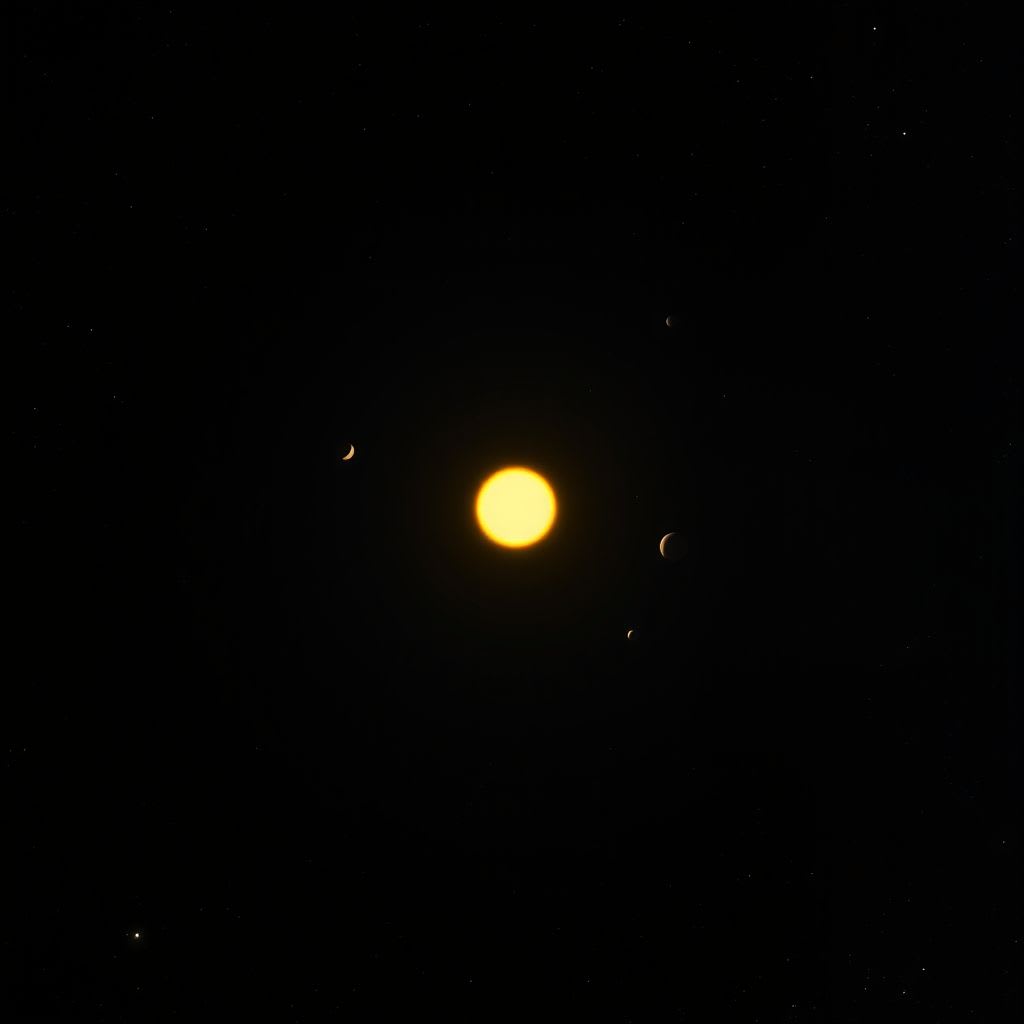
When you gaze up at the night sky, it’s natural to think of the Solar System as everything orbiting our Sun — the planets, asteroids, comets, and other space rocks. But have you ever wondered where exactly our cosmic neighborhood ends and the vast, mysterious expanse of “real” space begins? In other words, where does the Solar System stop, and the wider Universe start?
The answer isn’t as simple as drawing a line on a map. Unlike countries with clear borders, the Solar System’s edge is a fuzzy, complex zone. It depends on what you’re measuring: light, gravity, magnetic fields, or the solar wind — streams of charged particles flowing from the Sun.
The Solar Wind Boundary: The Heliopause
Our Sun is constantly blowing a gust of charged particles known as the solar wind. Imagine it as a mighty cosmic breeze, pushing outwards and inflating a giant bubble called the heliosphere around the Sun and all its planets. Inside this bubble, the solar wind travels at supersonic speeds, creating a protective shield that pushes back against the cold, thin gas and dust floating between the stars.
But as this solar wind rushes outward, it eventually hits the pressure of the interstellar medium — the matter that exists in the space between stars. At this point, the solar wind slows down dramatically, forming a shockwave called the termination shock. Beyond that lies the heliopause, the true “edge” of the Solar System according to many scientists. This is where the solar wind’s influence ends, and the environment starts being dominated by particles and forces from outside our Sun’s realm.
This boundary isn’t just theoretical — it’s been crossed by the famous Voyager 1 and Voyager 2 spacecraft. Launched in the late 1970s, these probes journeyed for decades before breaking through the heliopause, entering the first stretches of interstellar space. It was a historic moment, giving us our first direct measurements of the conditions beyond our Sun’s influence.
The Gravitational Edge: The Oort Cloud
While the heliopause marks the limit of solar wind influence, the Sun’s gravitational pull extends much further. Far beyond the planets and even beyond the heliopause lies a mysterious, distant region called the Oort Cloud — a spherical shell of icy objects thought to surround the Solar System at distances up to 100,000 astronomical units (AU). (For context, 1 AU is the average distance between Earth and the Sun.)
We haven’t directly observed the Oort Cloud because it’s so distant and faint, but its presence is inferred by the origins of long-period comets that occasionally visit the inner Solar System from these outer realms. The Oort Cloud acts like a final gravitational boundary, tethering countless tiny bodies to the Sun, even though they drift so far away they nearly touch the gravitational pull of other stars and the galaxy itself.
Beyond the Oort Cloud, the Sun’s gravity fades into the background noise of the Milky Way’s collective gravitational forces, meaning that if you consider gravity as the boundary, the Oort Cloud is the last frontier of the Solar System.
So, Where Does “Real Space” Begin?
By definition, space starts just above Earth’s atmosphere. But when we talk about interstellar space — the space between stars — things get trickier. Interstellar space officially begins just beyond the heliopause, where the solar wind no longer dominates and where cosmic rays, interstellar gas, dust, and magnetic fields from other parts of the galaxy take over.
However, even after you pass through the Oort Cloud and beyond the influence of our Sun, you’re still inside the Milky Way galaxy. The vast emptiness between galaxies — the intergalactic space — is what some might call the “real” or “true” cosmic void. It’s a realm so empty it can be hard to imagine: almost no stars, no planets, just cold, dark space stretching across millions of light-years.
Why Does It Matter?
Understanding where the Solar System ends isn’t just an academic exercise. It’s crucial for future space exploration and for protecting astronauts and spacecraft from cosmic radiation. Knowing the boundaries helps scientists plan missions that might one day venture beyond the Sun’s bubble and into the broader galaxy. It also deepens our understanding of how our star interacts with the galaxy, and how the local cosmic environment affects our own little corner of space.
The Big Picture
The Solar System isn’t just a handful of planets orbiting the Sun. It’s a vast, complex system stretching across tens of thousands of astronomical units, with fuzzy boundaries depending on how you look at it — whether through solar wind, gravity, or other forces.
No matter where we draw the line — at the heliopause, the Oort Cloud, or even further out — our Solar System is a tiny island in an enormous cosmic ocean. Beyond it lies the grander Universe, full of mysteries waiting to be explored.
So next time you look up at the night sky, remember: our familiar Solar System is just the beginning. Real space, the true cosmic frontier, starts where our Sun’s influence fades and the vast Universe takes over.
About the Creator
Keep reading
More stories from Holianyk Ihor and writers in Futurism and other communities.
The Farthest Objects Ever Discovered by Humanity: A Journey Beyond the Observable Universe
Since the dawn of civilization, humans have looked up at the night sky in awe, captivated by the distant, the mysterious, and the unknown. Today, thanks to incredible advancements in technology, modern telescopes act not just as lenses into space, but as time machines—allowing us to peer into the earliest chapters of the universe’s history. These instruments help us discover objects so far away that the light reaching us has traveled billions of years. Let’s take a fascinating journey through some of the most distant objects ever observed by humankind.
By Holianyk Ihor8 months ago in Futurism
About Binding Prometheus
I want to start actively advocating on behalf of my own work, and the most valuable part of my canon is, without a doubt, Binding Prometheus, the play I have been working on since 2019 and only finished in 2023 as part of my MA. The play itself is an amalgamation of a million different inspirations. On one end, it evokes the Ancient Greek myth-play, deriving its own title from the earliest extant work of Western drama we have, Aeschylus’s Prometheus Bound. On the other end, it borrows significantly from the sci-fi bulwarks from over the years, namely Mary Shelley’s Frankenstein and Karel Capek’s Rossum’s Universal Robots. The play could be an episode of Black Mirror, I fear. I don’t know. I’ve only ever seen one episode of Black Mirror.
By Steven Christopher McKnight12 days ago in Futurism
Australia Industrial Drying Equipment Market: Smart Manufacturing, Energy Efficiency & Future-Ready Processing
In 2024, Australia industrial drying equipment market reached USD 48.80 Million. Looking ahead, the market is expected to expand steadily to USD 85.07 Million by 2033, exhibiting a compound annual growth rate (CAGR) of 6.37% during 2025–2033.
By Kevin Cooper6 days ago in Futurism
Getting Serious About Comedy (Part I)
If I were asked to remark on my life and the childhood that paved some road leading me to this point, I would have to say something about all the funny people who surrounded me for the last 26,872 days (and counting). Somewhere along that road, I became a big fan of laughter and the comedy that spawns it – and, I mean not only my own laughter, but the laughter of others, some of which I have actually been responsible for inducing.
By John Oliver Smith4 days ago in Humor


Comments (1)
This article really got me thinking about the Solar System's edge. It's fascinating how it's not a clear-cut boundary. I remember learning about the solar wind in school, but never realized it forms such a complex boundary. The idea of the heliopause and Voyager 1 and 2 crossing it is mind-blowing. It makes you wonder what else is out there waiting to be discovered. How do you think our understanding of the Solar System's edge will change in the next few decades? Will we find new boundaries or phenomena we never knew existed?