
When the Sky Smiles: A Rare Triple Conjunction of the Moon, Venus, and Regulus This Week
On September 19, 2025, early risers around the world may witness a celestial smile formed by the Moon, Venus, and Regulus. Here’s what it means, how to see it, and why such alignments are so rare.

The Universe Has a Sense of Humor
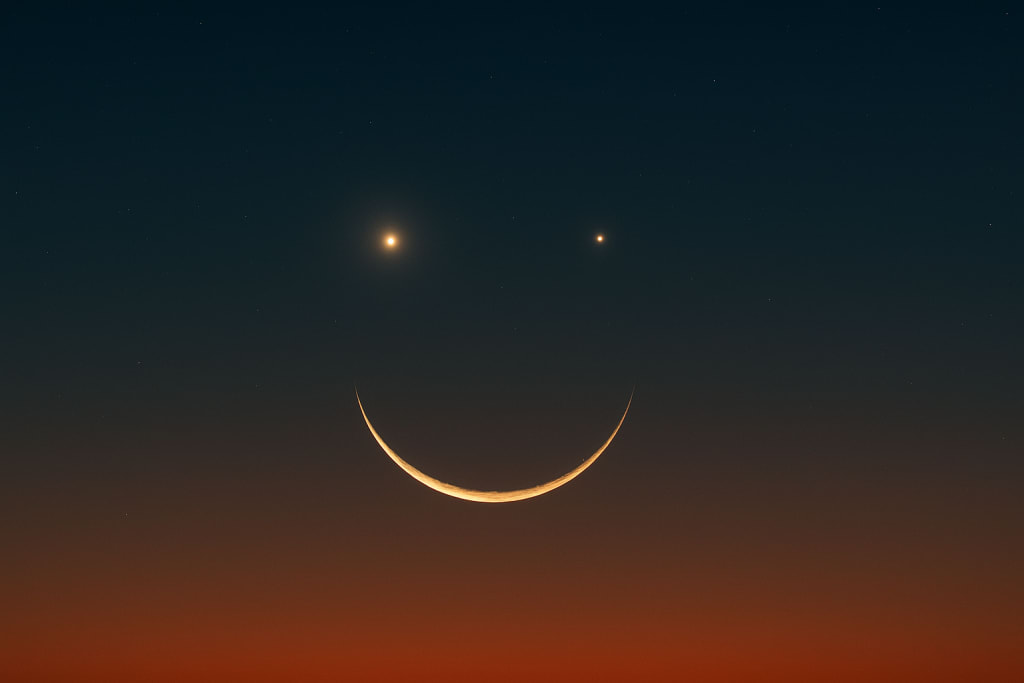
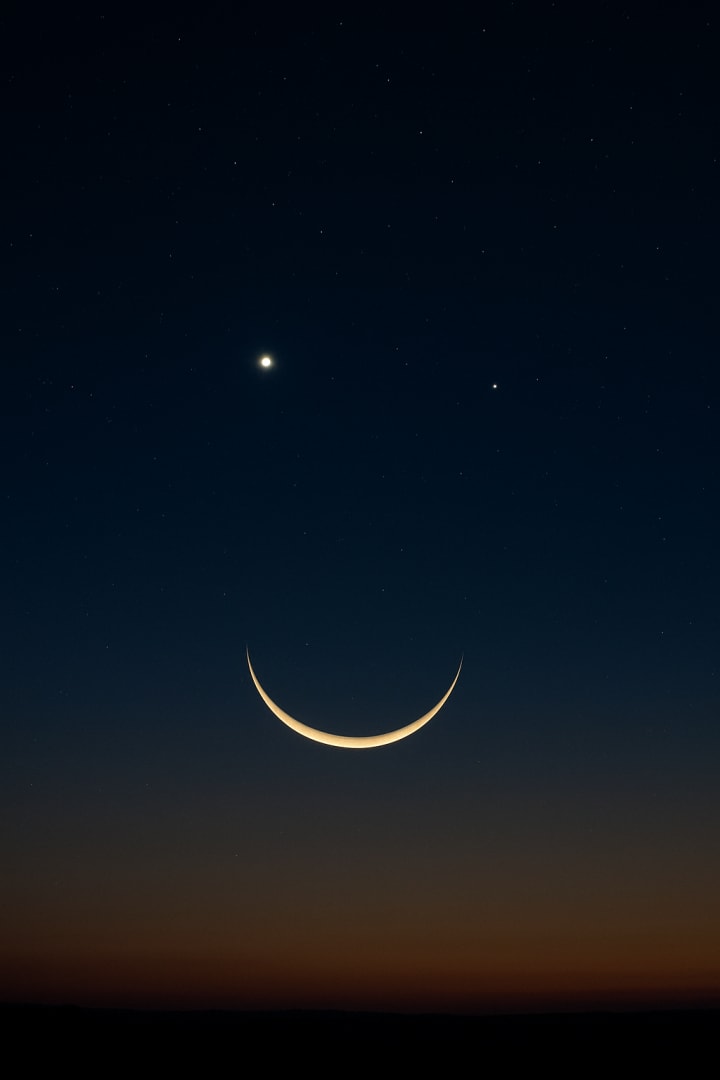
Every now and then, the night sky reminds us that astronomy isn’t always about numbers, charts, and distant galaxies—it can also surprise us with moments of wonder that feel almost playful. This week offers one of those moments. On Friday morning, September 19, 2025, a thin crescent Moon will align with the planet Venus and the bright star Regulus in the constellation Leo. Together, they will create the appearance of a giant smiley face in the sky.
For observers lucky enough to have clear skies, this sight won’t just be a passing curiosity—it will be one of the most visually striking conjunctions of the year.
What Exactly Is Happening?
In astronomy, a conjunction occurs when two or more celestial objects appear close together in the sky from our perspective on Earth. While these bodies may actually be millions of kilometers apart, their positions line up in such a way that they seem to form patterns.
In this case, the slim crescent Moon (about 5% illuminated) will appear below Venus and Regulus. Venus, shining brightly at about magnitude –4, will act like one glowing “eye,” while Regulus, slightly dimmer but still easily visible at magnitude +1.3, will serve as the other. The Moon’s curve will complete the illusion, forming a smiling mouth.
Of course, this smile is only from our perspective. The Moon is just 385,000 km away, Venus is about 12 light-minutes distant, and Regulus lies an astonishing 78 light-years away. Yet, on this morning, they will all fit into a neat little one-degree patch of the sky—the same width as your fingertip held at arm’s length.
Viewing Times by Region
The best time to catch this rare sight is just before sunrise on Friday, September 19. Since sunrise times vary across the globe, here are approximate windows for different regions:
North America: Between 5:30 AM – 6:30 AM local time, with the best “smile effect” visible in Alaska and the Yukon. The farther northwest you are, the more curved the alignment will appear.
Europe: Around 6:00 AM – 7:00 AM local time, low in the eastern sky. In many parts of Europe, the Moon will even occult Venus in daylight—a rare treat for those with binoculars or telescopes.
Asia: From 5:00 AM – 6:00 AM local time, visible before dawn. Observers in South and Central Asia should look toward the eastern horizon while the sky is still dark.
Africa: Roughly 5:30 AM – 6:30 AM local time, also before sunrise. Northern Africa will have one of the clearest views of the Venus-Moon pairing.
Australia and New Zealand: The timing is trickier, as the objects rise closer to twilight. Some observers may only catch Venus shining alongside the Moon before daylight washes the scene away.

👉 These times are approximate estimates—small differences in location, weather, and horizon conditions may shift visibility slightly. But astronomers agree: the chances are high that people across much of the world will see at least part of this conjunction.
Why This Event Is Rare
Conjunctions happen regularly, but not all of them look this photogenic. To get a smile in the sky, three conditions have to be met:
1. The Moon must be in the right phase—thin enough to look like a curved smile.
2. A bright planet like Venus has to line up nearby.
3. A prominent star must also join the scene, acting like a second “eye.”
This triple alignment doesn’t come around often. In fact, astronomers studying the millennium between the years 2000 and 3000 AD found only 85 such triple events worldwide. Most are too close to the Sun, hidden by daylight, or obscured by the full Moon’s brightness. That makes this September’s smile especially precious.
A Bit of History
Sky alignments have fascinated humans for centuries. Ancient civilizations often interpreted unusual celestial patterns as omens or messages from the gods. A smiling Moon would likely have been seen as a sign of favor or joy.
In more recent times, sky-watchers still treasure these alignments. One of the most famous occurred in April 1998, when the Moon passed in front of both Venus and Jupiter in a spectacular double occultation. For those who witnessed it, the memory has lasted a lifetime.
Now, in 2025, we’re lucky enough to witness a similar celestial dance—this time featuring Venus, Regulus, and our ever-playful Moon.
How to See It Best
Here are some tips to maximize your chances:
Check the weather forecast: Clear skies are essential. Even thin clouds near the horizon can block the view.
Find a dark spot: Go somewhere away from city lights, with a clear view of the eastern horizon.
Arrive early: Get outside at least 30 minutes before sunrise so you’re ready.
Use binoculars: While the smile is visible to the naked eye, binoculars make Venus and Regulus pop against the twilight.
Try photography: A standard DSLR or even a modern smartphone can capture the scene. Set the focus to infinity, use a tripod, and experiment with short exposures before the sky gets too bright.
The Science and the Wonder
On one level, this is a straightforward astronomical alignment: three objects, different distances, lining up by chance. But on another level, it’s a reminder of something deeper. The same Universe that produces supernovas and black holes also arranges the sky in playful, fleeting patterns that make us pause, smile, and look up.
In a time when most of us rush through our mornings, glued to phones and schedules, the idea of the cosmos itself smiling down at us feels like an invitation: slow down, step outside, and connect with something vast and timeless.
Looking Ahead
If you miss this conjunction, don’t worry—astronomy always has more in store. Just two days later, on September 21, 2025, a deep partial lunar eclipse will be visible across New Zealand, the South Pacific, and parts of Antarctica. And in the years to come, other rare alignments will surprise sky-watchers.
But for now, all eyes are on September 19. Whether you’re in North America, Europe, Asia, or Africa, this smile in the sky is worth setting an early alarm for.
Final Thoughts
The triple conjunction of the Moon, Venus, and Regulus is more than an astronomical event—it’s a reminder of how perspective shapes meaning. To the Universe, it’s just geometry. To us, standing here on Earth, it’s a smile.
So, when you step outside this Friday morning, look east. If the skies are clear, you’ll witness a fleeting but beautiful reminder that the cosmos has a playful side. Perhaps, just perhaps, the Universe really does have a sense of humor.
About the Creator
Amanullah
✨ “I share mysteries 🔍, stories 📖, and the wonders of the modern world 🌍 — all in a way that keeps you hooked!”
About Binding Prometheus
I want to start actively advocating on behalf of my own work, and the most valuable part of my canon is, without a doubt, Binding Prometheus, the play I have been working on since 2019 and only finished in 2023 as part of my MA. The play itself is an amalgamation of a million different inspirations. On one end, it evokes the Ancient Greek myth-play, deriving its own title from the earliest extant work of Western drama we have, Aeschylus’s Prometheus Bound. On the other end, it borrows significantly from the sci-fi bulwarks from over the years, namely Mary Shelley’s Frankenstein and Karel Capek’s Rossum’s Universal Robots. The play could be an episode of Black Mirror, I fear. I don’t know. I’ve only ever seen one episode of Black Mirror.
By Steven Christopher McKnight11 days ago in Futurism
GCC Cigarette Lighter Market: Rising Smoking Accessories Demand & Design Trends
According to IMARC Group's latest research publication, GCC Cigarette Lighter Market size reached USD 206.6 Million in 2025. The market is projected to reach USD 312.0 Million by 2034, exhibiting a growth rate (CAGR) of 4.68% during 2026-2034.
By Abhay Rajput4 days ago in Futurism


Comments (1)
"This article really opened my eyes to how upcoming celestial events connect us all, no matter where we live. I love how the timing was explained in detail—it makes me want to step outside and witness the sky with fresh excitement. Truly fascinating read!"