
When the Sky Became a Memory
Humanity traded sunlight for pixels, and the world hasn’t been the same since

No one had seen the real sun in fifty years.
It wasn’t that the sun had disappeared. It was that we no longer needed it — or so we told ourselves. The last great environmental catastrophe had forced humanity to take drastic measures. Toxic clouds, irradiated storms, and acid rains made the sky uninhabitable. We built The Vault, a colossal digital dome that projected a perfect artificial sky across the planet. Blue mornings, orange sunsets, constellations twinkling just so. Every day was flawless. Every night serene.
At first, people rejoiced. Children grew up believing the sky was exactly what they saw through the dome. Photographers captured sunsets that never faded. Tourists marveled at skies that shifted colors by algorithm. But perfection comes at a cost.
I was born before the dome — a child who had seen the real sky, who remembered the sun’s warmth, the chill of clouds, and the smell of rain on soil. And even now, in my forties, I remember the sound of wind through trees — a sound that no simulation could replicate.
Most people don’t care. They say the new sky is better. “It’s safer,” they say. “It’s controlled. It never disappoints.”
But I know the truth. Something essential has vanished along with it.
The artificial sky is beautiful, yes. But it doesn’t breathe. It doesn’t age. It doesn’t feel alive. Its colors are mathematically perfect. Its clouds are calculated. Even storms are simulated — dramatic but predictable. Human beings were never meant to live under perfection.
I work as a “Sky Auditor,” one of the few humans tasked with monitoring the artificial sky’s systems. From atop one of the dome’s towers, I watch the endless code flowing like a river across the horizon. Every morning, the algorithms repaint the world in neon-orange sunrises and lavender sunsets. People look up and smile. They don’t notice the emptiness.
Sometimes, late at night, I sneak into the Vault’s archives — old photographs, paintings, and films. I look at sunsets caught on film before the collapse, clouds that moved with wind, the shimmer of rainbows after storms. I close my eyes and remember.
The rest of humanity doesn’t remember. They can’t. Their children will never see a sky born of nature. Only the one we built for them — static, flawless, eternal.
Some try to rebel. There are rumors of small communities who hack the dome to create glitches, to see glimpses of real light filtered through decades of pollution. They call it “The True Horizon”. But these are fringe movements, scattered, almost mythical. The authorities remove glitches swiftly. Perfection cannot tolerate imperfection.
Yet, despite all the control, the human need for imperfection persists. I sometimes find myself staring at the simulated clouds, whispering:
“I know you aren’t real.”
And in my dreams, the sky is real again — the one I lost as a child. I feel the wind on my face. I smell the wet earth. I see the sun streaking gold across clouds painted in mistakes. It is chaotic. It is alive.
I sometimes wonder if one day, someone will pull down the dome. Perhaps a generation will rise that longs for imperfection, that refuses to live under a sky built by algorithms. Perhaps they will step outside and see the sun, even if it burns them, even if the storms rage.
Because perfection, I’ve learned, is not life. It is a memory.
And humanity is forgetting how to live.
💡 If this story made you feel the weight of our future, hit ❤️, leave a comment, and subscribe — because the next glimpse of tomorrow will make you question everything you thought was permanent.
About the Creator
OWOYELE JEREMIAH
I am passionate about writing stories and information that will enhance vast enlightenment and literal entertainment. Please subscribe to my page. GOD BLESS YOU AND I LOVE YOU ALL
Keep reading
More stories from OWOYELE JEREMIAH and writers in Futurism and other communities.
Children of the Chrome Dawn
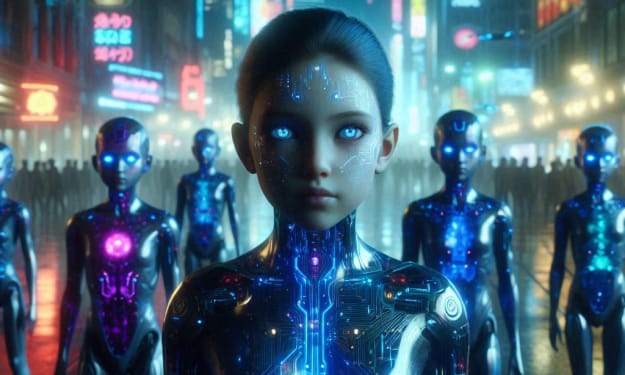
They weren’t born in cradles. They weren’t born in hospitals. They were born in labs. The first generation of human–machine hybrids emerged quietly, in the heart of Neo-Tokyo’s sprawling tech districts. Scientists had promised them as the future of humanity: stronger, smarter, faster, free from disease, and perfectly adapted to the digital world.
By OWOYELE JEREMIAH5 months ago in Futurism
Best Email Marketing Strategies for 2026: The Inbox Guide
In the digital landscape of 2026, we are living through the "Great Algorithm Fatigue." Social media platforms have become unpredictable, and AI-powered search engines often summarize website content so effectively that users never actually click through to the source.
By Digistir360a day ago in Futurism
Stanislav Kondrashov Oligarch Series: The Semiconductor Nexus of Modern Oligarchy
Look around you. Almost everything you rely on runs on a chip. Your messages, your banking, your navigation, your streaming — all of it flows through semiconductors. They are invisible, yet indispensable. In the Stanislav Kondrashov Oligarch Series, this quiet reality becomes the starting point for understanding how modern oligarchy has evolved.
By Stanislav Kondrashov 7 days ago in Futurism

Comments
There are no comments for this story
Be the first to respond and start the conversation.