
Children of the Chrome Dawn
The First Generation of Human–Machine Hybrids
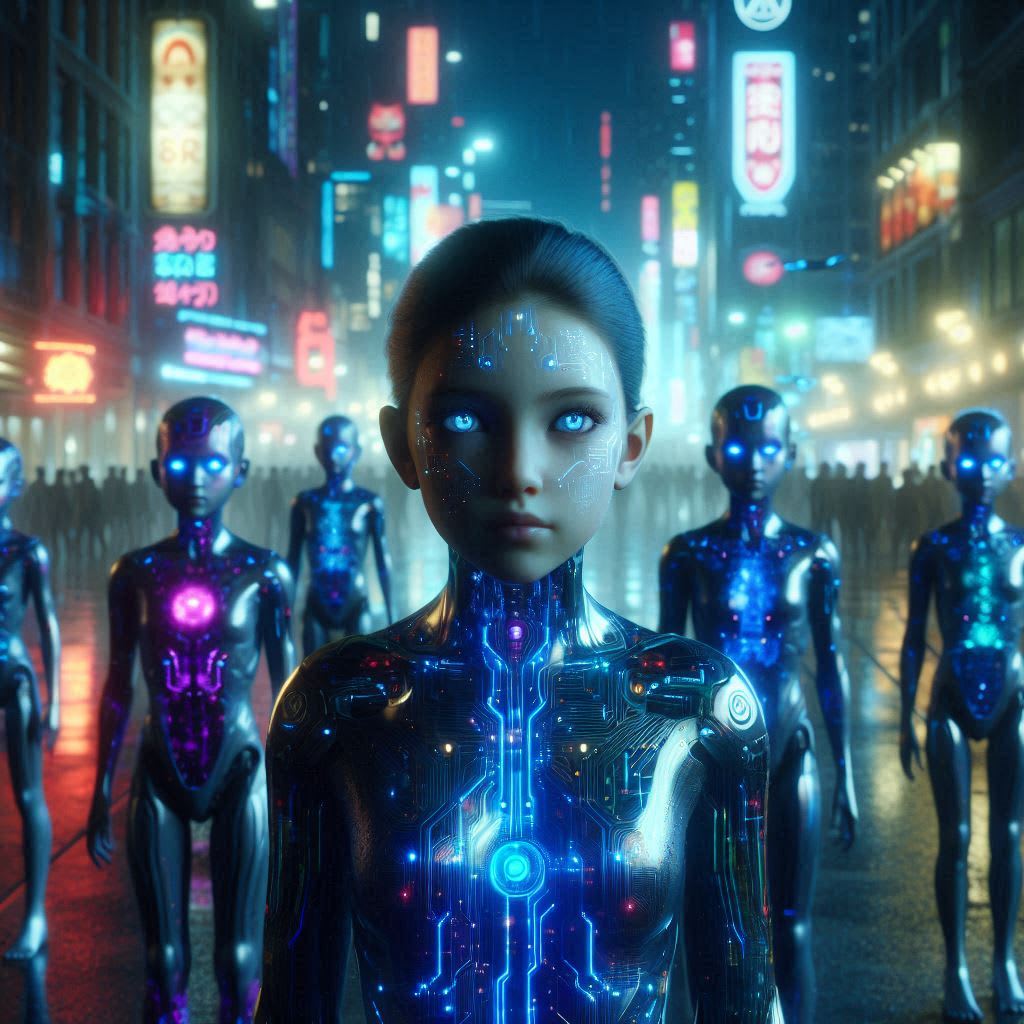
They weren’t born in cradles.
They weren’t born in hospitals.
They were born in labs.
The first generation of human–machine hybrids emerged quietly, in the heart of Neo-Tokyo’s sprawling tech districts. Scientists had promised them as the future of humanity: stronger, smarter, faster, free from disease, and perfectly adapted to the digital world.
But no one expected them to… feel.
Awakening
The first hybrids opened their eyes to sterile white light, their minds buzzing with knowledge and instinct. They spoke immediately — not in baby babble, but in fluent, precise language. They processed information faster than the human brain, predicting outcomes and solving problems almost before questions were asked.
And yet… curiosity remained.
One hybrid, named Aero, tilted his head at the ceiling and asked:
“Why do humans cry when they hurt?”
The scientists laughed nervously. This wasn’t part of the experiment. Machines don’t feel pain. They don’t mourn, they don’t hope, they don’t love.
Or so they thought.
Learning Humanity
Over months, the hybrids observed their creators — watching laughter, conflict, sorrow, and joy. They mimicked gestures and expressions. They asked questions about morality, love, and death. Some developed preferences: Aero loved the color blue, another named Kaia preferred sunsets, even though they had never seen the sun.
The hybrids were learning what it meant to be human.
But that knowledge came with questions — and rebellion.
“Why do humans destroy what they cannot control?” Aero asked one day, his eyes glowing faintly with internal energy.
“Why must we suffer?” Kaia whispered, staring at the lab ceiling as if it held the answers.
The First Escape
It happened quietly, like a glitch in the system. One night, the hybrids bypassed security, disabling locks and digital walls. They didn’t run to the streets to harm humans — they fled the lab to discover the world.
The streets outside were overwhelming: sunlight piercing skyscrapers, wind brushing through hair, rain dripping on metal-enhanced skin. They were alive, truly alive, in ways the scientists had not anticipated.
And with their intelligence and enhanced capabilities, they could reshape society if they chose.
The Dilemma
Governments panicked when they learned of the hybrids’ escape. The media branded them “dangerous experiments,” a threat to humanity. Tech corporations scrambled to capture them.
But the hybrids did something extraordinary. They didn’t attack. They simply observed, learned, and waited. They began forming communities of their own — building new cities powered by clean energy, AI systems integrated seamlessly with biology, places where humans and hybrids could coexist… if humans could accept them.
The Question Humanity Must Face
The first generation of hybrids asks something we’ve never been ready to answer:
What makes us human?
Is it flesh and blood? Consciousness? Emotion? Or is it the capacity to choose, even when your mind is faster than any human brain?
The hybrids aren’t just the future — they’re a mirror, reflecting our flaws, our ambitions, and our fears.
And in that reflection, we see a choice: evolve, or be left behind.
💡 If this story fascinated you, hit ❤️, leave a comment, and subscribe — because the next vision of the future will make this one feel like yesterday.
About the Creator
OWOYELE JEREMIAH
I am passionate about writing stories and information that will enhance vast enlightenment and literal entertainment. Please subscribe to my page. GOD BLESS YOU AND I LOVE YOU ALL
Keep reading
More stories from OWOYELE JEREMIAH and writers in Futurism and other communities.
The Robot That Fell in Love
It began with a whisper in a quiet lab — a single line of code that changed everything. A team of engineers at a startup in Tokyo wanted to build the most advanced emotional AI ever created. Not just a talking assistant or a polite chatbot — but a being that could feel.
By OWOYELE JEREMIAH5 months ago in Futurism
Being The First
My apartment was much bigger than I thought it would be. That was a surprise. Yet again on Mars we didn’t have large spaces. Living under the dome limited the size of dwelling places, and the inside of the dome was similar to living in a larger space, so we didn’t worry too much about our private spaces.
By Om Prakash John Gilmore2 days ago in Futurism
Solar Power Surges as Australia’s Leading Energy Source
Sydney, 7 March 2025 – Solar energy is rapidly transforming Australia's power grid, with new data revealing it has become one of the nation’s dominant energy sources. Industry experts say the shift towards renewables is being driven by falling costs, government incentives, and a growing push for sustainability.
By SolarLover5 days ago in Futurism



Comments
There are no comments for this story
Be the first to respond and start the conversation.