
What Really Happens During a Spacewalk: A Step Beyond the Edge of Earth
Space

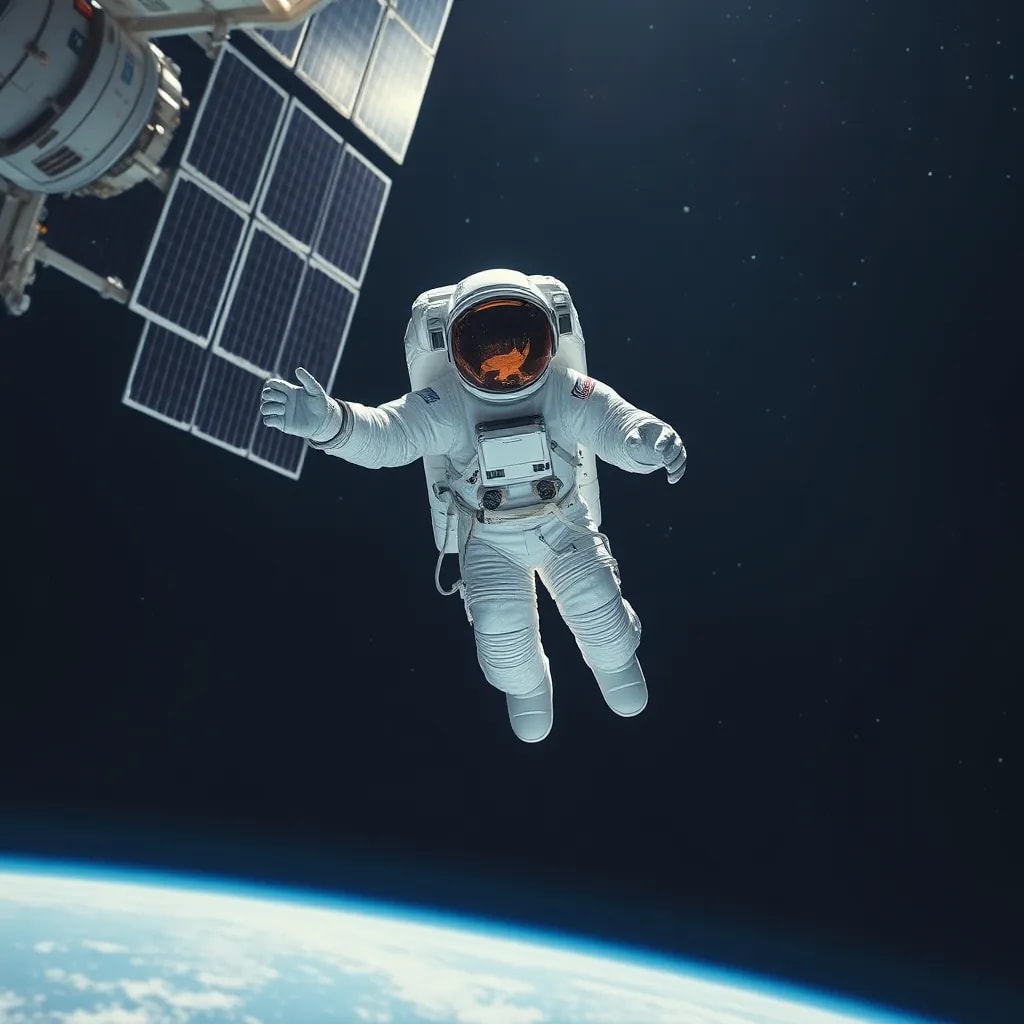
Floating above the Earth, with nothing but the stars ahead and the planet far below, astronauts stepping out of their spacecraft enter one of the most extreme and awe-inspiring environments imaginable — open space. Known officially as an EVA, or extravehicular activity, a spacewalk is a breathtaking feat of human engineering and courage. But what actually happens when someone leaves the safety of a spaceship and ventures into the cosmic void?
Beyond the Ship: Into the Hostile Void
Outer space is not just empty — it’s dangerously empty. There’s no air to breathe, no pressure to support the body, no atmosphere to shield against deadly radiation, and no sound. Temperatures swing wildly from around +120°C in direct sunlight to -150°C in the shade. In such an environment, a human would survive just seconds unprotected.
That’s why astronauts rely on one of the most advanced pieces of equipment ever created: the spacesuit. Think of it as a personal spacecraft. Modern suits provide oxygen, remove carbon dioxide, regulate temperature, maintain internal pressure, and shield astronauts from radiation and micrometeoroids.
Preparation: Rituals of Safety
A spacewalk doesn’t start with just “suiting up and going out.” Astronauts go through rigorous preparation. First, their suit is carefully inspected and tested. It’s composed of multiple layers, from airtight membranes to Kevlar-like armor, all wrapped around a life-support backpack.
Next comes the airlock — a chamber that gradually reduces pressure from the comfortable atmosphere inside the ship to the vacuum outside. This slow decompression is critical. A sudden drop in pressure could cause decompression sickness, similar to what deep-sea divers fear: nitrogen bubbles in the bloodstream.
Once the pressure matches that of space, the outer hatch opens. And suddenly, the astronaut is floating in true silence and infinite darkness.
In the Vacuum: The Experience of Weightlessness
The first thing most astronauts notice is the overwhelming quiet. With no air to carry sound, it’s completely silent — except for the noises inside the helmet: breathing, suit fans, maybe a creak from the life support pack. Outside, there's no up or down. Every movement must be deliberate.
Even a small push can send an astronaut spinning uncontrollably. That’s why they’re always tethered to the spacecraft with safety lines. Some also wear SAFER units — small jetpacks that allow limited movement and help recover from accidental drifting.
Spacewalks are far from leisurely floats. Astronauts often have a list of complex tasks: repairing instruments, installing solar arrays, conducting experiments, or collecting samples. Every movement is slow, rehearsed, and precise — because mistakes in space are difficult to fix, and the clock is always ticking. Oxygen is limited, and battery life is precious.
Hidden Dangers: Tiny Threats, Massive Consequences
The risks of EVA go far beyond the obvious. Micrometeoroids, some no larger than grains of sand, travel at speeds of up to 25,000 km/h. At that velocity, even the smallest particle could puncture a suit or damage critical equipment.
Then there's radiation. On Earth, we’re shielded by our magnetic field and atmosphere. In orbit, astronauts are exposed to solar and cosmic rays, which can damage cells and increase cancer risk. A single spacewalk can expose someone to a radiation dose equivalent to several chest X-rays.
Even the suit itself, while advanced, can cause issues: overheating, stiffness, or hand fatigue after hours of gripping and maneuvering in bulky gloves.
Coming Home: The Return to Safety
Once their tasks are complete, astronauts re-enter the airlock. The pressure is slowly restored to normal before they can safely remove their helmet. But the mission doesn’t end there. Medical check-ups follow every EVA. Even a few hours in space can stress the body, from dehydration to changes in vision or blood pressure.
Still, each successful spacewalk adds vital experience, supporting everything from maintaining the International Space Station (ISS) to preparing for future missions to the Moon and Mars.
Why Spacewalks Matter
Stepping outside a spaceship may seem like science fiction, but it's a critical part of real space exploration. Without EVA, we couldn’t maintain orbiting stations, fix satellites, or test the tools that might one day build colonies on other worlds.
Every spacewalk is a small step for science — and a giant leap for human endurance.
A Glimpse Back in Time: The First EVA
The first person to walk in space was Soviet cosmonaut Alexei Leonov in 1965. His spacesuit unexpectedly expanded during the EVA, making re-entry into the spacecraft a near-disaster. He had to release some air manually to fit through the hatch. It was risky, terrifying — and historic.
Final Thoughts: On the Edge of the Universe
A spacewalk is more than just a task — it’s a symbol of our cosmic ambition. Outside the spaceship, where sound vanishes and stars burn silently, humans float, explore, and build. It’s one of the most daring things we do, a testament to how far we’re willing to go for knowledge, for progress, and for the dream of touching the stars.
Because when we step out into space, we aren’t just fixing panels or collecting data. We’re proving that humanity belongs out there — one tethered step at a time.
About the Creator
Keep reading
More stories from Holianyk Ihor and writers in Futurism and other communities.
Why the Universe Doesn’t Fall Apart: The Forces Holding the Cosmos Together
The universe is vast, dynamic, and constantly expanding. It contains incomprehensible forces, staggering distances, and matter unevenly scattered across the cosmic landscape. So why doesn’t it all simply collapse or drift apart into chaos? The answer lies in the intricate balance of physical laws, the invisible forces of gravity, and the surprising roles played by dark matter and dark energy. These elements work together in a delicate harmony, holding the universe in a complex but stable structure.
By Holianyk Ihor7 months ago in Futurism
About Binding Prometheus
I want to start actively advocating on behalf of my own work, and the most valuable part of my canon is, without a doubt, Binding Prometheus, the play I have been working on since 2019 and only finished in 2023 as part of my MA. The play itself is an amalgamation of a million different inspirations. On one end, it evokes the Ancient Greek myth-play, deriving its own title from the earliest extant work of Western drama we have, Aeschylus’s Prometheus Bound. On the other end, it borrows significantly from the sci-fi bulwarks from over the years, namely Mary Shelley’s Frankenstein and Karel Capek’s Rossum’s Universal Robots. The play could be an episode of Black Mirror, I fear. I don’t know. I’ve only ever seen one episode of Black Mirror.
By Steven Christopher McKnight17 days ago in Futurism
Waterless Cosmetics Market Set to Soar to USD 23.17 Billion Driven by Digital Shift and Diverse Content
Waterless Cosmetics Market – Overview The waterless cosmetics market refers to beauty and personal care products formulated without water as a primary ingredient. Instead of water, these products use alternatives like botanical extracts, oils, powders, and butters to deliver concentrated active ingredients that offer potent performance and sustainability benefits. Compared to traditional liquid formulations, waterless cosmetics reduce reliance on freshwater, minimize preservative needs, and often use more eco-friendly packaging.
By James Smith6 days ago in Futurism



Comments
There are no comments for this story
Be the first to respond and start the conversation.