
What Lies Between Galaxies? Unveiling the Mysteries of Intergalactic Space
Space

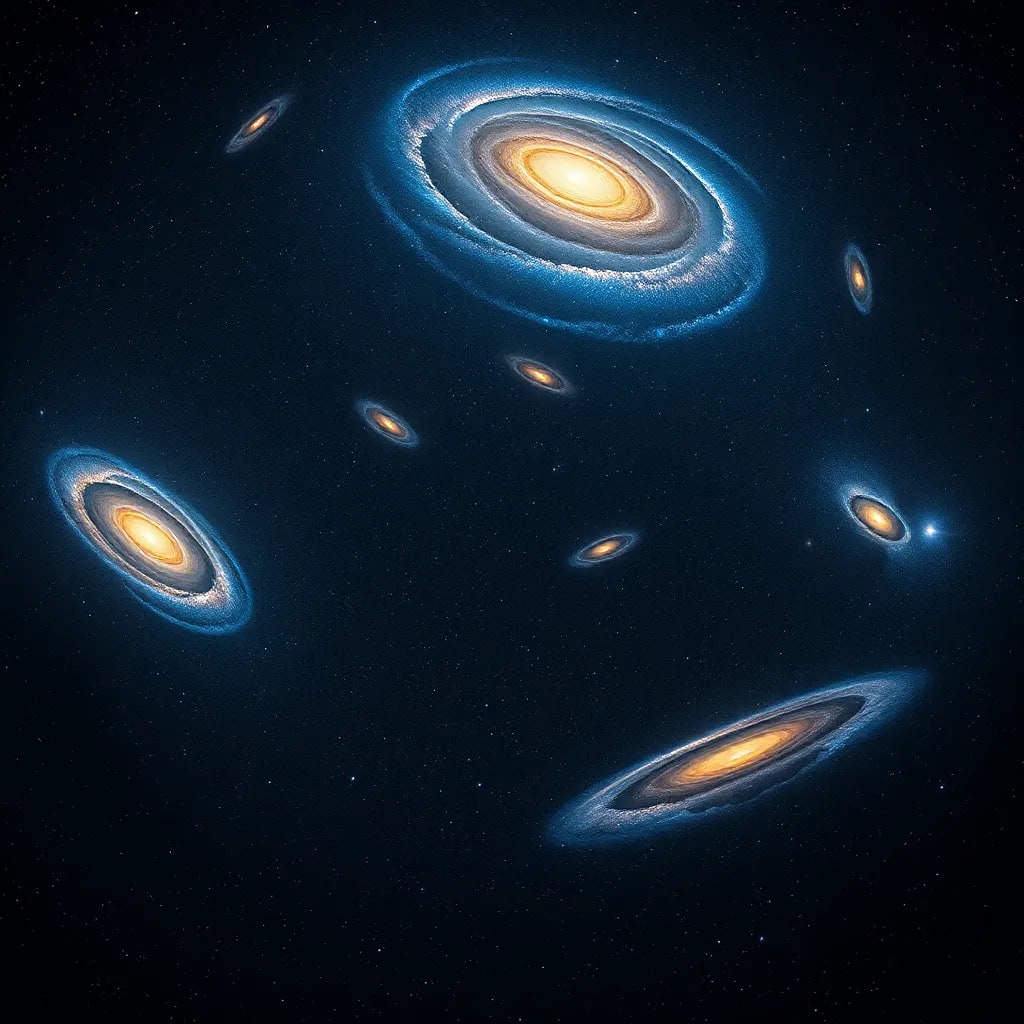
A Journey into the Hidden Fabric of the Universe
When we look up at the night sky, the vast darkness between galaxies might seem like an endless void cold, empty, and silent. But this impression couldn't be further from the truth. Intergalactic space is not just a vacuum between islands of stars; it is a dynamic, structured, and surprisingly rich part of our cosmos. In fact, some of the most important elements that shape the universe are found in the regions between galaxies.
More Than Emptiness
At first glance, intergalactic space appears barren, home only to a few stray atoms and a faint glow of ancient radiation. But modern astrophysics has shattered this outdated view. Intergalactic space is teeming with complex structures, mysterious forces, and essential components of the universe that have only recently come into scientific focus.
At the heart of this hidden world is the intergalactic medium (IGM) a sparse but significant collection of ionized hydrogen and helium gas. Though incredibly thin by Earth standards (a few atoms per cubic meter), this medium stretches across billions of light years, forming the connective tissue of the cosmos.
The Cosmic Web: A Universe of Threads
One of the most astonishing discoveries of modern cosmology is that galaxies aren’t randomly scattered across the universe. Instead, they are arranged in a colossal framework known as the cosmic web a vast network of filaments, sheets, and nodes made up of gas and dark matter.
Imagine a spiderweb made of invisible strands, with galaxies strung like beads along the threads. These threads are not just empty corridors they contain trillions of tons of hot gas, magnetic fields, and possibly a large fraction of the universe’s “missing” baryonic matter (the ordinary matter that forms stars, planets, and humans).
The Invisible Fire: Warm Hot Intergalactic Medium (WHIM)
Among the most intriguing elements of intergalactic space is a searing hot plasma known as the WHIM the Warm Hot Intergalactic Medium. With temperatures reaching millions of degrees Kelvin, this gas is so hot and diffuse that it doesn’t emit visible light, making it nearly impossible to detect directly.
Astrophysicists believe that over 40% of all baryonic matter in the universe is hidden in the WHIM, making it a key puzzle piece in understanding where all the “missing” matter has gone. Only with specialized instruments observing in X-ray and ultraviolet wavelengths have scientists begun to trace its elusive fingerprints.
Dark Matter: The Universe’s Invisible Scaffold
Perhaps the most mysterious substance between galaxies is dark matter. It doesn’t emit or absorb light and cannot be detected with traditional instruments. Yet its presence is undeniable. Dark matter creates the gravitational wells that galaxies form around and holds the cosmic web together.
Think of dark matter as the invisible skeleton of the universe without it, galaxies would fly apart due to their own rotational momentum. Though we can’t see it, dark matter accounts for about 27% of the universe’s total mass-energy content, and its gravitational influence shapes the evolution of the cosmos on the grandest scales.
Cosmic Rays and the Echo of Creation
Intergalactic space is also a highway for cosmic rays extremely energetic particles traveling near the speed of light. These particles, originating from events like supernovae and quasars, carry valuable information about the most energetic and violent processes in the universe.
In addition, the entirety of intergalactic space is filled with cosmic microwave background radiation (CMB) the residual glow from the Big Bang. This faint radiation is like a ghostly whisper from the universe’s infancy, offering a window into the very origin of time and space.
Could Life Exist Between Galaxies?
Could there be planets, or even life, drifting between galaxies? The conditions are extremely hostile: near total vacuum, intense radiation, and no nearby stars to provide warmth or energy. It’s highly unlikely that life as we know it could exist there. But the universe is full of surprises and we’ve only just begun to scratch the surface.
Why It Matters
Studying intergalactic space isn’t just about filling in the blanks. It’s about understanding the structure, history, and future of the entire universe. By mapping the cosmic web and analyzing the elements it contains, scientists are uncovering how galaxies formed, how matter evolved, and what role gravity and dark energy play in shaping the cosmos.
In a sense, intergalactic space is the unseen stage where the grand performance of the universe takes place. The galaxies may be the stars of the show, but the space between them holds the script.
Conclusion: The Darkness is Alive
Intergalactic space is far from empty. It is a vast, complex arena where invisible forces and hidden matter weave the fabric of reality. From scorching plasma to the enigmatic pull of dark matter, the "void" between galaxies is actually teeming with structure and activity.
The more we learn about it, the more we realize: the universe is not only bigger than we imagine it’s more intricate, interconnected, and mysterious than we ever dared to dream. And in those seemingly empty spaces, the true story of the cosmos is still being written.
About the Creator
Keep reading
More stories from Holianyk Ihor and writers in Futurism and other communities.
What Will Happen When the Sun Dies?
A Journey Into the Distant Future of Earth and the Solar System The Sun our radiant anchor in the cosmos gives life to everything on Earth. It lights up our days, warms our planet, and powers the processes that make existence possible. But like all things in the universe, the Sun is not eternal. One day, it will die. While this dramatic finale won’t happen for another five billion years, scientists already have a remarkably clear picture of what this future holds. And it’s a tale of awe-inspiring transformation both magnificent and catastrophic.
By Holianyk Ihor7 months ago in Futurism
About Binding Prometheus
I want to start actively advocating on behalf of my own work, and the most valuable part of my canon is, without a doubt, Binding Prometheus, the play I have been working on since 2019 and only finished in 2023 as part of my MA. The play itself is an amalgamation of a million different inspirations. On one end, it evokes the Ancient Greek myth-play, deriving its own title from the earliest extant work of Western drama we have, Aeschylus’s Prometheus Bound. On the other end, it borrows significantly from the sci-fi bulwarks from over the years, namely Mary Shelley’s Frankenstein and Karel Capek’s Rossum’s Universal Robots. The play could be an episode of Black Mirror, I fear. I don’t know. I’ve only ever seen one episode of Black Mirror.
By Steven Christopher McKnight17 days ago in Futurism


Comments
There are no comments for this story
Be the first to respond and start the conversation.