

A Journey Into the Distant Future of Earth and the Solar System
The Sun our radiant anchor in the cosmos gives life to everything on Earth. It lights up our days, warms our planet, and powers the processes that make existence possible. But like all things in the universe, the Sun is not eternal. One day, it will die. While this dramatic finale won’t happen for another five billion years, scientists already have a remarkably clear picture of what this future holds. And it’s a tale of awe-inspiring transformation both magnificent and catastrophic.
The Sun Today: A Stable Yellow Dwarf
At present, the Sun is in the “main sequence” phase of its life a long, stable period where it steadily fuses hydrogen into helium in its core. This process releases a massive amount of energy, which we feel as light and heat. It’s what makes life on Earth possible. But even the Sun’s fuel isn’t limitless. As it gradually runs out of hydrogen, a slow but unstoppable transformation will begin.
Running Out of Fuel: The Beginning of the End
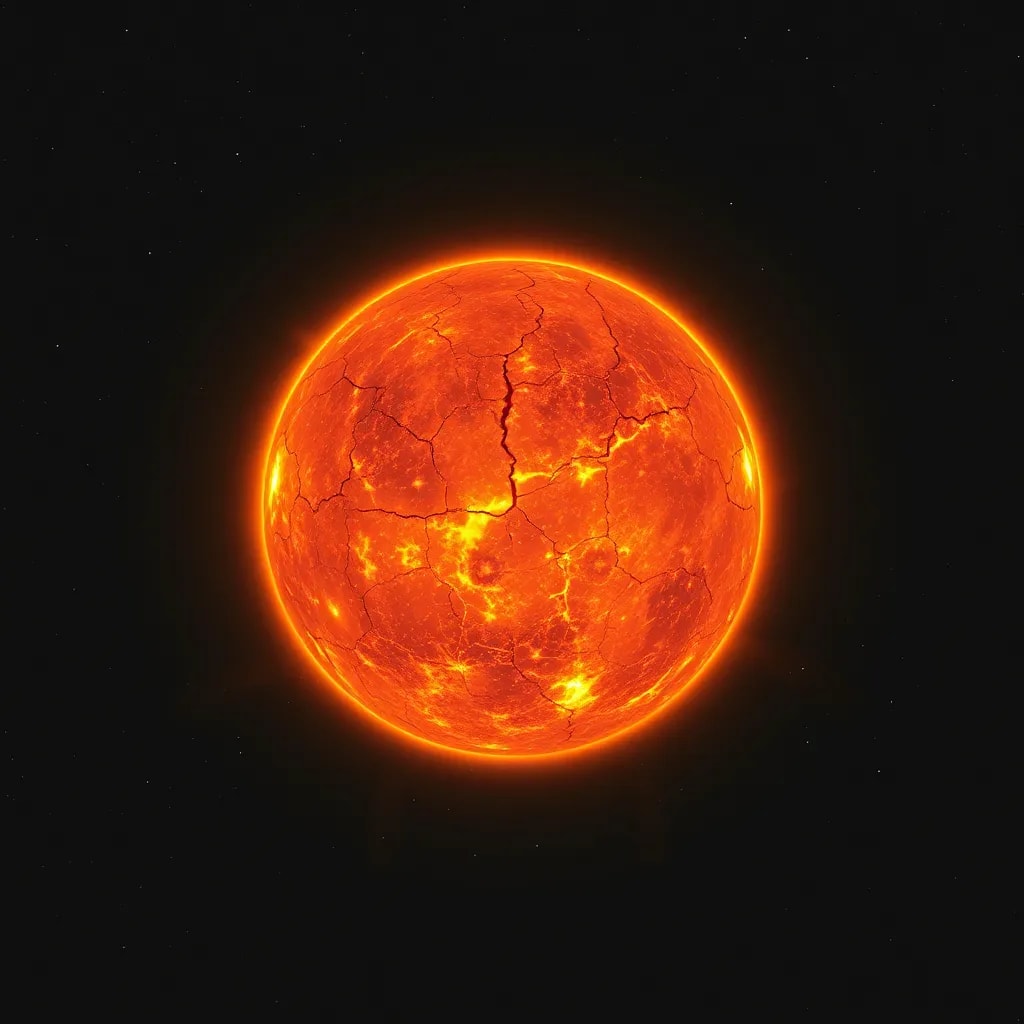
Once the hydrogen in the Sun’s core is depleted, gravity will take over, compressing the core and raising its temperature. Hydrogen fusion will shift to a shell around the core, and the outer layers of the Sun will begin to expand. This marks the start of the Sun’s evolution into a red giant.
In about five billion years, the Sun will swell to such enormous proportions that it could engulf the inner planets including Mercury, Venus, and possibly even Earth. Its outer atmosphere will cool and take on a reddish hue, but its size will increase hundreds of times over. The Sun’s surface will become unstable, blowing off massive waves of solar wind that will batter everything in its reach.
Farewell to Earth
Whether Earth is consumed by the expanding Sun or not, it’s unlikely to survive the red giant phase in any recognizable form. As the Sun expands, our planet’s atmosphere will be stripped away. Oceans will boil, and surface temperatures will soar to thousands of degrees. Even the toughest materials created by humans will melt and vaporize. Unless we’ve long since evacuated the planet and found shelter elsewhere, Earth will become a scorched, lifeless rock or vanish entirely.
The Birth of a White Dwarf
After its red giant phase, the Sun will shed its outer layers completely, forming a planetary nebula a glowing shell of gas and dust that drifts through space. What remains at the center is the Sun’s core: a white dwarf, roughly the size of Earth but with nearly the same mass as the Sun.
This white dwarf won’t shine like the Sun once did. Instead, it will slowly cool over billions of years, gradually fading into darkness. This stage is the Sun’s final form. Eventually, once it’s cooled enough, it will become a black dwarf a cold, dark remnant. However, since the universe is still too young, no black dwarfs exist yet; they're still theoretical.
What About the Other Planets?
The outer planets Jupiter, Saturn, Uranus, and Neptune will survive the Sun’s transformation, but not without consequence. Their orbits may shift, and their moons could become more prominent in the cosmic spotlight.
Take Titan, Saturn’s largest moon, for example. With its thick atmosphere and organic rich surface, it’s already considered a candidate for future human colonization. In a future where Earth is gone, moons like Titan might serve as sanctuaries for humanity if we’ve figured out how to live in such distant and alien environments.
And What About Us?
The most pressing question is: Will humanity survive the death of the Sun? It depends entirely on our technological and societal progress. If we continue advancing, exploring space, and settling new worlds, we might not only survive but thrive beyond Earth.
Today, scientists are already hunting for exoplanets Earth like planets orbiting distant stars. Ambitious missions and futuristic ideas like interstellar travel or space arks are being discussed in scientific and science fiction circles alike. If even a fraction of these dreams are realized, humanity could one day become a multiplanetary, even multistellar species.
Endings and Beginnings
The death of the Sun will be the end of an era but also the start of something new. The gases and dust ejected into space during its final moments will enrich the galaxy, contributing to the birth of new stars, new planets, and perhaps even new life.
This is the cycle of the universe: stars die, and from their remains, new stars are born. The atoms in our bodies were forged in the cores of ancient stars that exploded long ago. One day, the Sun will return the favor, helping to create the building blocks of new worlds.
A Cosmic Perspective
Although the Sun’s end is unimaginably far off, it’s a powerful reminder of our planet’s fragility and the rarity of life. Understanding this cosmic timeline should inspire us not with fear, but with determination. We have billions of years to prepare, explore, learn, and evolve. The future of our species doesn’t have to end with Earth. It could begin among the stars.
In the end, the Sun’s death is not just a story of destruction it’s a story of transformation, of opportunity, and of the incredible potential that lies ahead.
About the Creator
Keep reading
More stories from Holianyk Ihor and writers in Futurism and other communities.
Can a Civilization Become Immortal?
Exploring the Eternal Journey of Humanity The idea of a civilization achieving immortality is as fascinating as it is daunting. Philosophers, scientists, and futurists have long pondered whether humanity can outlive the fragility of individuals and rise to become an enduring presence in the universe. With our relentless drive for innovation building megacities, exploring the cosmos, creating artificial intelligence we seem determined to leave a legacy that outlasts the human lifespan. But can a civilization truly become immortal? Or is this just a beautiful illusion?
By Holianyk Ihor7 months ago in Futurism
About Binding Prometheus
I want to start actively advocating on behalf of my own work, and the most valuable part of my canon is, without a doubt, Binding Prometheus, the play I have been working on since 2019 and only finished in 2023 as part of my MA. The play itself is an amalgamation of a million different inspirations. On one end, it evokes the Ancient Greek myth-play, deriving its own title from the earliest extant work of Western drama we have, Aeschylus’s Prometheus Bound. On the other end, it borrows significantly from the sci-fi bulwarks from over the years, namely Mary Shelley’s Frankenstein and Karel Capek’s Rossum’s Universal Robots. The play could be an episode of Black Mirror, I fear. I don’t know. I’ve only ever seen one episode of Black Mirror.
By Steven Christopher McKnight15 days ago in Futurism
RegTech Market: Regulatory Complexity, Automation & Market Opportunities
According to IMARC Group's latest research publication, global RegTech market size reached USD 18.6 Billion in 2025. Looking forward, IMARC Group expects the market to reach USD 77.0 Billion by 2034, exhibiting a growth rate (CAGR) of 17.10% during 2026-2034.
By Andrew Sullivan3 days ago in Futurism




Comments
There are no comments for this story
Be the first to respond and start the conversation.