
What Is an Alcubierre Drive, and Could We Ever Build One?
Space

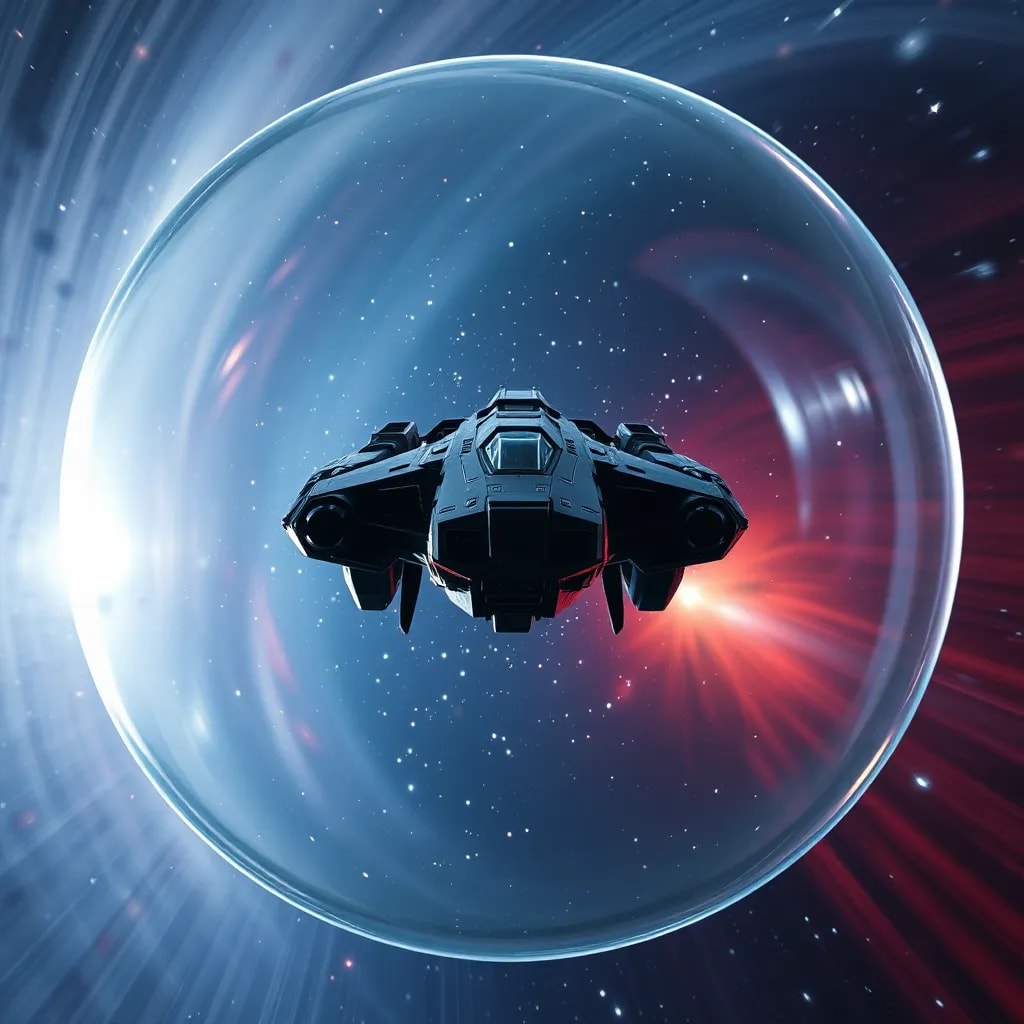
The speed of light is often considered the ultimate speed limit of the universe. According to Einstein's theory of relativity, nothing with mass can travel faster than light. But in 1994, a Mexican physicist named Miguel Alcubierre proposed a radical idea that could bypass this limitation without breaking any physical laws. His concept became known as the Alcubierre drive, or warp drive, a hypothetical engine capable of faster-than-light travel by warping space-time itself.
So what exactly is this futuristic engine, and is there any chance we could actually build it one day?
The Core Idea Behind the Alcubierre Drive
At first glance, the Alcubierre drive seems like something straight out of science fiction and in many ways, it is. The concept was inspired by the warp drives featured in Star Trek, but Alcubierre’s version is grounded in real mathematics and the framework of Einstein’s general relativity.
Rather than propelling a spaceship through space at incredible speeds, the Alcubierre drive would manipulate space itself. To understand the concept, imagine rolling a ball across a rug. That is regular movement through space. Now imagine pulling the rug behind the ball and pushing it forward in front of the ball. The ball appears to move, but it is actually being carried by the rug. In this analogy, the rug is space-time, and the ball is the spaceship.
In the Alcubierre model, the drive works by contracting space in front of the ship and expanding it behind, effectively carrying the ship forward in a bubble of warped space.
How Does It Work?
In Alcubierre’s original paper, he described what is known as a “warp bubble.” Inside this bubble, the spaceship remains stationary, while the bubble itself moves through the universe. Since it is space that is moving, not the ship, the light-speed barrier is not technically broken. Space itself can expand or contract at any speed it is not bound by the laws that govern objects moving within it.
This might sound like science magic, but the equations of general relativity do allow for this kind of space-time geometry. The challenge lies not in the math, but in making it work in the real world.
Why Haven’t We Built One Yet?
There are a few massive obstacles standing in the way of a working Alcubierre drive.
1. Exotic Matter Is Required
To create the warp bubble, one would need a substance with negative energy or negative mass something that does not occur naturally as far as we know. This so called exotic matter would need to exert a kind of negative pressure, pushing space-time apart instead of pulling it together.
Physicists have observed tiny amounts of negative energy in certain quantum effects, such as the Casimir effect, but these phenomena are extremely small in scale. We currently have no known way of generating or storing the amount of negative energy required to form even a tiny warp bubble.
2. Enormous Energy Demands
Initial estimates suggested that generating a warp bubble would require energy equal to the mass of Jupiter. More recent theoretical models have reduced this requirement significantly, down to around 700 kilograms of exotic matter but that is still far beyond our current capabilities, especially since exotic matter remains hypothetical.
3. Stability and Control Issues
Even if we could generate a warp bubble, we do not yet know how to stabilize it, steer it, or stop it safely. There is a chance that such a bubble could collapse, or worse, cause unpredictable damage to the fabric of space-time. These are serious issues that must be resolved before any practical application could be considered.
Have There Been Any Advances?
Despite these challenges, research is ongoing. In 2021, a team from the Limitless Space Institute led by former NASA engineer Dr. Harold "Sonny" White announced that they had observed a nano-scale structure that could mimic the effects of space-time distortion. While this is not a full warp bubble, it was hailed as an exciting step forward.
Meanwhile, theoretical physicists continue to explore modified versions of the Alcubierre drive that would require less energy or avoid exotic matter entirely. Some of these ideas involve sub-light warp fields, which would not break the speed of light but could still allow for faster-than-conventional space travel.
Is It Actually Possible?
Right now, the answer is no. We are far from having the technology needed to build even a miniature version of the Alcubierre drive. We do not know how to create or manipulate exotic matter, nor do we understand how to safely shape and control warped space-time.
But in the future, the answer might be different. The idea does not violate the known laws of physics, and space is full of surprises. A century ago, we could barely imagine leaving Earth’s atmosphere. Now, we send robotic probes beyond our solar system. With enough time and scientific progress, a real warp drive may someday be within our reach.
Conclusion
The Alcubierre drive is not just a fantasy, but it is not a near-future reality either. It remains a fascinating theoretical possibility an idea sitting at the crossroads of science fiction and serious physics. It continues to inspire scientists, engineers, and dreamers who envision humanity traveling to the stars.
Who knows? Maybe one day we will “warp” our way to another solar system in minutes instead of millennia. Until then, the Alcubierre drive reminds us just how much we still have to discover about the universe we live in.
About the Creator
Keep reading
More stories from Holianyk Ihor and writers in Futurism and other communities.
Could Dark Matter and Dark Energy Be the Key to Intergalactic Jumps?
Our universe is filled with mysteries vast, puzzling enigmas that defy our understanding. Among the greatest of them are dark matter and dark energy. Together, they make up about 95% of the total mass energy content of the cosmos, yet we can't see them, touch them, or measure them directly. They are the invisible architecture of reality. But what if these elusive forces are more than just curiosities for astrophysicists? What if they’re the missing link in our quest to leap between galaxies?
By Holianyk Ihor7 months ago in Futurism
About Binding Prometheus
I want to start actively advocating on behalf of my own work, and the most valuable part of my canon is, without a doubt, Binding Prometheus, the play I have been working on since 2019 and only finished in 2023 as part of my MA. The play itself is an amalgamation of a million different inspirations. On one end, it evokes the Ancient Greek myth-play, deriving its own title from the earliest extant work of Western drama we have, Aeschylus’s Prometheus Bound. On the other end, it borrows significantly from the sci-fi bulwarks from over the years, namely Mary Shelley’s Frankenstein and Karel Capek’s Rossum’s Universal Robots. The play could be an episode of Black Mirror, I fear. I don’t know. I’ve only ever seen one episode of Black Mirror.
By Steven Christopher McKnight16 days ago in Futurism
Device-as-a-Service Market: Transforming Enterprise Hardware Solutions
📌 Market Overview The Device‑as‑a‑Service (DaaS) market refers to a subscription‑based IT delivery model where organizations procure hardware (like computers, laptops, tablets, and smartphones) paired with software, maintenance, support, and lifecycle management services under one contract. Instead of purchasing devices outright, enterprises outsource procurement, updates, security, and end‑of‑life recycling to DaaS providers. This model shifts traditional capital expenditures (CapEx) to predictable operating expenses (OpEx), helping businesses scale and modernize IT infrastructure efficiently.
By James Smithabout 20 hours ago in Futurism
Miss Persephone's Manual to a Seemingly Ordinary Life
Miss Persephone was found at the dining table, her blue eyes swollen, her tears arriving and retreating like the tides of the ocean. Earlier that day, her family had visited her in the retirement home where she had lived for eight years. It was her eightieth birthday.
By Imola Tótha day ago in Fiction


Comments
There are no comments for this story
Be the first to respond and start the conversation.