
What Is a Supernova, and Will It Happen to Our Sun in the Future
The Explosive Death of Stars — and Why Our Sun Won’t Be One of Them
Introduction — Why talk about supernovae at all?
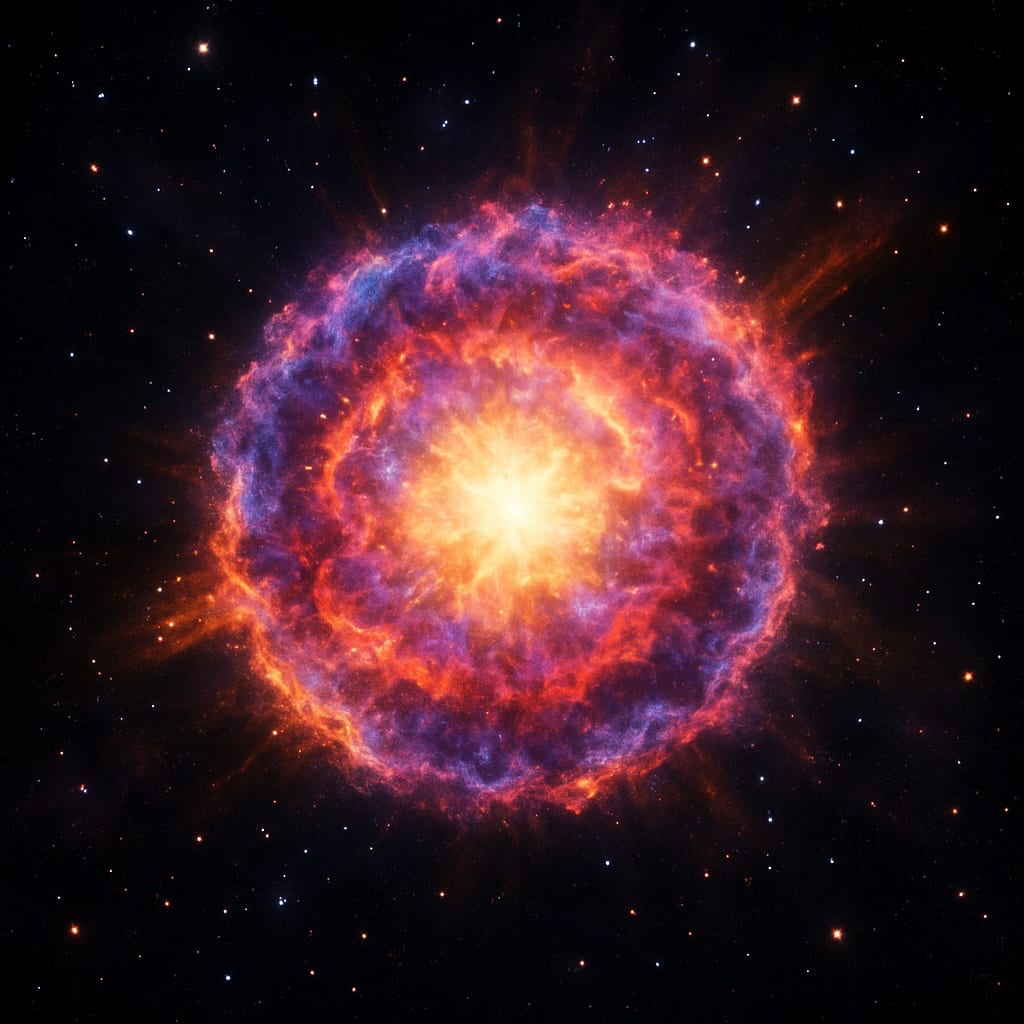
Every night—even if our unaided eyes never notice—dozens of stars somewhere in the cosmos detonate, flooding their surroundings with a brilliance that momentarily eclipses the entire galaxy they inhabit. These astronomical outbursts, known as supernovae, are far more than a spectacular light show: they hold the key to deciphering the life cycle of matter, the forging of heavy elements, the pace of cosmic expansion, and even the birth of new stellar systems. In this article, we will delve into the phenomenon—from the physics that triggers the blast, through the various classification schemes, to the potential implications for Earth and for modern science.
The Life Cycle of a Star — Essential Background for Understanding Supernovae:
A typical star, like our Sun, begins its journey within a cloud of molecular gas and dust. Gravity draws the material inward, raising temperature and pressure until nuclear fusion ignites, fusing hydrogen into helium. For most of its “adult life” the star remains in equilibrium: hydrogen continues to merge in the core, the energy released generates outward radiation pressure, and this counters the inward pull of gravity. Yet hydrogen is a finite resource. Once it is exhausted, the core turns to fusing heavier elements; temperatures soar, the outer envelope swells, and the star expands into a red giant—or a blue giant, depending on its initial mass.
What Happens Right Before the Explosion?
Nuclear fusion in the core progresses through a series of shells: helium fuses into carbon and oxygen, which in turn are captured and transformed into neon, magnesium, silicon, and eventually iron. Iron marks the end of the line—its fusion consumes energy rather than releasing it, causing the internal pressure to plummet abruptly. Gravity takes over, and the core collapses at tremendous speed. A shockwave ricochets from the center of the star outward toward its surface. In just a matter of seconds, density, temperature, and pressure change dramatically—and a supernova begins.
The Two Major Families of Supernovae:
Type II supernovae occur in stars with an initial mass ≥ 8 solar masses. When the core collapses, it forms either a neutron star or a black hole. This is known as a core-collapse supernova, and it is thought to account for the majority of visible-light supernovae observed in the universe.
Type I a supernovae, on the other hand, arise in close binary systems: a white dwarf siphons matter from a companion star until it crosses the Chandrasekhar limit (≈ 1.4 solar masses). As a result, a sudden thermonuclear ignition takes place, and the entire white dwarf explodes all at once, leaving no compact remnant behind. Due to this consistent mass “trigger,” Type I a supernovae always shine with nearly the same intrinsic brightness, making them ideal standard candles for measuring cosmic distances.
The Physics of Light and Energy:
A typical supernova releases an energy on the order of 10^44 joules—about one hundred billion times the total energy the Sun will emit over its entire lifetime. Most of this energy escapes in the form of a flood of neutrinos, with only a small fraction emerging as visible light, X-rays, and gamma radiation. Within a few days, the expanding cloud of hot gas—known as a supernova remnant—can swell to a diameter of several light-years.
This searing-hot medium, with temperatures soaring up to 10 billion kelvin, becomes a forge for heavy elements: copper, gold, and uranium form within its depths. It is through events like these that future solar systems—our own included—inherit the treasure trove of metals we now know.
Cosmological Implications — From the Universe's Expansion Rate to the Origins of Life
Because Type I a supernovae have an almost uniform intrinsic brightness, measuring how bright they appear from Earth reveals the distance to the galaxy in which they occurred. In the late 1990s, a series of such observations led to the discovery of the “accelerating universe” and the existence of dark energy.
Beyond helping map distances, supernovae also enrich the interstellar medium with elements essential to life: iron in our blood, calcium in our bones, iodine in our thyroid. Without these massive nuclear explosions, the matter that makes up Earth—and the humans capable of pondering these questions—would never have formed.
Risks and Proximity: Should We Be Worried?
A supernova occurring within 30 light-years of Earth could potentially disrupt the ozone layer, flood the planet with harmful radiation, and harm the food chain. However, at the more realistic distances typical within our galaxy—hundreds to thousands of light-years—the threat is negligible. The nearest known candidate is Eta Carinae, located about 7,500 light-years away. When it finally explodes—whether in the next century or a hundred thousand years from now—it will produce a spectacular light show for our generation, but it won’t be a doomsday event.
Popular Myths and Their Debunking:
Contrary to common belief, a supernova is not a “chemical explosion,” but rather a rapid outpouring of nuclear and gravitational energy. It is also not something our Sun will experience—our Sun lacks the necessary mass; its final stage will be a relatively quiet white dwarf. Another widespread myth is that a supernova always creates a black hole. In reality, most Type II explosions end with the formation of a stable neutron star, not a black hole.
Conclusion — The Legacy of the Great Explosion:
Supernovae are milestones in the history of the universe: they signify the death of a star and the beginning of a new cycle of matter. They illustrate how the forces of extreme physics can tell a story about vast cosmic distances, about the elements we breathe and consume, and about the cutting-edge instruments we use to explore regions billions of light-years away. As technology continues to evolve, we draw ever closer to understanding this “cosmic performance”—a spectacle in which the entire universe is the stage, and the backdrop changes faster than we ever imagined.
About the Creator
Keep reading
More stories from writers in Futurism and other communities.
About Binding Prometheus
I want to start actively advocating on behalf of my own work, and the most valuable part of my canon is, without a doubt, Binding Prometheus, the play I have been working on since 2019 and only finished in 2023 as part of my MA. The play itself is an amalgamation of a million different inspirations. On one end, it evokes the Ancient Greek myth-play, deriving its own title from the earliest extant work of Western drama we have, Aeschylus’s Prometheus Bound. On the other end, it borrows significantly from the sci-fi bulwarks from over the years, namely Mary Shelley’s Frankenstein and Karel Capek’s Rossum’s Universal Robots. The play could be an episode of Black Mirror, I fear. I don’t know. I’ve only ever seen one episode of Black Mirror.
By Steven Christopher McKnight17 days ago in Futurism
Top Enterprise Software Development Companies in 2026
Enterprise software has become the backbone of modern organizations. In 2026, enterprises are no longer focused solely on digitization—they are prioritizing scalability, security, interoperability, and long-term architectural resilience. As a result, the role of enterprise software development companies has evolved from implementation partners to strategic technology enablers.
By Isabella Rossi3 days ago in Futurism


Comments (1)
This article on supernovae is really fascinating. I remember learning about stars' life cycles in school, but this goes into way more detail. The part about iron causing the core to collapse is mind-blowing. It makes me wonder how exactly that shockwave forms and what determines its strength. Also, how do we know all these details about what happens inside a star during a supernova? It seems like a lot of complex physics is involved.