
What If Newton Never Saw the Apple Fall?
The Story of Gravity Without the Falling Fruit

The Story of Gravity Without the Falling Fruit
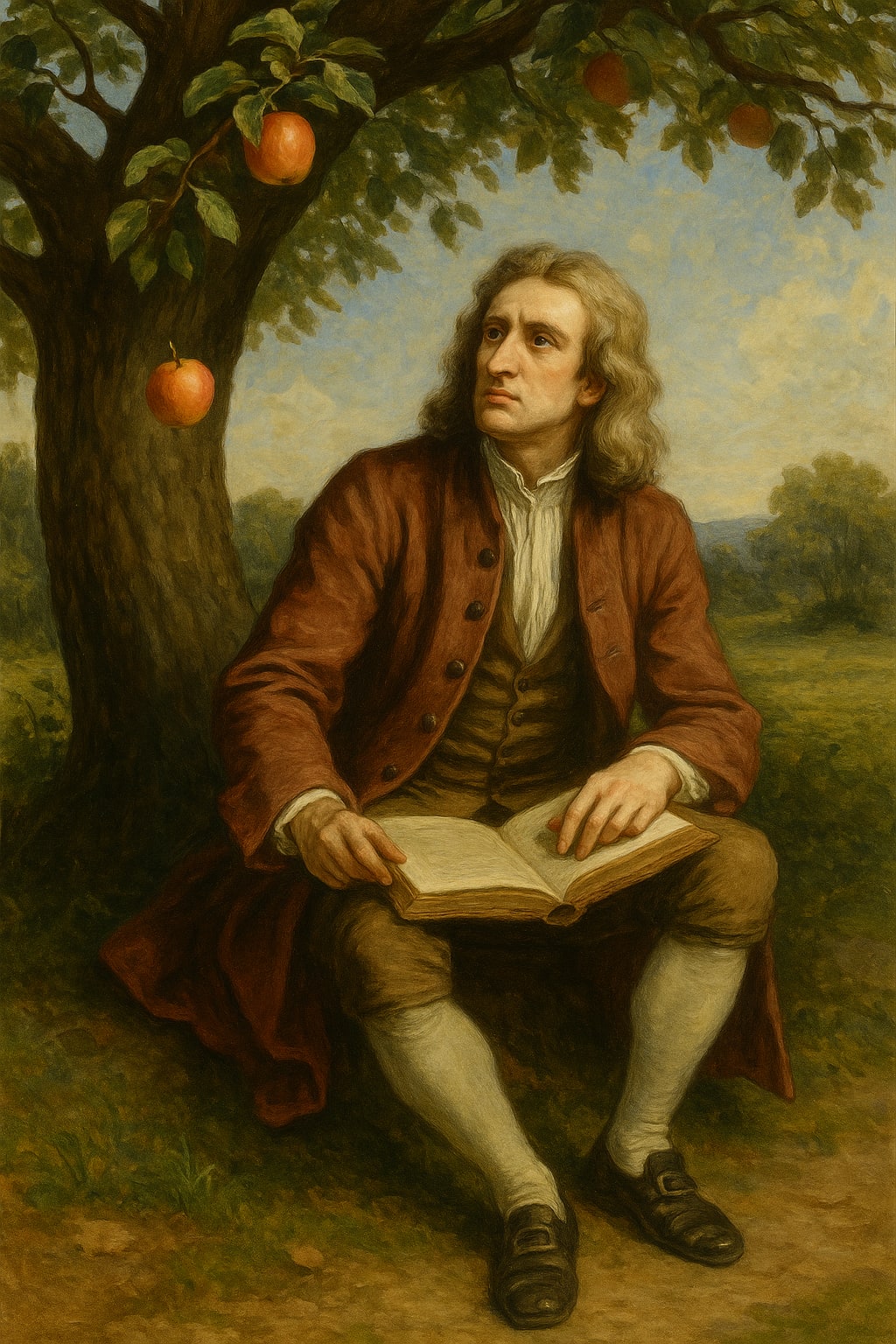
It’s one of the most iconic scenes in scientific history: a young Isaac Newton sits beneath an apple tree, when suddenly—plop!—an apple falls to the ground, triggering a cascade of thoughts that would lead to the discovery of gravity. This image, romanticized over the centuries, has become a symbol of sudden genius, divine inspiration, and the beauty of scientific curiosity. But what if that apple had never fallen? What if Newton had never glanced skyward to ponder why objects fall in the first place? Would humanity still have uncovered the laws that govern motion and gravity? Or would the world have waited longer, perhaps centuries more, for someone else to grasp the invisible threads pulling everything toward the Earth?
Unpacking the Myth of the Apple
First, let’s address the historical accuracy of the story. There is evidence that Newton himself mentioned the falling apple as a source of inspiration—though not in the dramatic, cartoonish way often portrayed. According to Newton’s friend and biographer William Stukeley, Newton did indeed reflect on the nature of gravity after observing an apple fall. However, this wasn’t necessarily a eureka moment under a tree. Instead, it was likely one moment in a long period of reflection and study.
Even so, whether the apple story is entirely true or just a charming anecdote, it highlights a deeper truth about how breakthroughs happen: through curiosity, persistent questioning, and a mind willing to look at the world differently.
A World Without Newton’s Apple
Had Newton not observed the falling apple—or if he had dismissed it as a mundane event—the world may have missed out on a profound leap in scientific understanding. However, this doesn’t mean gravity would have remained a mystery forever. Scientific discovery often follows a collective path. Think of how calculus was independently developed by both Newton and Gottfried Wilhelm Leibniz, or how the theory of evolution was proposed nearly simultaneously by Charles Darwin and Alfred Russel Wallace.
Before Newton, scientists like Galileo Galilei had already made significant progress. Galileo’s experiments with inclined planes helped establish the idea that objects accelerate uniformly under gravity. Johannes Kepler had formulated his laws of planetary motion, hinting at an invisible force holding the planets in their orbits. The pieces were already on the table—Newton simply fit them together with extraordinary clarity.
The Mind That Moved the World
While the apple may have been a spark, it was Newton’s unparalleled intellect and mathematical rigor that gave gravity a scientific foundation. His masterpiece, Philosophiæ Naturalis Principia Mathematica (1687), presented the three laws of motion and the universal law of gravitation. Newton showed that the same force pulling the apple to the ground also kept the Moon in orbit around the Earth and the planets revolving around the Sun.
Would someone else have made the same connections? Possibly. But would they have done it with the same elegance and mathematical precision? That’s harder to say. Newton didn’t just discover gravity—he gave us a framework for understanding the physical world, laying the foundation for classical physics and setting the stage for centuries of scientific progress.
The Ripple Effect of a Missed Moment
If Newton hadn’t formulated his theory of gravity when he did, the scientific revolution might have slowed. Technologies dependent on Newtonian physics—such as ballistics, mechanics, and later, space exploration—could have been delayed. The Enlightenment itself, fueled by scientific rationalism and the power of human reason, might have lost one of its brightest torches.
Moreover, Albert Einstein’s theory of general relativity, which refined Newton’s ideas, might also have been postponed. Without Newton’s groundwork, would Einstein have had the context to build upon? Every great scientific leap stands on the shoulders of giants—and Newton was among the tallest.
More Than a Fruit: The Real Lesson
The story of the apple, real or not, isn’t just about gravity. It’s about observation. It’s about taking the mundane—the everyday—and daring to ask why. Had Newton not seen the apple fall, perhaps he would have found inspiration elsewhere. A bird in flight. The arc of a thrown stone. The tides in the sea. Curiosity doesn’t need a specific trigger; it only needs a willing mind.
In that sense, the world might still have discovered gravity, with or without the apple. But the story reminds us that science often begins not in the lab, but in the ordinary moments we often overlook.
About the Creator
Abid khan
"Writer, dreamer, and lifelong learner. Sharing stories, insights, and ideas to spark connection."
The Piggy Project
I’ve had so many names in this life I lose track of which ones were ever really mine and which ones I wore because someone needed me to. Some were handed to me before I had words to refuse them, before I knew what they meant, before I knew I could say no. Most weren’t meant to hurt. That doesn’t mean they didn’t leave marks. Marks that told me who I belong to, who I am by way of who claims me, recognizes me in the good and bad, who walks beside me.
By Fatal Serendipity3 days ago in Confessions


Comments
There are no comments for this story
Be the first to respond and start the conversation.