
What If Humans Lived on Mars?
Exploring the Challenges of Survival and Terraforming on the Red Planet
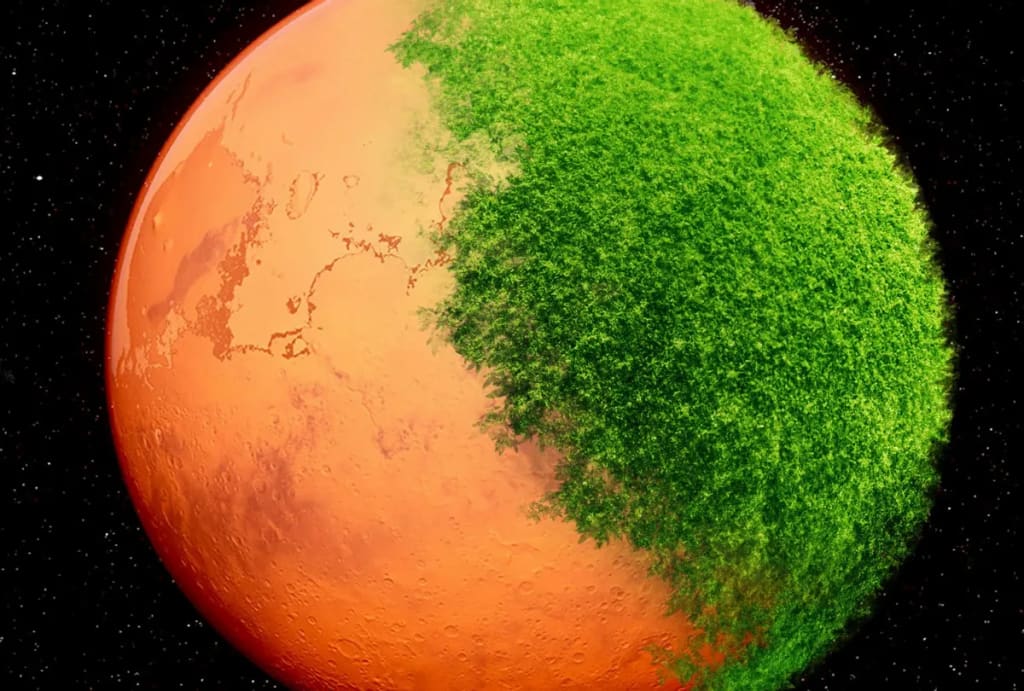
The idea of colonizing Mars has fascinated humanity for decades. But what if humans had already made the leap and settled on the Red Planet? How would life there unfold? Could we adapt to living on the surface, or would we be forced to seek shelter underground to escape the intense radiation Mars is exposed to? And what about terraforming—could we reshape the planet to make it more like Earth?
Mars, the fourth planet from the Sun, lies millions of kilometers away. At its closest, it’s about 56 million kilometers from Earth, but the distance can stretch to as much as 401 million kilometers. Traveling to Mars, even aboard the fastest spacecraft, could take anywhere from 40 days to over nine months, depending on the alignment of the planets.
Upon arrival, settlers would face a harsh and barren world. To survive, they’d first need to secure a reliable source of oxygen. The Martian atmosphere is incredibly thin and composed mostly of carbon dioxide—about 95%. Breathing would only be possible with the help of advanced machines capable of extracting oxygen from the carbon dioxide, like NASA’s MOXIE. This technology wouldn’t just provide breathable air; it could also produce liquid oxygen, a critical component for rocket fuel in case settlers needed to leave the planet.
Food production would also be a challenge. Mars lacks fertile soil, so settlers would turn to hydroponics—growing crops in nutrient-rich water solutions without soil. However, with no running water on the surface, they might only be able to produce about 20% of their food locally. The rest would need to be transported from Earth, most likely in dehydrated form. Fresh produce or meat would be rare luxuries.
As for shelter, living on the Martian surface would expose settlers to deadly radiation due to the planet’s thin atmosphere and lack of a protective magnetic field. While pressurized, inflatable habitats could be used initially, underground living spaces would likely offer the safest long-term solution. Below the surface, settlers would be shielded from both radiation and the planet’s extreme temperatures.
Mars is incredibly cold, with average temperatures far lower than the chilliest winters on Earth. In some areas, temperatures could plunge to -55°C, and near the poles, they might drop as low as -153°C. Venturing outside would require protective spacesuits designed to maintain warmth, regulate pressure, and block radiation.
A day on Mars, known as a “sol,” is only about 40 minutes longer than an Earth day. However, a Martian year is nearly twice as long, with distinct and prolonged seasons. Spring in the northern hemisphere could last seven months, followed by six months of summer, five months of autumn, and four months of winter. The planet also experiences dramatic temperature fluctuations, sometimes within a single week. These variations often trigger dust storms, which, while not dangerous to humans directly, could disrupt electronics and machinery.
The lower gravity on Mars—just one-third of Earth’s—would also be an adjustment for settlers, impacting everything from movement to long-term physical health.
Terraforming Mars to make it more Earth-like could take centuries. Engineers and scientists might consider importing ammonia ice from other celestial bodies to warm the planet. This process could release carbon dioxide from the polar ice caps, thickening the atmosphere and creating enough pressure for humans to survive without spacesuits. Extracting water from the planet’s underground ice deposits would further enrich the atmosphere, potentially leading to rain and snow. Over hundreds or even thousands of years, these changes could eventually result in a breathable atmosphere.
So, would you trade life on Earth for a new existence on Mars? Or would you rather focus on preserving our home planet and its unique environment?
About the Creator
Keep reading
More stories from Saida Ahmadli and writers in Futurism and other communities.
How to get emotional maturity
Steps to Emotional Maturity: How to Grow and Thrive Emotional maturity is more than a sign of personal growth—it’s a hallmark of a fulfilled and balanced life. It’s about managing emotions effectively, empathizing with others, and making thoughtful decisions in challenging situations. While physical maturity happens naturally, emotional maturity takes effort and self-awareness. Curious about how to develop this important trait? Here are eight actionable steps to become more emotionally mature.
By Saida Ahmadliabout a year ago in Motivation
I Built a GPT Store Side Project and Realized the Agent Didn’t Need Me Anymore
A side project in the GPT Store was supposed to give me leverage. Instead, it gave me a weird identity crisis. I built what I thought was a simple AI agent, and somewhere between shipping version one and refreshing analytics at 2:17 a.m., I realized something I wasn’t ready for:
By abualyaanartabout 18 hours ago in Futurism




Comments
There are no comments for this story
Be the first to respond and start the conversation.