

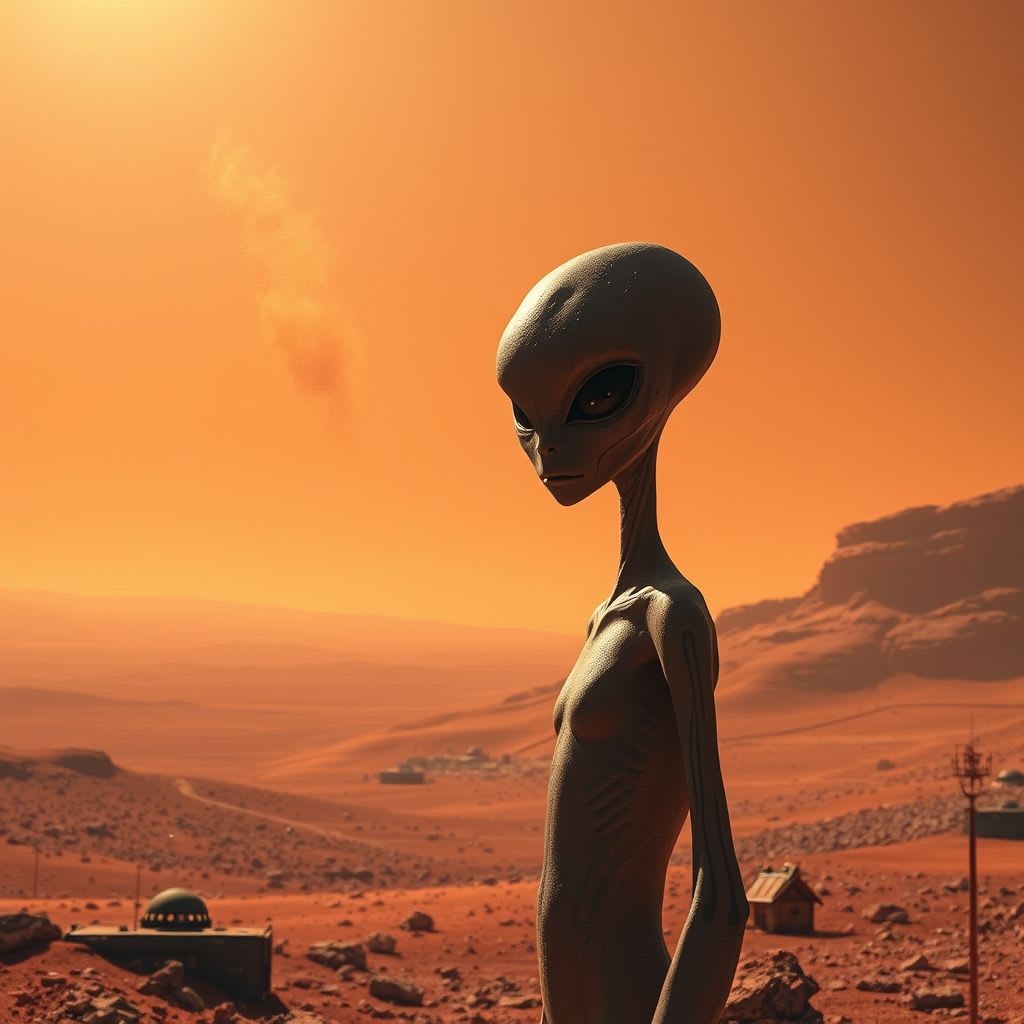
When we think of Mars, we usually picture a harsh, dusty landscape under a crimson sky, with frozen wastelands stretching endlessly. But what if it were different? What if life had actually begun not on Earth, but on the Red Planet? How would humans have evolved there, and how different would Martian civilization be from our own?
A Harsh Cradle of Life
Mars isn’t just a cold, barren desert. Billions of years ago, the planet may have been far more hospitable with rivers, lakes, and perhaps even oceans. Scientists are discovering increasing evidence that Mars once had a thick atmosphere and a magnetic field two essential ingredients for life as we know it to develop.
If evolution had taken root on Mars, it would have done so under vastly different conditions: gravity only about 38% that of Earth’s, a weak magnetic field, intense radiation, a thin atmosphere, and extreme temperature swings. These factors would have shaped a very different kind of human being.
What Would Martians Look Like?
1. Height and Build
With lower gravity, Martians would likely be taller and more slender than Earth humans. Their bones might be less dense, and muscles less bulky. Imagine graceful, almost ethereal beings, moving with ease over the rusty, rocky surface.
2. Eyes and Skin
Due to the high radiation levels and harsh sunlight filtering through the thin atmosphere, Martians may have evolved large, dark eyes equipped with extra membranes or pigments to protect their retinas. Their skin would be thicker, possibly rich in melanin or even reflective, like an insect’s shell to shield against UV rays.
3. Breathing and Lungs
Mars’ atmosphere contains very little oxygen, so Martians might have far more efficient lungs, additional respiratory structures, or even the ability to harness alternative energy sources perhaps similar to plants, capturing sunlight for energy production.
Culture and Technology
Life on Mars from the start would demand incredible ingenuity. The harsh environment would forge survival experts. Cities might be built underground or carved into rock, equipped with advanced life-support systems. Water would be the most precious resource, giving rise to philosophies centered on careful stewardship of nature. Martian civilization might lean heavily into bioengineering and symbiosis with their environment rather than attempting to conquer it.
Isolation and the difficulty of traveling across the planet could create tight-knit clans or communities developing unique, insular cultures. Their music might be deep and muffled, echoing off cave walls. Art could be minimalist and abstract, while written language might be visual or tactile perfect for a planet frequently shrouded in dust storms.
Could Martians Survive on Earth?
An intriguing question: if Martians landed on Earth, could they survive here? Most likely, Earth’s gravity would feel overwhelming, the dense, humid atmosphere stifling, and oxygen levels potentially toxic. They would have to adapt, just as we dream of adapting to Mars.
Echoes of the Red Planet
Some futurists and science fiction writers have speculated that humanity might actually be “seeds” sown on Earth from Mars after a catastrophe a kind of cosmic diaspora. In this light, the question “what if we evolved on Mars?” becomes less fantasy and more historical possibility.
Perhaps a part of us already carries that Martian legacy in our yearning for the stars, in our urge to leave our cradle planet behind and step out into the universe.
Final Thought
Imagining Martian evolution is not only a fascinating scientific exercise but also a profound reminder of how environment shapes life itself. If Mars had been our home, we’d be different not just in appearance, but in spirit. Yet maybe, through all the differences, the same dreams would drive us: to explore, to survive, and to understand the cosmos.
About the Creator
Keep reading
More stories from Holianyk Ihor and writers in Futurism and other communities.
What Would Happen If the Sun Collided With a Black Hole?
When we look up at the sky, the Sun feels like a permanent fixture a dependable beacon of warmth and light. But what if that certainty were shattered? Imagine a dramatic, yet scientifically plausible scenario: the Sun collides with a black hole. It sounds like pure science fiction, but astrophysicists take such possibilities seriously not because they’re likely, but because they reveal deep truths about the universe, gravity, and the ultimate fate of stars.
By Holianyk Ihor6 months ago in Futurism
About Binding Prometheus
I want to start actively advocating on behalf of my own work, and the most valuable part of my canon is, without a doubt, Binding Prometheus, the play I have been working on since 2019 and only finished in 2023 as part of my MA. The play itself is an amalgamation of a million different inspirations. On one end, it evokes the Ancient Greek myth-play, deriving its own title from the earliest extant work of Western drama we have, Aeschylus’s Prometheus Bound. On the other end, it borrows significantly from the sci-fi bulwarks from over the years, namely Mary Shelley’s Frankenstein and Karel Capek’s Rossum’s Universal Robots. The play could be an episode of Black Mirror, I fear. I don’t know. I’ve only ever seen one episode of Black Mirror.
By Steven Christopher McKnight15 days ago in Futurism
Home Furnishings Market in Saudi Arabia: Modern Interiors, Smart Living, Vision 2030 & Growth Outlook
According to IMARC Group's latest research publication, Saudi Arabia home furnishings market size reached USD 20.57 Billion in 2024. The market is projected to reach USD 43.79 Billion by 2033, exhibiting a growth rate (CAGR) of 8.76% during 2025-2033.
By Jeffrey Wilson7 days ago in Futurism



Comments
There are no comments for this story
Be the first to respond and start the conversation.