
What Would Happen If the Sun Collided With a Black Hole?
Space

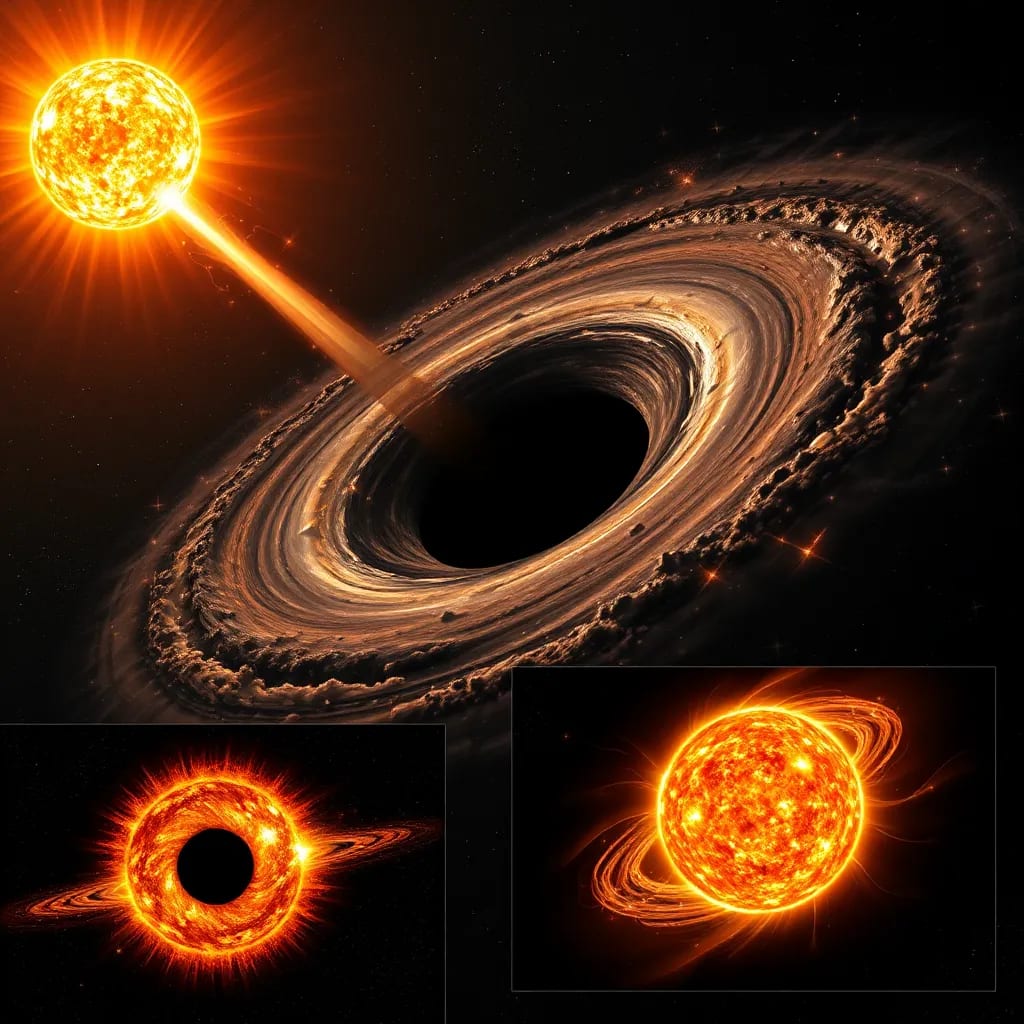
When we look up at the sky, the Sun feels like a permanent fixture a dependable beacon of warmth and light. But what if that certainty were shattered? Imagine a dramatic, yet scientifically plausible scenario: the Sun collides with a black hole. It sounds like pure science fiction, but astrophysicists take such possibilities seriously not because they’re likely, but because they reveal deep truths about the universe, gravity, and the ultimate fate of stars.
The Ultimate Cosmic Duel
A black hole is one of the most extreme objects in the universe. It's a region of space with gravity so intense that not even light can escape it. Black holes come in many sizes: some may weigh as much as a car, while others like those found in galactic centers can outweigh our Sun by millions or even billions of times.
Now picture one of these gravitational monsters approaching our Sun. The outcome of their encounter depends heavily on the black hole’s mass and speed.
Scenario One: A Black Hole the Size of the Sun
Let’s assume the black hole is roughly the same mass as our Sun. In this case, we wouldn't see a sudden explosion or quick obliteration. Instead, we’d witness a slow, horrifying cosmic dance.
The Sun would begin to stretch and distort due to the black hole’s powerful tidal forces. As the two objects spiral closer, the black hole would start pulling off the Sun’s outer layers like a silent, invisible funnel sucking in glowing plasma. This process is known as tidal disruption.
The results would be both terrifying and spectacular. Streams of hot gas would spiral around the black hole, forming a glowing accretion disk. Immense amounts of X-ray radiation would blast outward. From Earth, we might observe a burst of intense light the dying scream of our star. Within hours or days, the Sun would be gone, reduced to a swirling halo of its former self, orbiting the invisible predator.
Scenario Two: A Supermassive Black Hole
Now consider something even more terrifying: the Sun meets a supermassive black hole the kind lurking in the hearts of galaxies, weighing millions of solar masses. This wouldn’t be a fight. It would be an instant annihilation.
The Sun would cross the event horizon (the point of no return) without much resistance. There would be no grand fireworks, no dramatic light show perhaps just a faint ripple of X-rays, a cosmic burp, and then silence. The black hole wouldn’t even notice it had devoured an entire star.
What About Earth?
If the Sun disappears whether torn apart or swallowed whole Earth’s fate would be sealed. Eight minutes after the event (that’s how long it takes sunlight to reach us), our skies would go completely dark. Temperatures would plummet rapidly. Within weeks, oceans would begin to freeze over. Life as we know it would vanish in the cold and darkness.
And if the black hole continues moving toward the inner solar system, things could get even worse. Its gravity could disrupt planetary orbits, hurling worlds like Earth into interstellar space. Our planet might become a frozen wanderer or get pulled in and consumed like the Sun before it.
Any Chance of Survival?
In the short term none. Humanity wouldn't stand a chance against such a cosmic disaster. But if this event occurred billions of years from now, there’s hope. By then, we might be a spacefaring species, scattered across many star systems. Perhaps we’d have the technology to detect and even avoid such threats. In that sense, this terrifying idea also serves as a call to action to explore, to expand, and to never stop learning.
Fiction or Real Possibility?
Thankfully, the odds of a black hole colliding with our Sun are incredibly slim. Space is unimaginably vast, and black holes while fascinating are few and far between. But that doesn’t stop scientists from modeling these scenarios. Doing so helps them test theories of physics, better understand stellar behavior, and simulate the most extreme events the universe can throw at us.
Final Thoughts
A collision between the Sun and a black hole would be a cosmic spectacle a drama played out on a scale far beyond human comprehension. It would be the end of our solar system, but also a key to unlocking the universe’s most mysterious forces. In studying such impossible events, we gain insight into black holes, the life cycles of stars, and perhaps even our own future as a species.
So next time you look at the Sun, remember: even the most stable star isn’t truly immortal. And out there in the dark, the universe plays by its own rules.
About the Creator
Keep reading
More stories from Holianyk Ihor and writers in Futurism and other communities.
The Galaxy Maze: Can Space Really Twist Like in Fairy Tales?
When we read fairy tales about magical realms, we're often transported to worlds where a single turn around a corner leads to another dimension or an enchanted forest. These ideas seem like pure fantasy but what if the universe actually behaves in similar ways? What if our galaxy isn’t just a sprawling spiral of stars, but a massive cosmic maze full of hidden paths, warped shortcuts, and unexpected turns?
By Holianyk Ihor6 months ago in Futurism
About Binding Prometheus
I want to start actively advocating on behalf of my own work, and the most valuable part of my canon is, without a doubt, Binding Prometheus, the play I have been working on since 2019 and only finished in 2023 as part of my MA. The play itself is an amalgamation of a million different inspirations. On one end, it evokes the Ancient Greek myth-play, deriving its own title from the earliest extant work of Western drama we have, Aeschylus’s Prometheus Bound. On the other end, it borrows significantly from the sci-fi bulwarks from over the years, namely Mary Shelley’s Frankenstein and Karel Capek’s Rossum’s Universal Robots. The play could be an episode of Black Mirror, I fear. I don’t know. I’ve only ever seen one episode of Black Mirror.
By Steven Christopher McKnight15 days ago in Futurism
High Purity Alumina Market: Clean Energy Adoption & Material Innovation Trends
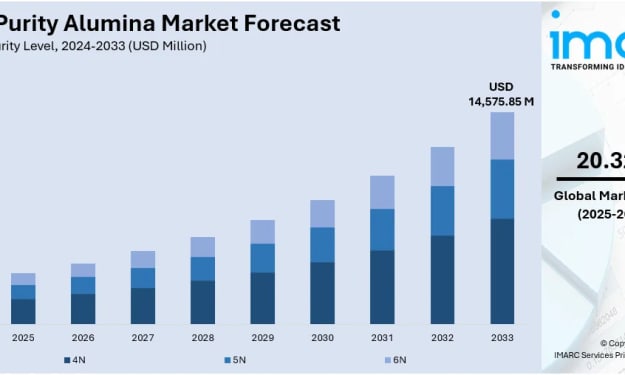
According to IMARC Group's latest research publication, global high purity alumina market size reached USD 2,547.04 Million in 2024. Looking forward, IMARC Group expects the market to reach USD 14,575.85 Million by 2033, exhibiting a growth rate (CAGR) of 20.32% during 2025-2033.
By Andrew Sullivan3 days ago in Futurism



Comments
There are no comments for this story
Be the first to respond and start the conversation.