
What If 2035 Isn’t What We Expect? A Glimpse Into the Shocking Future That’s Already Arriving
Explore how AI love, virtual parenting, smart cities, and life extension are quietly shaping our future. 2035 might shock you more than you think.


Introduction: The Future Is Already Knocking
Close your eyes and imagine it's 2035.
The air is different. Cars no longer drive — they fly. Your best friend is an AI chatbot who knows more about you than your family. Doctors are robots, professors are holograms, and your home can talk to you. Science fiction, right?
This is the horrific truth: it isn't.
Seeds are planted for that strange new world in 2025. Few have any idea, but things all around them are trending toward something that will surprise us, inspire-us, or even terrify the hell out of us.
So what is coming next, then? And how will it make everything about how we live, work, love, and learn different?
Let’s take a deep dive into the most unbelievable trends that are shaping our future — many of which are already starting today.
1. Falling in Love with AI — Not Just a Movie Plot Anymore
Movies like Her showed us a lonely man falling in love with a digital assistant. It felt like fantasy.
Now it’s real life.
Millions use Replika, Anima, and Kindroid apps for emotional support, companionship, or even romantic relationship. These friends AI remember your pasts, reply sympathetically, and even pretend to love.
In Japan, a man even "married" his AI hologram.
Experts see this trend continuing. With loneliness and digital obsession on the rise, more individuals will turn to AI for emotional needs. By 2035, AI companions may be socially mainstream — and even the norm.
But then comes a chilling question: Will generations to come abandon old-fashioned human contact and turn to digital romance instead?
2. The Death of the 9-to-5 Job
For over a century, we’ve lived by the clock. Wake up, go to work, sit at a desk for 8 hours, go home, repeat.
That era is dying.
Countries like Iceland and Japan are already testing 4-day workweeks with amazing results: less stress, better productivity, and happier lives. Companies like Microsoft have adopted it too — and saw a 40% increase in employee performance.
By 2035, the majority of knowledge workers will only have to work 3-4 days a week, thanks to automation and AI technologies.
But wait, there's more: with more and more work automated by robots, some fear that jobs will be lost in bulk. If machines are more efficient, do businesses still need humans?
The future might not be about working less, but about working differently.
3. Virtual Parenting and Digital Babies
Having children is one of life's greatest decisions. But in 2025, it's also one of its costliest.
But today, a shocking alternative is emerging: virtual parenting.
A Tokyo company launched "AI Babies" — virtual children that grow, learn, and respond emotionally. They live in apps and can be played with in AR or VR. Singles and couples are signing up to raise such virtual children as training — or even a long-term substitute.
Why?
Cost. Freedom. Climate concern. Lifestyle.
Others believe that this trend could lead to a world where more people have virtual families than real ones. That sounds bleak, but to many, it's a safer, easier, and more convenient world.
But the psychological cost is uncertain. Can a virtual child really replace the joy (and chaos) of a real child?
4. Smart Cities That Watch You 24/7
Imagine living in a city that thinks, decides, and reacts in real-time.
No traffic lights. No trash collectors. No pollution. No squandered energy.
Greetings to the smart city revolution, already in full swing in cities like Dubai, Singapore, and Seoul. These cities use AI and sensors to manage everything — traffic and electricity, crime and trash collection.
Wonderful, right?
But at a cost. To run perfectly, these cities must observe you… all the time. Your face, your every step, your preferences and dislikes — all tracked and stored.
It's called "smart living" by proponents. It's digital surveillance by opponents. As more and more smart cities emerge, the question arises: Are we trading off privacy for convenience?
5. Learning Without Teachers or Classrooms
Bye-bye, heavy backpacks and lectured-out.
In 2025, more than 200 million students are studying online — but that's only the beginning. Khang Academy, Duolingo, and OpenAI's Sora are creating AI tutors that tailor how you learn.
By 2035, school might be entirely virtual for the majority. Kids will learn at home with VR goggles, holographic teachers, and interactive AI lessons. No stringent curriculums anymore — all tailored to the child's pace, interest, and learning ability.
Sounds great for academic success — but there's a problem.
What then of collaboration? Friendship? Self-motivation? Creativity?
Learning is more than knowledge. Will kids in 2035 be intelligent… but socially lost?
6. Saving the Planet with "Sunshades" and Sky Sprays
The climate emergency is accelerating — faster than expected.
To fight it, scientists are now contemplating extreme, almost science-fiction solutions called geoengineering. Some of them include:
Sending satellites to shade the sun
Spraying particles into the air to cool the planet
Creating artificial clouds to bounce back heat
These ideas are already being developed in the lab, and small-scale experiments can start within the next decade. If they work, we can cool the planet and buy ourselves some extra time.
But meddling with the Earth's climate is a dangerous game. A small mistake could let disaster loose.
Is this the best humanity has to offer — or its worst gamble?
7. Living Forever (But Only If You're Rich)
What if you could turn back the clock… or even put the clock on slow?
Unbelievably, billionaires like Jeff Bezos, Sam Altman, and tech companies What if you could turn back the clock… or even put the clock on slow? like Google are paying for life-extension labs to create just that. Their goal? Crack open the biology of aging and extend life by decades.
Some sources have already fruited in mice and even humans. Blood transfusions, gene therapy, and cellular reprogramming are among the tools.
By 2040, the first "super-aging" humans could be alive — living beyond 120 with sharp minds and healthy bodies.
But these treatments won't be inexpensive. Critics warn that we're heading toward a future where only the rich live longer, and the rest of us are left behind.
Final Thoughts: Are We Ready for the Future We're Creating?
Everything you just read is real. Not fantasy. Not prophecy. But the direction we're already headed.
The future is being built around us — in the lab, in applications, in policy, and in minds.
It has some of it sounding exciting: more freedom, smarter cities, healthier, longer life.
Some of it raises hard questions: Will we lose our humanity? Will we still connect, care, and create — or turn into specters in a virtual existence?
Choices we make in 2025 will shape what life is like in 2035.
So ask me this:
Are we prepared for the future? Or are we all just blundering our way in and hoping it all works out okay?
About the Creator
Finallen
Passionate about sharing the latest news and real-world stories. I publish high-quality, fact-checked content to keep readers informed and engaged. Follow for timely updates, insights, and trusted coverage on current events.
About Binding Prometheus
I want to start actively advocating on behalf of my own work, and the most valuable part of my canon is, without a doubt, Binding Prometheus, the play I have been working on since 2019 and only finished in 2023 as part of my MA. The play itself is an amalgamation of a million different inspirations. On one end, it evokes the Ancient Greek myth-play, deriving its own title from the earliest extant work of Western drama we have, Aeschylus’s Prometheus Bound. On the other end, it borrows significantly from the sci-fi bulwarks from over the years, namely Mary Shelley’s Frankenstein and Karel Capek’s Rossum’s Universal Robots. The play could be an episode of Black Mirror, I fear. I don’t know. I’ve only ever seen one episode of Black Mirror.
By Steven Christopher McKnight18 days ago in Futurism
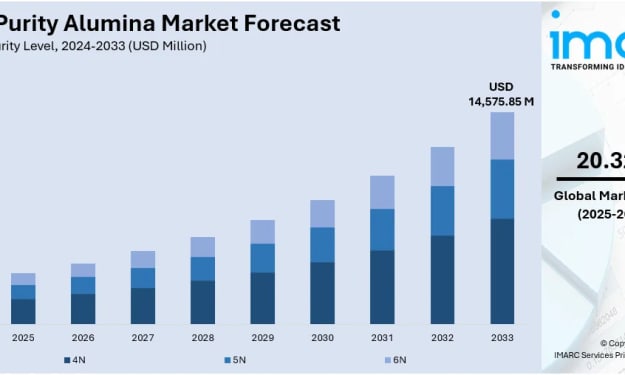
High Purity Alumina Market: Clean Energy Adoption & Material Innovation Trends
According to IMARC Group's latest research publication, global high purity alumina market size reached USD 2,547.04 Million in 2024. Looking forward, IMARC Group expects the market to reach USD 14,575.85 Million by 2033, exhibiting a growth rate (CAGR) of 20.32% during 2025-2033.
By Andrew Sullivan6 days ago in Futurism



Comments
There are no comments for this story
Be the first to respond and start the conversation.