
What Happens Inside a Meteor During Its Fall to Earth?
Space

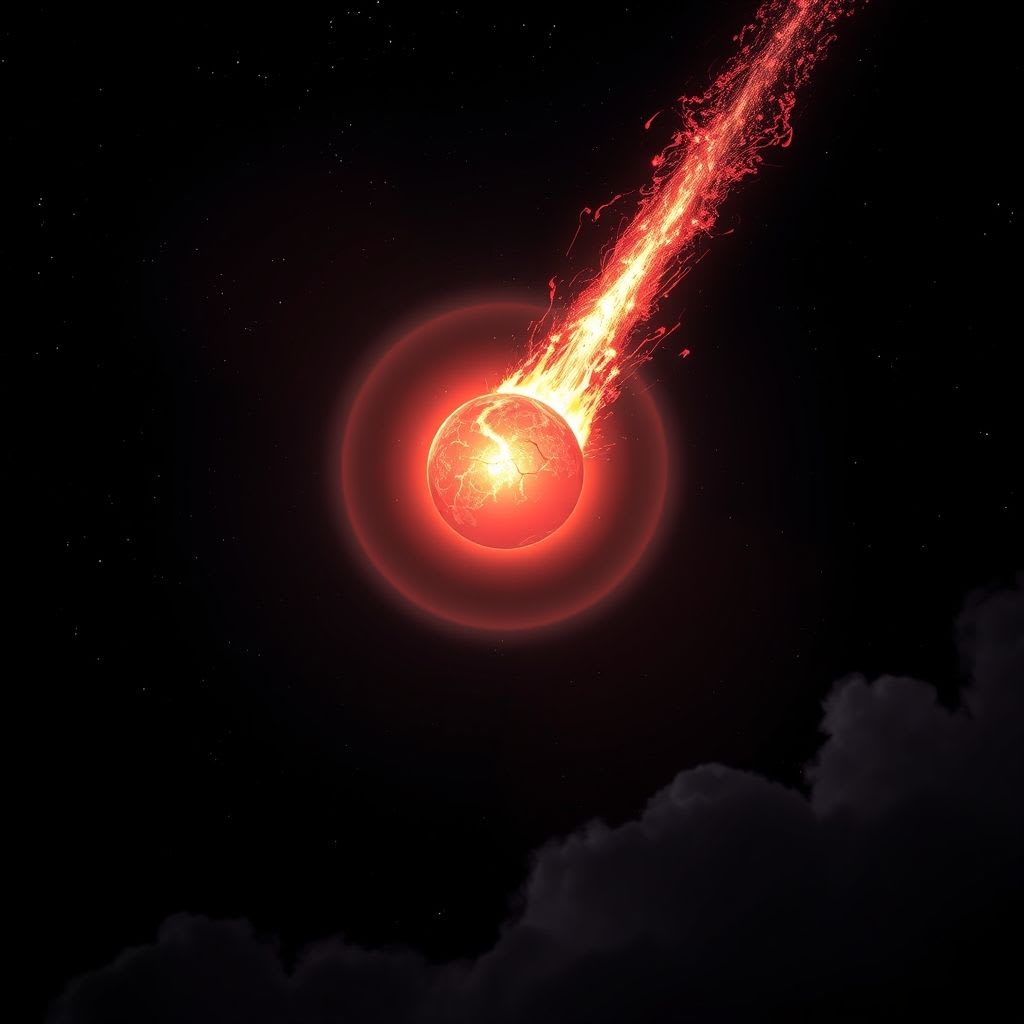
Every time we see a bright streak across the night sky a meteor blazing through the atmosphere we’re witnessing a truly cosmic event. But have you ever wondered what’s happening inside that fiery object during those dramatic seconds of descent? A meteor is not just a rock falling from the sky. It’s undergoing a violent transformation, both physically and chemically. Let’s take a journey into its core and uncover the incredible events unfolding within.
1. Entering the Atmosphere at Hypersonic Speed
Meteors enter Earth’s atmosphere at incredible speeds anywhere from 11 to 72 kilometers per second (25,000 to 160,000 mph). That’s dozens of times faster than a bullet. At such velocity, the resistance from the air becomes overwhelming. The outer layers of the meteor slam into atmospheric molecules, rapidly heating up to temperatures of 2,000–3,000°C (3,600–5,400°F) or higher.
Contrary to popular belief, this heating isn’t caused by friction alone. It mainly results from the compression of air in front of the meteor. As the meteor plows through the atmosphere, the air in front of it is compressed so violently that it forms a glowing plasma, which surrounds the rock and begins to strip it apart.
2. Thermal Explosion and Surface Ablation
As the exterior of the meteor superheats, it begins to ablate - that is, the outer material vaporizes and burns off, forming a glowing trail of ionized gas. That’s the famous “shooting star” we see in the sky.
Inside the meteor, however, things get even more fascinating. Despite the intense heat outside, the interior remains relatively cool — at least initially. Most meteors are composed of rock, which is a poor conductor of heat. As a result, the heat from the surface penetrates only a few millimeters to centimeters inward.
This means the meteor is experiencing a fierce contrast between its fiery exterior and its cold, untouched core.
3. Internal Stress and Micro-Explosions
Here’s where the real drama begins.
As the surface heats and expands while the core stays cold and rigid, thermal stress builds up. This creates a dangerous imbalance, causing cracks, micro-fractures, and even miniature explosions inside the rock.
Imagine pouring boiling water on ice it cracks violently. A similar effect happens in reverse inside the meteor: the outer layer is swelling from heat, while the core resists. If the meteor contains porous materials or frozen gases (like those found in carbon-rich meteorites), these substances rapidly expand or turn to vapor under the heat, leading to pressure buildup and internal ruptures.
Sometimes, this can cause the meteor to break apart mid-flight, resulting in a meteor shower or a group of fragments raining down instead of a single object.
4. Chemical Changes in the Core
Inside the meteor, chemical reactions may begin to occur. Intense heat can melt certain minerals, vaporize volatile compounds, or cause them to react with traces of oxygen that sneak in through internal cracks.
This process sometimes forms glassy droplets called chondrules, which scientists often find inside meteorites that reach the ground. These tiny beads provide important clues about the early Solar System and the conditions under which the meteorite formed.
5. The Final Impact
If a meteor survives the journey through the atmosphere and doesn’t completely disintegrate, it eventually reaches the Earth’s surface. By the time it lands, its fiery trail has faded usually at an altitude of 10 to 30 kilometers and it continues downward like a fast-moving rock.
Interestingly, it may no longer be glowing or even hot by the time it hits the ground. However, internally, it may still harbor hidden stresses and fractures, which can cause it to break apart after impact.
Why Does It Matter?
Understanding what happens inside a meteor during its fall helps scientists unlock the history of the Solar System. Many meteorites are incredibly ancient some date back more than 4.5 billion years, even older than Earth itself.
Their internal structures serve as cosmic archives, preserving evidence of their formation and journey through space. Even microcracks and heat damage provide valuable data about the conditions they endured before crashing into our world.
Conclusion
A meteor falling to Earth isn’t just a pretty light in the sky. It’s a miniature cataclysm, full of extreme physics and chemistry. Inside that glowing rock, unseen by the naked eye, are violent reactions, internal explosions, and transformations that have taken billions of years to set in motion.
So, the next time you spot a shooting star, remember: within that brief moment of light, an entire universe of action is playing out, deep inside a rock that once drifted silently through the cosmos.
About the Creator
Keep reading
More stories from Holianyk Ihor and writers in Futurism and other communities.
When the Moon Was Closer: What the Sky Looked Like Millions of Years Ago
Imagine looking up at the night sky hundreds of millions of years ago. The stars were still there, the Milky Way still stretched like a luminous river across the heavens but the Moon? It was a very different sight. Back then, it loomed much larger and brighter in the sky, dominating the night with an intensity we can barely imagine today. Its gravitational pull stirred the seas with incredible force, shaping coastlines and perhaps even influencing the origins of life itself. But how close was the Moon, and what did the world look like beneath its powerful glow?
By Holianyk Ihor6 months ago in Futurism
About Binding Prometheus
I want to start actively advocating on behalf of my own work, and the most valuable part of my canon is, without a doubt, Binding Prometheus, the play I have been working on since 2019 and only finished in 2023 as part of my MA. The play itself is an amalgamation of a million different inspirations. On one end, it evokes the Ancient Greek myth-play, deriving its own title from the earliest extant work of Western drama we have, Aeschylus’s Prometheus Bound. On the other end, it borrows significantly from the sci-fi bulwarks from over the years, namely Mary Shelley’s Frankenstein and Karel Capek’s Rossum’s Universal Robots. The play could be an episode of Black Mirror, I fear. I don’t know. I’ve only ever seen one episode of Black Mirror.
By Steven Christopher McKnight14 days ago in Futurism
Flexible Packaging Market Size and Forecast 2024–2033
Introduction The global packaging industry is undergoing a fundamental transformation as businesses, regulators, and consumers demand lighter, more sustainable, and more functional solutions. At the heart of this transformation lies flexible packaging—a category that has moved far beyond its early reputation for basic plastic wraps and bags. Today, flexible packaging is synonymous with innovation, sustainability, branding potential, and operational efficiency across industries.
By Aaina Oberoiabout 18 hours ago in Futurism



Comments
There are no comments for this story
Be the first to respond and start the conversation.