


Continued from Part 1.
It’s easy to smirk at my friend’s final comment, especially if you consider yourself a futurist. But it represents a common phenomenon, even amongst very clever people. And after all, why on earth should we spend any time thinking about what we want the world to look like in a hundred years? It would seem to make sense to focus on our current problems, and only worry about the next five to ten years or so.
I think this exclusive focus on the near future converges with the exclusive focus on minor reforms in political economy. They are failures not only of Scope but of Aim.
The Scope part is obvious. As longtermists like to remind us, the future has the potential to be vast and full of people. This means that the things we do now could potentially have huge effects on how the world turns out for this vast majority of people who have yet to be born. I don’t intend to go into the arguments around longtermism here except to say that it’s hard to argue that we shouldn’t care about the future at all. We might make pragmatic arguments about the difficulty of knowing how our actions will affect the long-term future, but it at least seems that we should care about it somewhat, in the same way that we would think it wrong for Ancient Egyptians to have said “the twenty-first century? Who cares about that?” and convinced the sun god Ra to send an asteroid towards Earth that would only hit us in 2021.
But I think the Failure of Aim is also egregious, and harder to convince people of. Consider a human life. Say you know you’re going to live for ninety years if you don’t do anything too reckless like smoking or sitting down for more than eight hours each day. Now imagine you’ve just turned twenty one. You’re in your physical prime, you’re mentally sharp, and you have an array of skills and resources at your disposal; maybe you’ve gotten a good education, saved up a little money, and you have access to the internet for crying out loud. There are hard limits to what you accomplish, but like your parents like to say there is a very real sense in which ‘the world is your oyster’. Now, with all of this under your belt, you’re about to step forward into adult life.
At this moment in your life, it might be smart to stop and consider where you actually want to end up. Sure eventually you will get very old and die. But what do you want your life to be like in that intervening time? In these considerations of personal ideals you might think of things like what you want your relationships to be like, whether you want children, what an ideal vocation might be for you, where you’d like to live, how you’re going to take care of your health, and even simply what kind of person you want to be in the world.
Of course there are always epistemic problems of one sort or another. Maybe you think you want to be an engineer but after working as one for a while you realise that architecture would be a better fit for your skills and interests. Maybe you don’t want kids now but you will once you’re in your thirties. And yes, this is a real consideration - there’s only so much you can know from your starting position. You may find yourself adjusting your aim a little as you go through life, acquiring more insight into yourself and the world, and as you naturally change. But the fundamental utility of considering what you want still remains. After all, we all know people who are ostensibly seeking nothing from life. They (at least the ones who aren’t buddhas) seem to consistently end up with unenviable lives. This is because when you don’t aim at something, you’re inviting life to simply happen to you - and in the complexity of the world, there seem to be far more undesirable states than desirable ones. But deeper than that, humans are always aiming. That guy who lives with his parents at thirty five and who buries his deeply restless melancholy beneath Doritos and porn isn’t aimless. He’s just allowing himself to act on unreflective aims. In the absence of considered goals, our brain knows what to aim for: things like basic security and sensory pleasure.
This is why considering what we want our life to be like is valuable. Because otherwise, the natural forces of the world and our own unconsidered behaviour could conspire to create a less than ideal life for us. And as a twenty one year old, we shouldn’t just be thinking on a granular level “maybe I should replace some of the snacks in my apartment with nuts and celery going forward”. We also need to be thinking about the bigger picture, the fundamentals of our life - “why do I care about my health in the first place?”, “should I be a vegetarian?”, and even “in ten years, would I like to be a celibate monk in Thailand, or a New York architect about to start a family?”
I’m sure my heavy-handed analogy is pretty obvious. The twenty-one year old is us, as societies, nation-states, or even as a global civilisation. We find ourselves with a pretty decent amount of knowledge and technology, and a bunch of systems and institutions (the equivalent to the twenty-one year olds possessions, habits, and capabilities). And we know that we could be around for quite a while - you could think of the young person’s eventual death as representing the heat death of the universe, or some other inevitable end-point for humanity. And that’s where Aim comes in. What do we really want out of society? Out of our politics, economies, and institutions? What would the best possible world look like, or at least a really good one? This is where I think we’re falling short. We’re good at talking about interest rates and tax loopholes. And yes, these things have important effects on the world that we should be talking about. But on the margin, couldn’t we be talking a bit more about a grander vision? About the motivations for even bothering with any of this in the first place?
I think a lot of the reason people don’t ask these questions is an impoverished sense of the possible. I was born in 1996 and have spent my whole life in perhaps one of the most stable places in history. Say what you will about the Russian Revolution, but they were really pushing the boundaries of how the world could be shaped. The entire early twentieth century was marked by a shaky sense that things could really change in a bunch of really drastic ways. And yeah, we can kind of conceive of a post-scarcity communist utopia or whatever wild future we’re presented with, but these very different states of affairs tend, for most of us, to feel abstract and insubstantial. The problem is that technology marches ever onwards. And out of this terrible unfolding could come wonderful futures, nightmares, or anything in between. We can keep counting grains of sand or we can look up and see the great tide swelling towards us.
There is a real intellectual excitement behind this urge to drill down on first principles. But it’s not merely hypothetical. The founders of many nations and international institutions have troubled over these questions. And yet, it seems really difficult to find this kind of discussion in the popular discourse. I’m not saying all of our time should be spent discussing big-picture goals for society, but I suspect the optimum lies above zero.
What do we want?
What is possible?
How would we get from where we are to that intersection between what we want and what is possible?
To be continued in Part 3.
About the Creator
Keep reading
More stories from Conor McCammon and writers in Futurism and other communities.
Carnivorous Vegans
Today, vegans are a small but dedicated group who, despite market pressure, make morally driven consumption decisions. That is, they allow a moral principle to guide their purchases and consumption over personal utility. Of course, some vegans just hate the taste of meat or are vegans for health reasons. But the vegans that I’m talking about specifically are Moral Vegans. Be it about rights, welfare, or the environment, Moral Vegans are stubbornly principled in the face of social conventions and economic influences. They often pay more for vegan alternatives, and are relatively marginalised in the marketplace (although a fairly robust niche for vegan alternatives has definitely emerged in the last few years). They remain stoic: they're in the right, and everyone else is making a terrible consumptive mistake.
By Conor McCammon5 years ago in Futurism
Australia Robotics Market: Industrial Automation, AI Integration & Application Expansion
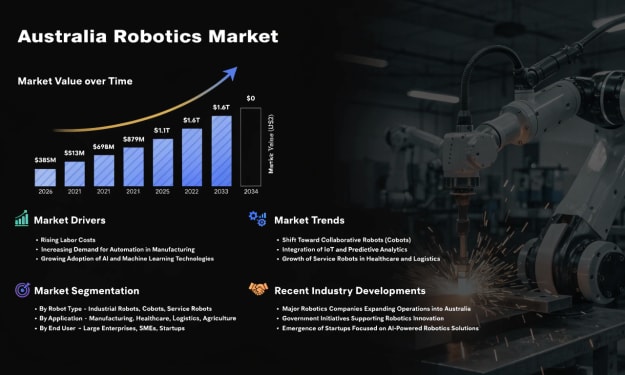
According to IMARC Group, the Australia robotics market reached USD 1.5 Billion in 2024 and is projected to expand to USD 6.7 Billion by 2033, exhibiting a robust compound annual growth rate (CAGR) of 16.20% during 2025–2033. This remarkable growth underscores Australia’s accelerating transition toward automation and intelligent systems across Australia. Robotics—spanning industrial arms, autonomous vehicles, service robots and AI-enabled collaborative systems—has evolved from niche industrial tools into critical infrastructure for manufacturing, mining, healthcare, agriculture and logistics. As businesses prioritize efficiency, productivity and safety, robotics adoption is becoming central to Australia’s digital and industrial transformation strategy.
By Shrestha Roy6 days ago in Futurism
Australia Mining Equipment Market: Automation Adoption, Safety Focus & Sustainable Technologies
According to IMARC Group, the Australia mining equipment market reached USD 1.5 Billion in 2025 and is projected to expand to USD 2.3 Billion by 2034, exhibiting a compound annual growth rate (CAGR) of 5.15% during 2026–2034. This growth reflects the strategic modernization of mining operations across Australia, one of the world’s leading producers of iron ore, coal, lithium and gold. As global demand for critical minerals rises—particularly for renewable energy and electric vehicle supply chains—Australia’s mining sector is investing heavily in advanced equipment that enhances efficiency, safety and environmental performance.
By Kevin Cooper6 days ago in Futurism



Comments
There are no comments for this story
Be the first to respond and start the conversation.