
Australia Robotics Market: Industrial Automation, AI Integration & Application Expansion
How increasing industrial automation, growing integration of artificial intelligence and expanding application areas are shaping Australia’s robotics market
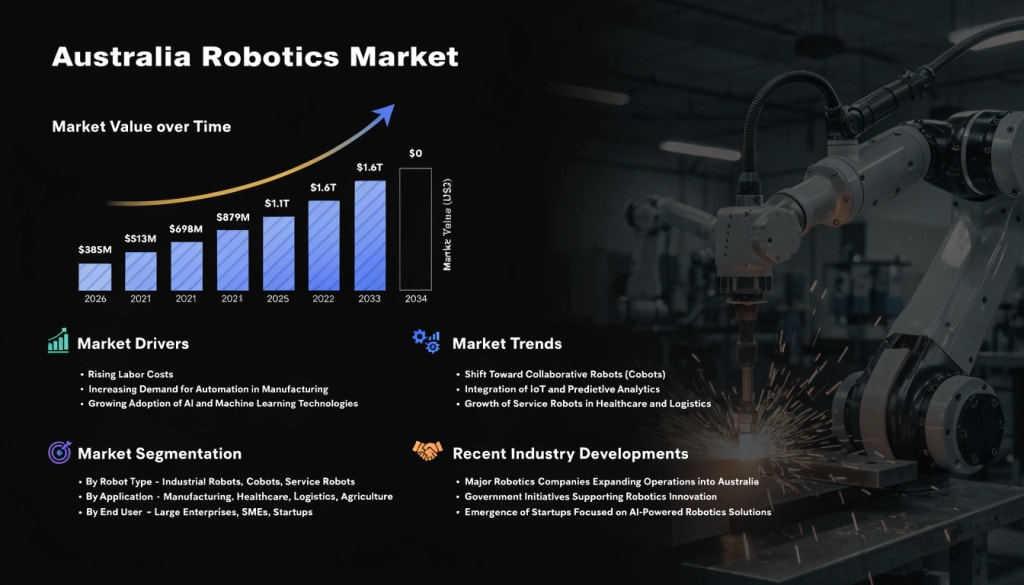
According to IMARC Group, the Australia robotics market reached USD 1.5 Billion in 2024 and is projected to expand to USD 6.7 Billion by 2033, exhibiting a robust compound annual growth rate (CAGR) of 16.20% during 2025–2033. This remarkable growth underscores Australia’s accelerating transition toward automation and intelligent systems across Australia. Robotics—spanning industrial arms, autonomous vehicles, service robots and AI-enabled collaborative systems—has evolved from niche industrial tools into critical infrastructure for manufacturing, mining, healthcare, agriculture and logistics. As businesses prioritize efficiency, productivity and safety, robotics adoption is becoming central to Australia’s digital and industrial transformation strategy.
Why Should Smart Buyers and Investors Know About the Australia Robotics Market?
High-Growth Trajectory
With a projected CAGR of 16.20%, robotics represents one of Australia’s fastest-expanding technology segments.
Multi-Sector Diversification
Robotics applications span mining, agriculture, healthcare, manufacturing and logistics, reducing sector-specific risk.
Strong Alignment With Digital Transformation
Robotics supports national Industry 4.0 initiatives and AI-driven innovation strategies.
Productivity and Safety Gains
Automation enhances operational efficiency while improving worker safety in hazardous environments.
Long-Term Competitive Advantage
Organizations adopting robotics early gain operational resilience and global competitiveness.
Recent Trends & Developments in the Australia Robotics Market
August 2024:
Mining operators expanded deployment of autonomous vehicles to improve safety and reduce operational costs.
March 2024:
Logistics companies integrated AI-powered robotic sorting systems in distribution centers.
November 2023:
Healthcare providers increased adoption of robotic-assisted surgical systems in major hospitals.
Australia’s robotics market is entering a transformative growth phase driven by industrial automation, AI integration and expanding application domains. Backed by IMARC’s strong growth projections, the sector reflects a broader national shift toward intelligent systems and digital industrial infrastructure. From autonomous mining equipment to precision agriculture and healthcare robotics, innovation continues to redefine productivity standards across industries. Government incentives, research collaborations and AI advancements further strengthen market momentum. As labor shortages persist and demand for operational efficiency intensifies, robotics adoption is no longer optional—it is strategic. For investors, technology developers and industrial stakeholders, Australia’s robotics market presents a forward-looking opportunity grounded in automation, artificial intelligence and long-term economic modernization.
Australia Robotics Market Vision 2050
1. Fully Autonomous Industrial Ecosystems
Factories may operate with integrated robotic networks connected via AI-driven control systems.
2. Human-Robot Collaboration (Cobots) Expansion
Collaborative robots could become standard across SMEs, supporting human workers rather than replacing them.
3. Robotics in Aged Care and Personal Assistance
Service robots may assist elderly populations with mobility and daily tasks.
4. AI-Driven Agricultural Ecosystems
Fully autonomous farms could leverage robotics for planting, irrigation and harvesting.
5. Sustainable and Energy-Efficient Robotics
Energy-efficient robotic systems may reduce industrial carbon footprints.
What Are the Key Growth Drivers in the Australia Robotics Market?
Rising Demand for Industrial Automation
Manufacturers across automotive, food processing, electronics and heavy industry are adopting robotics to improve precision, consistency and output quality. Automation reduces production downtime, enhances scalability and improves workplace safety. With increasing global competition, Australian industries are leveraging robotics to strengthen productivity and maintain cost competitiveness.
Addressing Labor Shortages
Persistent labor shortages across manufacturing, mining and agriculture are accelerating robotic deployment. Robots provide a scalable solution for repetitive or hazardous tasks, helping businesses mitigate workforce gaps while maintaining operational continuity.
Strong Adoption in Mining and Resources
Australia’s mining sector is among the most technologically advanced globally. Autonomous haul trucks, robotic drilling systems and remote-controlled machinery enhance efficiency and safety in remote mining operations. Robotics integration in mining continues to serve as a cornerstone of national industrial modernization.
Precision Agriculture and Agritech Growth
Agricultural robotics—including automated harvesting systems, drones and AI-driven crop monitoring solutions—are transforming farm productivity. Precision agriculture enhances yield optimization while reducing resource waste, aligning with sustainability goals.
E-Commerce and Logistics Automation
The rapid expansion of e-commerce has intensified demand for warehouse automation, robotic sorting systems and autonomous guided vehicles (AGVs). Distribution centers increasingly rely on robotics to improve fulfillment speed and reduce human error.
Healthcare Robotics Integration
Robotic-assisted surgeries, rehabilitation robots and automated hospital systems are enhancing clinical precision and patient outcomes. Healthcare providers are investing in robotic solutions to improve operational efficiency and address staffing challenges.
Government Incentives and R&D Collaboration
Public funding initiatives, innovation grants and academic partnerships support robotics research and commercialization. Universities and technology institutions collaborate with industry to accelerate AI-driven robotics development.
Artificial Intelligence-Enabled Smart Robotics
AI integration is transforming robotics capabilities. Machine learning algorithms allow robots to adapt, recognize patterns and perform complex decision-making tasks. Smart robotics enhances autonomy and reduces reliance on manual programming.
About the Creator
Keep reading
More stories from Shrestha Roy and writers in Futurism and other communities.
Australia Regenerative Medicine Market: Clinical Demand, Research Innovation & Therapeutic Advancements
According to IMARC Group, the Australia regenerative medicine market reached USD 636.5 Million in 2025 and is projected to surge to USD 2,875.4 Million by 2034, exhibiting a remarkable compound annual growth rate (CAGR) of 18.24% during 2026–2034. This rapid expansion highlights Australia’s growing prominence in advanced biomedical innovation across Australia. Regenerative medicine—encompassing stem cell therapy, tissue engineering, gene therapy and biologics—focuses on repairing, replacing or regenerating damaged cells and tissues. As chronic diseases and age-related conditions rise, demand for transformative therapeutic solutions is reshaping the country’s healthcare and life sciences landscape.
By Shrestha Royabout 3 hours ago in Futurism
Which AI Tools Are Actually Useful in 2026?
At the start of the AI boom, every new tool promised disruption. Slide decks featured bold claims about automation, prediction, and limitless productivity. Founders pitched platforms that would “replace” entire departments. Investors poured billions into startups racing to define the future.
By Samantha Blakea day ago in Futurism
Surimi Market: Asian Cuisine Popularity, Global Export Demand & Growth Outlook
According to IMARC Group’s latest research publication, the global surimi market size was valued at USD 6.7 Billion in 2025. Looking forward, IMARC Group estimates the market to reach USD 10.7 Billion by 2034, exhibiting a growth rate (CAGR) of 5.17% during 2026-2034.
By sujeet. imarcgroup5 days ago in Futurism




Comments
There are no comments for this story
Be the first to respond and start the conversation.