
Utopia, But Boys Will Be Boys
Humans have finally figured out which minority to forcibly remove from the census in order to achieve world peace. Now, Earth is applying for membership in the Milky Way's interstellar Trading Conference.



I’m not sure exactly when I started holding my breath. Dr Pradhan told us that because we were equally qualified to conduct Earth Sample Interviews, the team would have to be chosen by chance. The department had sixty-five interested graduate students, but only five were allowed down to the surface of the planet. Dr Pradhan assigned us numbers by the arbitrary rule of birth order, then rolled one six-sided die and one ten-sided die to determine the lucky interviewers.
After the second roll designated #39 Thurma Regulan to the team, I noticed the tension in my chest and the staleness on my tongue. I released the held breath slowly and tried to inhale as silently as I could. The room may have been alive with anticipation, but expressing it with an acute gasp when my colleagues had more dignity would have been too mortifying to bear.
I concentrated on breathing for a few moments. Of course, I thought too much about the concept of breathing, lost all ability to do it naturally, and resorted to timing my inhalations and exhalations with my watch.
My fourth colleague stood in front if the lecture hall with Dr Pradhan. I reminded myself that I would breathe normally if I just allowed it to happen, and focused instead on anything else. Our professor rolled the dice again.
“Sixty-seven, that’s a re-roll,” they said. They rolled a sixth time. “Twelve.”
We all applauded politely as #12 Rowald Hraft stood up, but instead of joining the team, they waved a hand.
“Yes, Mx Hraft?”
“Thank you so much for the opportunity, Dr Pradhan, but I must decline. I found out this morning that I am currently ineligible for exposure to Earth’s microorganisms.”
Our professor congratulated them on their expanding family. I joined in the chorus of graduate students cheering for Hraft and their mate. Whether or not I had the pleasure of joining the team, I could still delight in someone’s good news today. Smiling for Hraft dulled my personal anxiety as Dr Pradhan rolled one more time.
“Forty-two.”
In one of Earth's historical subcultures, the number forty-two had been associated with “Life, the Universe, and Everything.” The number seven had been considered “lucky.” Now, the seventh roll designated #42 to conduct an Earth Sample Interview.
I smiled politely as I stepped forward to join my team.
Three days (approximately five Earth-days) later, my shuttlepod landed me on the western coast of the island-continent called Australia. I realized very quickly that months of classroom study under a human professor did not, in fact, prepare me to be surrounded by humans. Each bipedal body walked with its own rhythm. Each person’s glands released a constant, pleasant scent, reminiscent of the flowers back home. Like Dr Pradhan, many of them augmented these smells with native flora, which reminded me of the scents of baked goods.
The ocean smelled almost the same as back home, though.
I started jotting down notes immediately. Other departments had already surveyed infrastructure, medical practices, etc.; but in the study of culture, nothing is truly irrelevant. I wrote every observation I could.
The city of Onslow definitely attempted, and may have successfully met, accessibility and safety requirements for 99% or greater of the native population. I noticed very few mobility aids in use, but every single building I passed had proper ramp or mag-lift accommodations. Pedestrian and non-motorized traffic had sensible pathways. Motorized traffic had been routed and sequestered appropriately.
I met my interviewee, Tavita Redfern, in an orchard of citrus trees. We exchanged pleasantries and assumed relaxed postures on benches on either side of a table designed for dining outdoors.
“I’d like to start with an explanation of the Earth-greeting, the ‘handshake,’” I said.
Tavita’s brow furrowed, but their smile remained. “Oh,” they said. “You did it so naturally, just now. Was that your first?”
Dr Pradhan had taught the whole class, and we had practiced amongst ourselves. However, global education standards are part of a planet’s cultural testing before it can be admitted. I told Tavita, “Please don’t feel obligated to gauge or improve my understanding. I’m not here to test the accuracy of Mx Tavita Redfern’s answers, or to make any decisions, for that matter. The Trading Conference just wants a better understanding of Earth culture, and there’s no better way to learn it than to ask Earth natives.”
Tavita’s posture and facial expression grew less rigid. “All right. Well, the handshake supposedly derived from a greeting where two men clasped each other's wrists to prove that they weren’t holding blades or concealing them for immediate use. We do it with our right hands, because most of us have asymmetrical dexterity and the majority are right-hand-dominant.
“While we’re on the subject of greetings and addresses,” Tavita continued, “I am Miss Tavita Redfern, but you can of course call me Tavita. Most humans identify with a binary gender, and for the majority of us, that identity is closely related to biological sex. I know your language doesn’t use gendered pronouns, but when speaking Earth Standard, please refer to me as ‘she’ and ‘her.’”
“Noted,” I said, writing every word. “I was prepared for this ‘binary.’ My professor, Dr Pradhan, is a ‘man.’”
“So you refer to him as ‘he’ and ‘him?’”
“I… this is my first time referring to him in Earth Standard. So, yes.”
This amused my interviewee.
I moved on to my next question. “I understand that humans achieved faster-than-light travel within three generations of global unity. In your understanding, how did First Contact with the Trading Conference impact people’s daily lives?”
“I don’t think the impact can be completely measured yet,” Tavita said, tilting their her head to one side. “But I did have a class project in elementary school where I had to interview an elder about the transition. My great-grandmother told me it was ‘like every other big change humans had to face.’ Our species loves its binaries, but can never really divide between them. Almost half the population embraces progress. Almost half the population fears change. A small fraction of us lives outside the two groups, for one reason or another. And the two main groups have their own subdivisions, which are likely to squabble amongst themselves.”
I remained silent. It was up to Tavita to continue on this topic or ask for a new one.
“I guess that’s a ‘big picture’ answer,” Tavita said. “Tibu said that in the days after sentient extrastellar life was confirmed, there was a lull in our usual divisiveness. She was thirteen years old at the time, so she and her peers were all in some stage of puberty. I’m no specialist in health or human development. I can’t explain the factors at play in detail, but I can confidently tell you that there is typically a decrease in empathy and increase in aggression.
“The social hierarchy Tibu knew had been based on fashion choices, taste in music, superficial attractiveness, athletic ability, and such shallow concerns. That is the adolescent human ‘normal.’
“But, in the time when Tibu and her peers were most likely to tease each other, test boundaries, and hurt feelings? Earth made First Contact with the Trading Conference. Suddenly, there was a brand new binary. There was a barely-comprehensible ‘them,’ meaning sapient people who weren’t human. And there was a unifying ‘us.’
“The kids stopped picking on each other. For a few weeks, they even spontaneously collaborated with more frequency. Tibu and her fellow rugby players helped the dance committee decorate for Homecoming. That sort of thing.
“Since then, I think we have more or less become accustomed to the concept of aliens,” Tavita concluded. “Teens are back to teasing each other about their hairstyles. But, look around. There are, what, a hundred humans enjoying the orchard this afternoon? During Tibu’s youth, a crowd would have formed around you, possibly motivated by fear. Today, your appearance sparks no more curiosity than a human with an unfamiliar accommodation or eccentric presentation.”
Our interview continued for a little over a half-tenth (approximately 1.25 Earth hours). From Tavita and my observations, I gathered adequate evidence of Earth’s cultural progression. As Dr Pradhan suspected, humans seemed ready to join the Trading Conference.
I told Tavita, “We only have one question remaining: what is humans’ ‘but?’”
She blinked.
I waited.
She laughed. “You aren’t asking about what I’m sitting on.”
“I thought this was called a ‘picnic table.’”
“This is, yes.” Tavita wiped moisture from her eyes and breathed in irregular, laughing gasps.
Anxiety clenched my gut. Had I misspoken? Would my mistake reflect poorly on me in front of the class? Would it make the class appear foolish to our colleagues?
“I’m so sorry,” Tavita said, calming herself down. “In Earth Standard, the conjunction ‘but’ has a homophone. Depending on context, it refers to the fleshy backside of a pelvis, or to the anus.”
I honked my amusement, too. Birds took fright at the unfamiliar sound, and several of the nearby humans looked my way in surprise.
“Is that your laughter?” Tavita asked with an expression of delight. “It sounds like a trumpet doing one of those complicated jazzy solos.”
“Yes, that’s laughter,” I admitted. “I’m asking about the conjunction. So far, the Trading Conference participants span one hundred and three solar systems. All of us, and approximately seven-eighths of the other civilizations we have encountered, have achieved a level of development colloquially referred to as ‘utopia, but.’
“Adequate, sustainable resources are available to ninety-six percent or more of the native population. The types of work people perform, and the amount of time they spend performing it, depends mostly on an individual's abilities and interests. Standards of shelter, healthcare, nutrition, education, and so on, apply across the vast majority of the planet’s native population. But there is always a ‘but.’
“My people genetically engineered our species to experience social pain as physical. We must take care of each other because when we see someone suffer, it literally hurts us. We must fit in with each other, because if we stand out in any embarrassing way, the resulting sting can incapacitate us for days.”
“That’s a big ‘but!’” Tavita’s face contorted with an emotion I didn’t yet know how to read. “Our genetic engineering removed some diseases, but we certainly haven’t added any features.”
“It doesn’t have to be genetic engineering,” I explained. “Many of the Trading Conference member planets sacrifice individual freedoms in order to achieve safety for the majority of their populations. Some can only induce collectivism medicinally, and are thus wholly dependent on a drug. One of our member planets devised a system where each city of millions of happy people is maintained by the torture of their resident scapegoat child.”
Tavita didn’t respond.
I continued my explanation. “There are more extreme examples in the universe. One planet outside of the Conference has developed a system of ethics around a parent’s duty to painfully murder and consume their own offspring. I’ve also heard rumors of a collective that forcibly assimilates every new species it encounters.”
“When you put it like that, the price of our happiness is quite the bargain,” Tavita said. “All humans have is the occasional Pruning.”
“Pruning?” I asked.
“Originally a gardening term,” Tavita said. “By cutting back a little bit of a branch and removing dead leaves, a gardener can coax a plant into more healthy growth.”
Dr Pradhan had never covered this topic in class.
“We Prune the adults who are incapable of empathy,” Tavita said. “Youths who engage in antisocial behaviors are monitored closely. They receive support to help them develop cognitive empathy and the ability to make healthy choices. The human brain typically finishes developing at about twenty-five years of age. So, when an adult of twenty-six or more years fails to engage in collectivistic behavior or exhibit empathy, the nearest firing squad executes him.”
The last word in Tavita’s explanation tugged at my attention. “Him,” I repeated.
“It isn’t exclusively men,” Tavita said. “But it’s mostly men.”
I consulted my notes from the beginning of my studies under Dr Pradhan. The human sex ratio at birth in the past two decades averaged 51.9% male, 46.4% female, 1.7% intersex; and the human sex ratio at what they called age 80 was 47.3% male, 51.8% female, 0.9% intersex. Gender identity ratio told a similar story: 47.1% men, 50.4% women, 2.5% not within the man/woman binary.
The official interview didn’t include questions on this matter. The moment one looked deeper into biological sex than “most males like this, most females like so,” one realized that biological sex comprised of numerous variables outside the standard Earth curriculum. There were infinite combinations of genetics and environmental factors during fetal development. Even specialists with advanced mathematical models of the human endocrine system couldn’t account for every naturally-occurring level of hormonal production and receptivity.
Human sex was like the stripes on my people’s necks—most have Black or Red, but some have both, some have neither, and the exact size and position are unique to every individual.
Still. Tavita implied that her species Prunes more men than women. I chewed the concept like mineral supplement cud.
“Is everything all right?” Tavita asked.
I felt the dull ache of embarrassment. I must have been lost in silent contemplation for a socially unacceptable length of time for her to ask. “Please excuse my inattention. I just can’t help but wonder at the biological and social factors that lead to Pruning.”
Tavita raised and lowered her shoulders. The gesture seemed to convey companionship in a state of insufficient data. “We have an ancient proverb: ‘Boys will be boys.’”
Four simple words gathered up all the complicated phenomena of human bodies and social structures into one concise truism. “Boys will be boys.” I made a note to review the sex and gender ratios of Pruned individuals. I added notes to question which antisocial behaviors flagged a person as lacking empathy, and how the decision to Prune someone was made, and who decided which people would serve on a firing squad…
I didn’t want to impose my silence on Tavita any further. I thanked her for the interview, assuring her that she provided a favorable impression of her species.
The Earth Sample Interview team gathered with Dr Pradhan for the evening meal. We discussed the Pruning’s effectivity in maintaining a sufficient utopia, and Earth’s viability as a member of the Trading Conference. Thurma brought up the phrase, “Boys will be boys.” The resulting conversation carried us through the meal, past the cud (Dr Pradhan sipped a stimulant drink called “coffee” while we chewed), and well into the night.
Overall, we submitted a unanimous recommendation to admit Earth into the Conference. As scholars, we’d all like to know more about the Pruning. However, the missing details would not disqualify the planet.
-------------------------------------------------------
About the Creator
Deanna Cassidy
(she/her) This establishment is open to wanderers, witches, harpies, heroes, merfolk, muses, barbarians, bards, gargoyles, gods, aces, and adventurers. TERFs go home.
Keep reading
More stories from Deanna Cassidy and writers in Futurism and other communities.
The Price of Admission
The sliding glass door had been painted with the word “Welcome,” but it didn’t open for me. My heart leapt to my throat with the sudden conviction that THF had rejected my application after all. Then I noticed the palm scanner to the right of the door, and the complementary hand washing station beside it. I washed my hands, scanned my right palm, and sighed audibly at the little green light over the scanner.
By Deanna Cassidy10 months ago in Futurism
Australia Construction Equipment Market: Infrastructure Growth, Urban Development & Technology Adoption
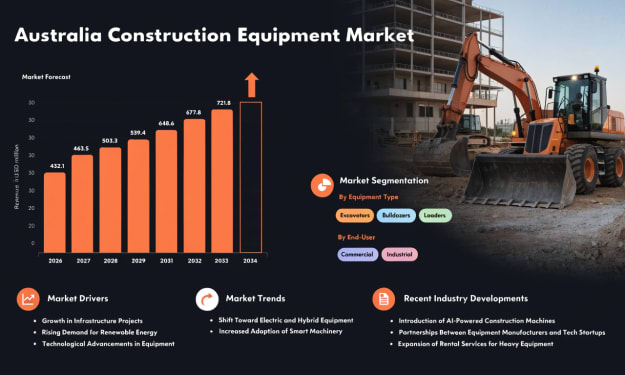
According to IMARC Group, the Australia construction equipment market reached USD 1.9 Billion in 2024 and is projected to expand to USD 2.4 Billion by 2033, exhibiting a compound annual growth rate (CAGR) of 2.50% during 2025–2033. This steady growth reflects sustained infrastructure expansion and urban development across Australia. Construction equipment—including excavators, loaders, cranes, bulldozers and road-building machinery—plays a critical role in delivering transportation networks, residential housing, commercial developments and mining operations. As Australia invests in modernization and sustainability, demand for advanced and eco-friendly equipment solutions continues to evolve.
By Kevin Cooper7 days ago in Futurism
Bioherbicides Market Outlook: Sustainable Weed Management and Agricultural Growth Opportunities
According to IMARC Group's latest research publication, The global bioherbicides market size reached USD 3.3 Billion in 2025. Looking forward, IMARC Group expects the market to reach USD 8.1 Billion by 2034, exhibiting a growth rate (CAGR) of 10.01% during 2026-2034.
By James Whitman7 days ago in Futurism



Comments (3)
Wooohooooo congratulations on your win! 🎉💖🎊🎉💖🎊
Wow. First, congratulations on the win in the Challenge! And this is a really excellently presented story. Compelling, creating a new intelligence and world without too much detail, but just enough.
I imagine how our lives may seem peculiar to aliens, Well written.