
United States E-Commerce Market Size and Forecast 2025–2033
United States E-Commerce Market Poised for Strong Digital Expansion Amid Shifting Consumer Behavior


United States E-Commerce Market Outlook
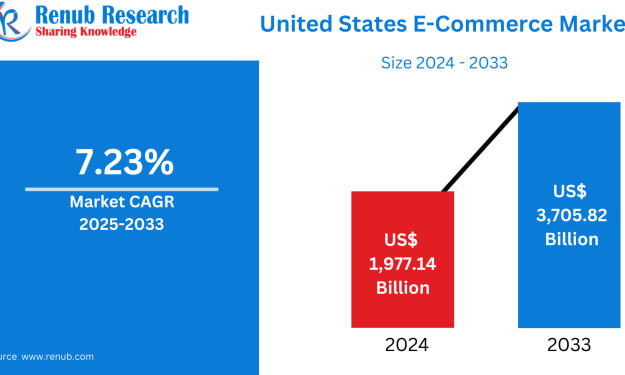
The United States E-Commerce Market is expected to reach US$ 3,705.82 billion by 2033, rising from US$ 1,977.14 billion in 2024, expanding at a compound annual growth rate (CAGR) of 7.23% from 2025 to 2033. This sustained growth reflects the rapid transformation of retail driven by digital adoption, evolving consumer expectations, and continuous technological innovation.
E-commerce has moved far beyond being an alternative shopping channel. In the United States, it has become an integral part of everyday consumer life, influencing how products are discovered, compared, purchased, and delivered. From groceries and fashion to electronics and healthcare essentials, online platforms are reshaping purchasing habits across demographics. The increasing reliance on smartphones, secure payment systems, and fast logistics networks continues to strengthen the foundation of the U.S. e-commerce ecosystem.
United States E-Commerce Industry Overview
The U.S. e-commerce industry has undergone a dramatic evolution over the past decade, emerging as a cornerstone of the country’s retail economy. Consumers now expect seamless digital experiences that combine speed, personalization, and convenience. Retailers have responded by investing heavily in platform optimization, artificial intelligence, data analytics, and automation to meet these expectations.
Mobile commerce plays a crucial role in this transformation. With smartphones becoming the primary shopping device for millions of Americans, retailers are prioritizing mobile-friendly interfaces, app-based shopping experiences, and frictionless checkout systems. Secure digital payments, flexible delivery options, and real-time order tracking have further strengthened consumer confidence in online retail.
At the same time, subscription-based services, loyalty programs, and personalized recommendations are deepening customer engagement. E-commerce platforms are no longer just transactional spaces; they are evolving into comprehensive digital ecosystems where content, commerce, and community intersect. These developments position the U.S. e-commerce market as a long-term growth engine for the broader economy.
Role of AR and VR in Enhancing Online Shopping
One of the most influential trends shaping the future of U.S. e-commerce is the integration of Augmented Reality (AR) and Virtual Reality (VR) technologies. These tools address one of the biggest limitations of online shopping—the inability to physically interact with products before purchase.
AR-powered virtual try-ons allow consumers to see how clothing, accessories, cosmetics, or furniture would look in real-world settings. Similarly, VR enables immersive showroom experiences where shoppers can explore products in simulated environments. These technologies reduce uncertainty, improve purchase confidence, and significantly lower return rates.
In April 2024, Veesual, an AI-driven virtual try-on platform, partnered with Eileen Fisher to enhance digital fashion experiences for U.S. consumers. Likewise, in February 2024, Joybird, part of La-Z-Boy, upgraded its online 3D Space Planner using advanced room-scanning technology, allowing shoppers to visualize furniture layouts with remarkable accuracy.
Consumer demand for such tools is strong. According to a Harris Poll conducted in November 2022, 73% of U.S. consumers said that features like virtual try-ons and room visualizers would be helpful when shopping online. As AR and VR adoption increases, these technologies are expected to play a significant role in sustaining long-term e-commerce growth.
Key Factors Driving United States E-Commerce Market Growth
Growing Adoption of Advanced Technologies
The rapid adoption of advanced technologies is a major growth catalyst for the U.S. e-commerce market. Artificial intelligence and machine learning are being widely used to analyze consumer behavior, optimize pricing strategies, and deliver highly personalized shopping experiences. Recommendation engines, chatbots, and automated customer support tools enhance user satisfaction while reducing operational costs.
Mobile commerce continues to expand as consumers increasingly rely on smartphones for browsing and purchasing. Retailers are responding by improving app performance, simplifying navigation, and integrating mobile payment solutions. In March 2024, AliExpress introduced major platform updates for U.S. users, including improved mobile functionality and faster delivery guarantees, highlighting the growing focus on mobile-first strategies.
Expansion of Omnichannel Retail Models
Omnichannel retailing has become one of the strongest growth drivers in the U.S. e-commerce landscape. Consumers increasingly expect a seamless experience across online and offline channels, such as buying online and picking up in-store or returning online purchases at physical locations.
This hybrid approach enhances convenience while helping retailers maximize sales and customer loyalty. Large marketplaces also enable small and medium-sized businesses to reach national and international audiences without heavy infrastructure investments. Cross-border e-commerce is gaining traction as U.S. consumers seek access to global brands and niche products, further expanding market opportunities.
Rising Consumer Convenience and Digital Penetration
High internet penetration and widespread smartphone usage continue to reshape consumer behavior in the United States. Online shopping offers unmatched convenience, time savings, and access to a broader product range, making it the preferred channel for many consumers.
User-friendly interfaces, secure payment systems, real-time delivery updates, and hassle-free returns have strengthened trust in digital platforms. Subscription models and personalized offers further enhance engagement and encourage repeat purchases. Together, these factors reinforce e-commerce adoption and support steady market expansion through 2033.
Challenges in the United States E-Commerce Market
Logistics and Last-Mile Delivery Constraints
Despite rapid growth, logistics remains a critical challenge for the U.S. e-commerce sector. Last-mile delivery, in particular, poses operational and financial difficulties. Meeting consumer expectations for same-day or next-day delivery requires extensive infrastructure investments and efficient route optimization.
Rural areas and densely populated urban centers present additional challenges, including higher transportation costs and delivery delays. While automation, fulfillment centers, and advanced logistics software are improving efficiency, last-mile delivery remains a key barrier to profitability for many e-commerce players.
Data Privacy and Cybersecurity Concerns
As e-commerce platforms handle massive volumes of sensitive consumer data, cybersecurity has become a top priority. Data breaches, identity theft, and online fraud threaten consumer trust and brand reputation. Compliance with data privacy regulations further increases operational complexity and costs.
Retailers must invest continuously in secure payment gateways, encryption technologies, and fraud detection systems while maintaining a smooth customer experience. Balancing security and convenience remains a significant challenge for the industry.
United States E-Commerce Market Overview by States
The U.S. e-commerce market exhibits strong regional diversity, with higher adoption rates in states with advanced infrastructure, dense populations, and strong digital ecosystems.
California E-Commerce Market
California stands at the forefront of U.S. e-commerce adoption, supported by high internet usage, technological innovation, and a diverse consumer base. The presence of major technology companies and robust logistics infrastructure strengthens the state’s position as a key growth driver. Consumers in California are early adopters of digital-first shopping experiences, making the state a critical contributor to national market growth.
Texas E-Commerce Market
Texas has emerged as a rapidly growing e-commerce hub due to its expanding population, strong economy, and improving logistics networks. Consumers increasingly rely on online platforms for everyday purchases, including groceries and electronics. Retailers are investing heavily in omnichannel strategies to serve both urban and rural customers efficiently.
New York E-Commerce Market
New York’s high population density and strong purchasing power make it a major e-commerce market. Demand for fast delivery services is particularly strong, driving innovation in last-mile logistics. Retailers are leveraging advanced technologies and omnichannel models to capture market share in this highly competitive environment.
Florida E-Commerce Market
Florida’s growing population, tourism-driven demand, and strong logistics connectivity support steady e-commerce growth. The state’s ports and transportation infrastructure make it a strategic hub for international e-commerce. Digital adoption across sectors such as fashion, healthcare, and electronics continues to rise.
Recent Developments in the U.S. E-Commerce Market
May 2025: Amazon’s attempt to dismiss an antitrust lawsuit related to its price-parity policies was rejected by the District of Columbia Court of Appeals, signaling increased regulatory scrutiny.
April 2025: Shopify reported US$ 2.4 billion in Q1 sales, reflecting a 27% year-over-year increase and highlighting the strength of merchant-centric platforms.
March 2025: Walmart announced plans to increase e-commerce penetration to 25% of total revenue by FY30, leveraging grocery leadership and marketplace expansion.
Market Segmentation
By Product Category
Food & Beverage, Apparel & Accessories, Health & Personal Care, Consumer Electronics, Office Supplies, Toys & Hobby, Furniture & Home Furnishing, Books/Music/Video, Others
By Payment Method
Digital Wallets, Credit Cards, Debit Cards, Account-to-Account (A2A), Buy Now Pay Later (BNPL), Cash on Delivery, Prepaid, Cryptocurrency
By States
California, Texas, New York, Florida, Illinois, Pennsylvania, Ohio, Georgia, New Jersey, Washington, North Carolina, Massachusetts, Virginia, Michigan, Maryland, Colorado, Tennessee, Indiana, Arizona, Minnesota, Wisconsin, Missouri, Connecticut, South Carolina, Oregon, Louisiana, Alabama, Kentucky, Rest of the United States
Competitive Landscape
The U.S. e-commerce market is highly competitive, with global giants and regional players continuously innovating to gain market share. Key companies operating in the market include Amazon.com Inc., Walmart Inc., eBay Inc., Rakuten Inc., Alibaba Group Holding Limited, JD.com Inc., Zalando SE, and Otto Group.
These players focus on technology upgrades, logistics optimization, and customer-centric strategies to maintain competitive advantage.
Final Thoughts
The United States E-Commerce Market is set for sustained expansion through 2033, supported by digital innovation, evolving consumer behavior, and expanding omnichannel strategies. While challenges related to logistics and cybersecurity persist, continuous investment in technology and infrastructure is strengthening the market’s long-term outlook.
As retailers adapt to rising expectations for convenience, personalization, and speed, e-commerce will remain a defining force in the U.S. retail landscape—reshaping how businesses operate and how consumers shop in the digital age.
About the Creator
Renub Research
Renub Research is a Market Research and Consulting Company. We have more than 15 years of experience especially in international Business-to-Business Researches, Surveys and Consulting. Call Us : +1-478-202-3244
Keep reading
More stories from Renub Research and writers in Futurism and other communities.
United States E-Commerce Market Size and Forecast 2025–2033
United States E-Commerce Market Outlook The United States E-Commerce Market is expected to reach US$ 3,705.82 billion by 2033, rising from US$ 1,977.14 billion in 2024, expanding at a compound annual growth rate (CAGR) of 7.23% from 2025 to 2033. This sustained growth reflects the rapid transformation of retail driven by digital adoption, evolving consumer expectations, and continuous technological innovation.
By Renub Research9 days ago in Futurism
About Binding Prometheus
I want to start actively advocating on behalf of my own work, and the most valuable part of my canon is, without a doubt, Binding Prometheus, the play I have been working on since 2019 and only finished in 2023 as part of my MA. The play itself is an amalgamation of a million different inspirations. On one end, it evokes the Ancient Greek myth-play, deriving its own title from the earliest extant work of Western drama we have, Aeschylus’s Prometheus Bound. On the other end, it borrows significantly from the sci-fi bulwarks from over the years, namely Mary Shelley’s Frankenstein and Karel Capek’s Rossum’s Universal Robots. The play could be an episode of Black Mirror, I fear. I don’t know. I’ve only ever seen one episode of Black Mirror.
By Steven Christopher McKnight10 days ago in Futurism
Edge AI Market Analysis: Power Efficiency, AI Chips, and Performance Optimization
According to IMARC Group's latest research publication, the global Edge AI market size was valued at USD 18.30 Billion in 2024. Looking forward, IMARC Group expects the market to reach USD 83.99 Billion by 2033, exhibiting a growth rate (CAGR) of 17.53% during 2025-2033.
By Andrew Sullivan2 days ago in Futurism



Comments
There are no comments for this story
Be the first to respond and start the conversation.