
Unified Communications Market Size and Forecast 2025–2033: The Backbone of the Digital Workplace Revolution
How cloud collaboration, remote work, and AI-powered platforms are reshaping global business communication


Global Unified Communications Market Overview
The global Unified Communications (UC) market is undergoing a historic transformation as businesses across industries redefine how they connect, collaborate, and operate. According to Renub Research, the Unified Communications Market is expected to reach US$ 535.54 billion by 2033, growing from US$ 138.44 billion in 2024, at a remarkable CAGR of 16.22% from 2025 to 2033. This extraordinary expansion highlights the growing dependence on integrated communication platforms in an increasingly digital-first global economy.
Unified communications refers to the integration of multiple real-time communication tools—voice, video, messaging, conferencing, email, and file sharing—into a single unified platform. Instead of managing fragmented systems, organizations now rely on centralized communication ecosystems that enable seamless interaction across devices, locations, and teams.
As digital transformation accelerates, UC solutions are no longer optional. They are becoming the backbone of the modern workplace, enabling hybrid work, improving customer engagement, reducing operational complexity, and enhancing productivity at scale.
Why Unified Communications Is Becoming Mission-Critical
The explosive growth of the unified communications market is not driven by a single trend—it is the result of multiple converging forces reshaping the global business landscape.
The Rise of Hybrid and Remote Work
The shift to hybrid and remote work models has permanently changed organizational communication. Employees now expect to collaborate from anywhere, on any device, without sacrificing performance or security. Unified communications platforms make this possible by integrating voice, video, messaging, and collaboration tools into one consistent experience.
According to industry surveys, over 95% of Indian companies have adopted or plan to continue work-from-home or hybrid work models, while a 2022 Gallup poll found that 8 out of 10 employees globally now work remotely or in hybrid environments. This structural shift has made UC platforms indispensable for workforce continuity and employee engagement.
Cloud-Based UCaaS Is Dominating Adoption
The rapid rise of Unified Communications as a Service (UCaaS) has transformed the market. Cloud-based UC platforms are scalable, cost-effective, easy to deploy, and accessible from anywhere, making them ideal for both enterprises and SMEs.
UCaaS eliminates the need for heavy on-premises infrastructure while offering automatic updates, high availability, and flexible pricing. As organizations focus on agility and cost optimization, cloud deployment has become the preferred model, accelerating global market growth.
Customer Experience Is a Major Growth Driver
Customer experience (CX) has become a top priority for businesses, and unified communications plays a central role in enhancing it. Studies show that 68% of consumers are willing to spend more with companies that provide superior customer service, and 93% are likely to return after a positive service experience.
UC platforms allow businesses to manage customer interactions across voice, chat, email, and video from a single interface. This results in faster response times, improved consistency, and better issue resolution—ultimately strengthening brand loyalty and revenue.
Technological Innovation Is Accelerating Market Expansion
Advances in cloud computing, artificial intelligence (AI), machine learning, and Voice over Internet Protocol (VoIP) are continuously redefining UC capabilities. AI-driven features such as real-time transcription, sentiment analysis, meeting summaries, and intelligent routing are transforming collaboration from a basic function into a strategic advantage.
A notable example is the Zoom–Verizon partnership, which allows users to join Zoom meetings seamlessly from Verizon VoIP or wireless phones. Similarly, Acronym Solutions Inc. introduced a cloud-hosted UCaaS platform designed to deliver global collaboration insights and improve business performance.
Key Challenges in the Unified Communications Market
Despite rapid adoption, the UC market faces several challenges that vendors and organizations must address to sustain growth.
Data Privacy and Security Concerns
Unified communications platforms manage vast volumes of sensitive data, making them attractive targets for cybercriminals. The expansion of remote work further increases risks, especially when employees access systems through personal devices or unsecured networks.
To build trust, UC providers must invest in end-to-end encryption, multi-factor authentication, zero-trust security models, and compliance with global regulations like GDPR, HIPAA, and SOC 2. Balancing strong security with user-friendly experiences remains a persistent challenge.
Interoperability and Integration Issues
Many organizations operate complex IT environments with legacy systems, making UC integration difficult. Ensuring seamless interoperability between audio, video, messaging, CRM, ERP, and HR platforms requires open APIs, standardized protocols, and careful planning.
Without proper integration, organizations risk lower user adoption, communication silos, and increased support costs. Vendors that offer flexible integration capabilities are gaining a competitive edge in this evolving market.
Regional Market Insights
United States Unified Communications Market
The United States remains the largest and most technologically advanced UC market globally. Enterprises across healthcare, education, finance, government, and technology sectors rely heavily on UC platforms to support distributed teams and digital workflows.
Cloud-based UCaaS dominates new deployments due to its scalability and flexibility. The U.S. is also a leader in AI-enhanced collaboration, with businesses rapidly adopting intelligent meeting tools, virtual assistants, and analytics-driven communication platforms. Strong R&D investments and a mature vendor ecosystem continue to drive innovation.
United Kingdom Unified Communications Market
The UK market benefits from a strong service economy, widespread remote work adoption, and supportive digital infrastructure policies. Organizations are increasingly using UC solutions to enhance teamwork across geographically dispersed operations.
Cloud-based platforms are preferred for their agility and cost efficiency, especially among SMEs. Compliance with UK and EU data regulations remains a critical consideration, driving demand for secure and compliant UC solutions. The UK market is mature, innovation-driven, and shaped by evolving work cultures.
India Unified Communications Market
India is one of the fastest-growing UC markets, fueled by digital transformation, expanding mobile connectivity, and a booming IT and services sector. Businesses in IT, education, healthcare, retail, and BFSI are investing heavily in UC platforms to improve internal and external communication.
Government initiatives promoting digital inclusion, smart cities, and cloud adoption further support market expansion. While challenges such as cybersecurity awareness and network reliability remain, ongoing infrastructure upgrades are closing these gaps rapidly, positioning India as a high-growth UC market.
United Arab Emirates Unified Communications Market
The UAE is emerging as a regional hub for unified communications, driven by smart city initiatives, high internet penetration, and government-led digital transformation programs. Organizations in finance, education, hospitality, and government are embracing cloud-based UC solutions to improve efficiency and service delivery.
International vendors and regional providers are expanding their presence in the UAE, offering AI-powered, secure communication platforms aligned with global best practices. The country’s digital vision and infrastructure investments continue to accelerate UC adoption.
Recent Developments in the Unified Communications Industry
The UC market is evolving rapidly, with vendors focusing on innovation, partnerships, and enhanced user experiences:
August 2023: Avaya Inc. signed a cooperative purchasing agreement with Sourcewell, enabling government and public sector organizations in the U.S. and Canada to access Avaya’s solutions more easily.
August 2023: Mitel Networks released a new version of MiCollab, providing users with a flexible collaboration platform that supports multiple meeting providers, improving usability and customization.
These developments reflect a broader industry trend toward flexibility, interoperability, and customer-centric design.
Unified Communications Market Segmentation
By Component
Solutions
Services
By Product Type
On-premises
Hosted
By Organization Size
Small & Medium-sized Enterprises (SMEs)
Large Enterprises
By End User
Enterprises
Education
Government
Healthcare
Others
By Region
North America: United States, Canada
Europe: France, Germany, Italy, Spain, UK, Belgium, Netherlands, Turkey
Asia-Pacific: China, Japan, India, South Korea, Thailand, Malaysia, Indonesia, Australia, New Zealand
Latin America: Brazil, Mexico, Argentina
Middle East & Africa: Saudi Arabia, UAE, South Africa
Competitive Landscape: Key Market Players
The global unified communications market is highly competitive, with major players focusing on innovation, AI integration, and cloud expansion:
8x8 Inc.
Avaya Holdings Corp.
Cisco Systems Inc.
GoTo (Citrix Systems Inc.)
Huawei Technologies Co. Ltd.
Microsoft Corporation
Mitel Networks Corporation
NEC Corporation (AT&T Inc.)
RingCentral Inc.
Verizon Communications Inc.
Each company is actively expanding its UCaaS offerings, improving interoperability, and embedding AI-driven intelligence to strengthen market position.
Final Thoughts: The Future of Unified Communications
The unified communications market is entering a golden era of growth, driven by cloud adoption, hybrid work, digital transformation, and rising customer experience expectations. As organizations move away from fragmented tools toward integrated collaboration ecosystems, UC platforms will become even more central to business strategy.
With the market projected to grow from US$ 138.44 billion in 2024 to US$ 535.54 billion by 2033, unified communications is no longer just an IT investment—it is a strategic enabler of agility, productivity, and competitive advantage.
In the coming decade, organizations that embrace intelligent, secure, and cloud-based unified communications will be best positioned to thrive in the digital economy.
About the Creator
Renub Research
Renub Research is a Market Research and Consulting Company. We have more than 15 years of experience especially in international Business-to-Business Researches, Surveys and Consulting. Call Us : +1-478-202-3244
Keep reading
More stories from Renub Research and writers in Futurism and other communities.
Online Education Market Size & Forecast 2025–2033
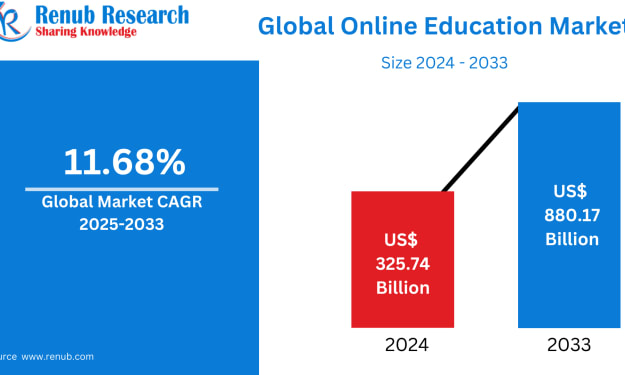
Introduction: A Digital Transformation of Education The education sector is undergoing one of the most significant transformations in modern history. Driven by advances in digital infrastructure, changing learner expectations, and the growing demand for flexible skill development, online education has evolved from a supplemental learning method into a global education ecosystem. From professional certifications and virtual classrooms to full-scale online universities and enterprise training platforms, digital learning now touches millions of learners across borders and socioeconomic backgrounds.
By Renub Research6 days ago in Futurism
About Binding Prometheus
I want to start actively advocating on behalf of my own work, and the most valuable part of my canon is, without a doubt, Binding Prometheus, the play I have been working on since 2019 and only finished in 2023 as part of my MA. The play itself is an amalgamation of a million different inspirations. On one end, it evokes the Ancient Greek myth-play, deriving its own title from the earliest extant work of Western drama we have, Aeschylus’s Prometheus Bound. On the other end, it borrows significantly from the sci-fi bulwarks from over the years, namely Mary Shelley’s Frankenstein and Karel Capek’s Rossum’s Universal Robots. The play could be an episode of Black Mirror, I fear. I don’t know. I’ve only ever seen one episode of Black Mirror.
By Steven Christopher McKnight19 days ago in Futurism
Wood Vinegar Market: Agroforestry Integration, Sustainable Practices & Adoption Trends
According to IMARC Group's latest research publication, the global wood vinegar market size reached USD 5.21 Billion in 2024. Looking forward, IMARC Group expects the market to reach USD 8.32 Billion by 2033, exhibiting a growth rate (CAGR) of 5.30% during 2025-2033.
By Andrew Sullivan5 days ago in Futurism
Wild Card Weekend Recap: What Happens Now?
I think I figured out why I love Wild Card Weekend so much. It's because it's the first playoff anything of the calendar year. The NFL season starts in the fall, and once upon a time, the champion was crowned either on or slightly before New Year's. The evolution of the NFL schedule has resulted in the playoffs starting just into the New Year, and currently, the final week of the season falls on the first weekend of the New Year, with Wild Card Weekend coming a week after that. So yes, chronologically, the NFL's Wild Card Weekend serves as the first playoff anything of the calendar year.
By Clyde E. Dawkins7 days ago in Unbalanced



Comments
There are no comments for this story
Be the first to respond and start the conversation.