
Twinkle, Twinkle, Bang!
The Supernova that Wiped the Windscreen of the Universe


A roaming group of hunters, the direct ancestors of modern humans, gaze at a new star, a piercing pinpoint of bright, white light that shines in the late afternoon sky. As evening draws in, the light reveals its source; the dazzling glint of a sword, the blade of another hunter who has emerged from the night – the constellation of Orion. A full moon rises and its shadows compete with those of the new star; except that the star is only new to Homo heidelbergensis and its glare, which outshines an entire galaxy for months on end, is the last that anyone will see of it for around 340,000 years.
Our ancestors have witnessed not a new star, but the death of an old one; a spectacular supernova at relatively close quarters, the swan song of a sun that was at least eight times as large as our own and an explosion so large that its remains are still hurtling across the sky at 15,000 miles an hour. Today, we know the remnants of this star as Geminga.

It’s well named. In 1972, Italian astrophysicists discovered a powerful source of radiation coming from an apparently empty patch of sky in the constellation of Gemini. Geminga, it turns out, is not only a handy contraction of “Gemini gamma radiation source”, but is also pronounced exactly the same as a word in the Milanese dialect that means “it isn’t there”. It was there, however, it just took some time to see what’s left of it; a rapidly spinning, super-dense radioactive ball bearing just 12 kilometres in diameter which emits a faint glow a million times dimmer than even the least enthusiastic star that can be seen by the naked eye.
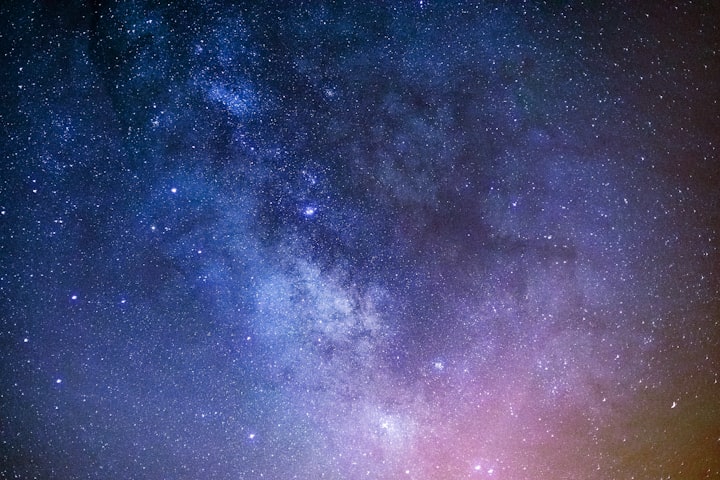
It’s ironic that Geminga is only barely visible, because the manner of its disintegration blew away a local patch of gas and dust that normally fills the space between the stars – the interstellar medium – and left us an exceptionally bright night sky as a consequence. Scientists call this hole in the cosmic cobwebs that normally obscure our view the ‘Local Bubble’ and its effect on our outlook is surely staggering. To see why, you only need to imagine the night sky without its canopy of stars.

In the 1950s, science fiction authors Robert Silverberg and Randall Garrett invented a planet that was permanently sheathed in clouds – Nidor – where the human-like occupants had no concept of a universe beyond the clouds. Perhaps because of the lack of any external stimulation, Silverberg and Garrett painted Nidorian culture and technology stuck in an agrarian phase not unlike early Renaissance Europe.
Although a work of speculative fiction, the mind can only boggle at how different our civilisation might have turned out without such a rich and opulent night sky, a backdrop that has, perhaps, given all of our dealings on Earth something of a sense of perspective.
Without the Local Bubble, which is less like a bubble and more like an open cylinder, there would simply not be as many stars to see in the sky. Even the stars that would be visible would appear much redder and dimmer, for the same reasons that a hot, dry day in high summer produces aesthetically appealing sunsets - we’re looking at the sun through a thick layer of dust. And it’s not just a clearer view of our galaxy, where the majority of objects we see in the night sky reside, but also other galaxies – as luck would have it, the Local Bubble is oriented at right angles to the disk of the Milky Way, offering us a window of clear space to observe the rest of the Universe through.

But even now, when Geminga has done its cosmic housekeeping, set the default setting for the brightness of the stars and long hurtled away from the scene, the constellation from which it was borne – Orion – is still captivating. Gazing up on a moonless winter’s night, Orion draws the eye and dominates the midwinter sky as he strides across the heavens with the kind of chutzpah we demand from a Greek hero. It isn’t one of those fiddly zodiac signs that look nothing like their designation, either; it’s a constellation, along with the Big Dipper or Plough, that does exactly what it says in the star catalogue. You want a big saucepan in the sky? No problem. How about a large man with a club, wearing a belt and dagger? Here’s Orion.
Like the Plough, Orion is a constellation that a lot of us know from a very early age. Perhaps these easy-to-identify groupings of stars call on our innate ability to recognize patterns in a jumble of visual data. That intuitive sense that once alerted us to the presence of partially obscured man-eating tigers in the undergrowth is still alive, and now that there is less call for vigilance in the suburbs of Godalming and Splott, it assists us instead, with sky-based dot-to-dot puzzles.
The patterns that constellations form are outcomes of our position in space; the stars themselves can be at wildly different distances from us and the constellations would look very different from another part of the galaxy. Most of the stars of Orion, however, are moving through space together in a loose association and the constellation’s shape is not merely an accident of our line of sight. Either way, as a shape in the sky, Orion is so ingrained in our consciousness, it would be difficult to combine its stars into any other shape and that, it appears, is how it has been with almost every cosmologically-aware culture since the Babylonian star catalogues of the Bronze Age, in which Orion is the Loyal Shepherd of Heaven. The Babylonians inherited the constellation from the Sumerians who saw their own hero – Gilgamesh – in the pattern of stars. The Bible, too, mentions the same configuration of stars (naming Orion as ‘Kesil’), while the ancient Egyptians called him the Soul of Osiris. He appears in Homer’s Odyssey and Iliad as both a legendary hunter and as a constellation; in short, wherever you look in history, Orion is there in some form or another.
For those reasons alone it would be a terrible shame if one of its number – like Geminga before it – went bang tonight. That is, it would be a shame were it not for the spectacular surprise that the star that marks the left shoulder of Orion, Betelgeuse (there are various pronunciations, but most people opt for beetlejuice) appears to be preparing for us.
Betelgeuse is a red supergiant - not only one of the brightest, but also one of the biggest stars in the sky - a relatively cool, low density sun, around twenty times the mass and over one and a half billion times the volume of our own but little more than half as hot. Red supergiants have brief, glorious lives; Betelgeuse is under nine million years old and will be lucky to last another million before it goes, in the words of one astrophysicist, ‘ker-blooey’.
By way of comparison, our dependable, gracefully-aging sun is five billion years old and will be around for a long while yet. Betelgeuse’s life span, however, is so short that while it first shined on a relatively modern world - albeit one that predates the earliest species of humans, even Heidelbergensis – its disintegration will be witnessed by man, possibly tonight, maybe in a 1,000 years or more but certainly, in terms of deep time, very soon (just as long as man doesn’t go ‘ker-blooey’ first).
Scientists have discovered that Betelgeuse has recently shrunk by 15% in as many years and some believe that that contraction is the beginning of its end. Stars start to collapse as they run out of hydrogen, atoms of which are combined into helium at the star’s core by the process of nuclear fusion. Nuclear fusion is, essentially, a runaway, non-stop hydrogen bomb, albeit in the case of the Sun, one that is sufficiently distant enough to bring us only sunshine and seasonal demand for ice cream.
In fusion, a pair or more of atomic nuclei - the kernels that lie at the centre of atoms - combine to form a single heavier nucleus, releasing huge quantities of energy in the process. The outward pressure of this energy is what temporarily delays all that mass from coalescing into a super-dense blob of matter of some kind – the ultimate fate of all stars.
Fusion of the nuclei of atoms releases energy only so long as the atoms are small and light enough. The larger the atom, however, the more energy it needs to bind its nuclei together, such that the fusion of atoms of iron or anything heavier actually consume more energy than the fusion releases. Likewise, with elements lighter than iron, the lighter the nucleus, the more energy its fusion releases; hydrogen has the lightest atom of all – its nucleus contains just one particle. This simple physical constant is the reason why Betelgeuse will shortly go bang.
At the centre of all stars, hydrogen fuses to form helium, but what happens when the hydrogen runs out? In red supergiants like Betelgeuse, the core starts to collapse. Collapses occur in steps, each partial collapse kick-starting the fusion of already-fused heavier elements into even heavier elements and so on. When hydrogen runs out at the core, it collapses until pressure and heat builds up again sufficient to fuse the helium into carbon. The energy released is sufficient to halt collapse until the helium is depleted and the collapse begins again and so on over a handful of increasingly rapid stages until the core is made of iron, which cannot fuse without the addition of lashings of energy.
Once this point is reached, the star’s core stops pumping out thermal energy and, after some frankly exotic alchemy, it finally becomes unable to overcome collapse and starts to implode. The implosion flies inward at around 45,000 miles per second, compressing the core to the density of an atomic nucleus which then rebounds, meeting incoming material which then rebounds in turn. The shockwave blows off all the material around the core and this is the process we see when we witness a supernova.
Like Geminga before it, Betelgeuse’s destruction will be so bright that it will outshine every other star in the night sky and will probably even be brighter than the full moon, while another candidate for imminent ker-blooey, Eta Carinae – a star of the southern hemisphere and one of the largest and most luminous in the night sky – may be so bright that you’ll be able to read a newspaper by its light.
While scientists almost casually observe stellar annihilation in other galaxies through automated telescope searches, history tells us that supernovae of the kind that Betelgeuse and Eta Carinae promise are far from routine occurrences.

Early Chinese dynasties were the first to systematically record supernovae as part of a wider astronomical and astrological culture – important, as it was, for timekeeping, navigation, agriculture and divination. The first of these ‘guest stars’, as they were known, was noted in the Astrological Annals of the Houhanshu in 185 CE, where it was described as having “scintillating, variegated colours”. On May 30, 1006, what is probably the brightest supernova on record was seen and seems to have been described in correspondingly more detail. It had the shape of a half-moon and objects could be seen by its light; it was not merely a bright twinkling single pinpoint, but an object large enough that its shape could be determined. Along with detailed observations of its position, the record shows that it was eventually seen as a propitious omen – a Chou-po star that promised great prosperity to the state. It was certainly auspicious to the chief official of the Song Dynasty’s Astronomical Bureau, Chou K’o-ming, whose reading of the omen quelled disquiet among the million or so people who lived in the Chinese capital of Kaifeng.
The star had apparently first appeared to be large and yellow with pointed rays – the hallmarks of an ominous Kuo Huang guest star, which promised war and pestilence, flood and famine. Chou K’i-ming was absent from the capital when the supernova first appeared but, on his return reassured the Emperor that it was an auspicious sign that would only be seen during the reign of a wise and virtuous ruler. He suggested that celebrations of the event would calm the population, a suggestion that the Emperor followed before turning the advice into something of a self-fulfilling prophecy for Chou K’i-ming, who was promoted to Librarian and Escort to the Crown Prince as a result.

What stands out in these contemporary accounts of supernovae from a millennium ago – and there are accounts from Japan, Korea and the Middle East as well as China – is that they are often detailed enough to allow modern science marry them up with their remnants. Less than fifty years after Chou K’i-ming flattered his way to promotion, there was another supernova observed and recorded by the Song Dynasty’s astronomical administrators and the detail of the report has enabled modern astrophysicists to declare that the Crab Nebula – located at the foot of Orion’s upstairs neighbour, Taurus – is what is left of a guest star observed in 1054. As it’s 6,500 light years away and just a candle-flame wisp of dust and gas, it’s hard to spot. You might catch a slight, small white smudge if you happen to catch it in binoculars under a dark sky, but only a large telescope does it justice and observation of the neutron star – the Crab Pulsar – spinning at thirty times a second at its centre, is way beyond most of our promotion prospects; perhaps we should flatter an Emperor.

Stars that become supernovae have different final fates according to what kind of star they were in the first place and how big they are when they go bang. Betelgeuse, like Geminga and the Crab Pulsar, will become a neutron star, a highly compact and dense body with an extreme gravitational field. A neutron star is so dense that little more that a teaspoon of material from one that is around 20 kilometres across would weigh about the same as seven billion people - the entire human race.
Perversely, the smaller the neutron star the heavier it is, although it is actually the other way around; the more mass a neutron star has, the greater the gravitational ‘pull’ and the denser it becomes. Gravity is so powerful on the surface of a neutron star that any surface irregularity - a ‘hill’ or ‘mountain’ - barely rises above 5 millimetres. However, climbing it in such gravitational conditions would be a feat of superhuman proportions given that, on the star’s surface, you would weigh around a billion tons and would be spread very thinly over a wide area like peanut butter on a very large and hot piece of toast.
You won’t be surprised to hear that the cores of neutron stars are made out of neutrons and that matter that is made entirely out of neutrons is called neutronium*. Neutrons are particles found, with protons, at the nucleus of all atoms.
*Neutronium, as any follower of Star Trek will tell you (often without being asked), is impervious to the Enterprise’s phaser beam. Which is all well and good in a fictional universe full of prosthetic foreheads and pixie ears, but neutronium is far more interesting than science fiction. It has been proposed as an additional element in the periodic table, and with its potential to transcend any other nucleus in terms of its size and weight which, while not infinite, takes it to the very boundary of matter as we know it.
The exact nature of the cores of neutron stars has not been ascertained, but it has been predicted that they are filled with a superfluid* that has the density of an atomic nuclei which is hardly surprising because that is, essentially, what the inside of a neutron star is, an enormous atomic nuclei which, unlike any other, has no protons. A neutron star is to an atomic nucleus what a freshly-laid ostrich egg is to a single-cell amoeba; a larger and more splendid example of the same basic unit.
* A superfluid is a fluid that has no viscosity and, therefore, infinite fluidity. If left in an uncovered cup, it will actually climb out. I’m not making this up.
Another consequence of the way a neutron star is formed is its rotation. All stars rotate - our Sun, for instance, revolves a rather stately once a month - but when collapse of a star reduces its radius while it retains its mass, rotational speed dramatically increases. It’s a law of physics called the ‘conservation of angular momentum’, but it’s essentially the reason why an ice skater in a spin speeds up markedly when they draw their arms in.

Now, imagine if that ice skater was holding a torch with a very bright, tightly focussed beam. If you were in the right place in the audience, you might see an effect a bit like the light from a turbo-charged lighthouse; as the beam swept past your eyes you would see a flash of light, but from other places around the rink you might not notice anything at all. What our theoretical ice skater has created is a metaphor for a particular kind of neutron star, a pulsar.
We’ve met pulsars already in the shape of Geminga and the star responsible for the Crab Nebula. The bursts of radiation picked up by the various gamma and x-ray telescopes that have been pointed in its direction are like our skater's torch, except that in the place of torchlight, the pulsar emits either a narrow beam of intense visible light, gamma-rays, x-rays or radio waves.
The pulse of energy from a pulsar is usually regular and gives scientists an accurate measure of speed; pulsar neutron stars rotate anything between once every eight seconds to over 700 times a second. The fastest that has been discovered so far rotates at nearly 43,000 rpm. Pulsars are so regular in their rotation that the first to be discovered, in 1967, was playfully nicknamed LGM-1, short for ‘Little Green Men’ by the British radio-astronomers and astrophysicists who detected it.
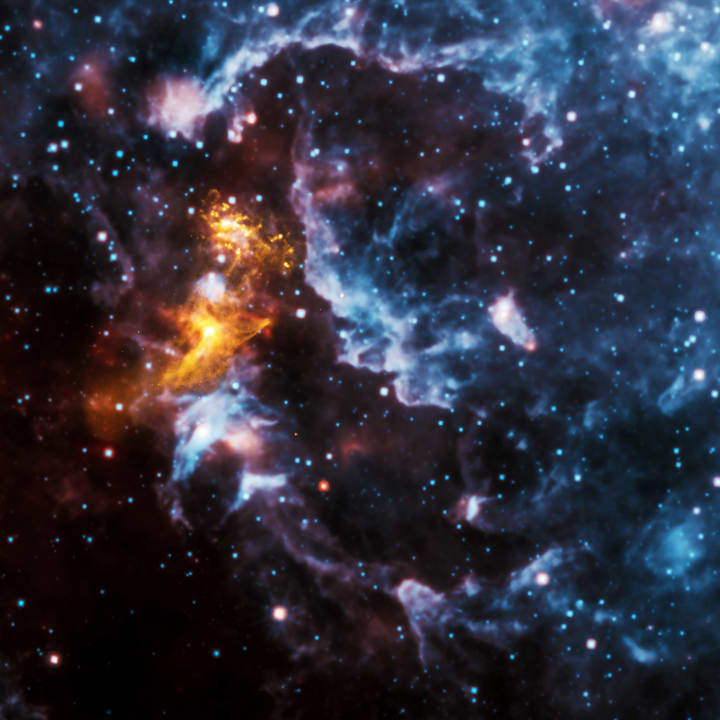
The gamma ray source of Geminga was first detected by the Small Astronomy Satellite 2 mission of 1972-1973, but it took until 1991 until the true nature of Geminga was discovered, linking the observations of 340,000 years ago and those of modern humans, still gazing up into the sky.
About the Creator
Ian Vince
Erstwhile non-fiction author, ghost & freelance writer for others, finally submitting work that floats my own boat, does my own thing. I'll deal with it if you can.
Top Writer in Humo(u)r.
About Binding Prometheus
I want to start actively advocating on behalf of my own work, and the most valuable part of my canon is, without a doubt, Binding Prometheus, the play I have been working on since 2019 and only finished in 2023 as part of my MA. The play itself is an amalgamation of a million different inspirations. On one end, it evokes the Ancient Greek myth-play, deriving its own title from the earliest extant work of Western drama we have, Aeschylus’s Prometheus Bound. On the other end, it borrows significantly from the sci-fi bulwarks from over the years, namely Mary Shelley’s Frankenstein and Karel Capek’s Rossum’s Universal Robots. The play could be an episode of Black Mirror, I fear. I don’t know. I’ve only ever seen one episode of Black Mirror.
By Steven Christopher McKnight11 days ago in Futurism
Waterless Cosmetics Market Set to Soar to USD 23.17 Billion Driven by Digital Shift and Diverse Content
Waterless Cosmetics Market – Overview The waterless cosmetics market refers to beauty and personal care products formulated without water as a primary ingredient. Instead of water, these products use alternatives like botanical extracts, oils, powders, and butters to deliver concentrated active ingredients that offer potent performance and sustainability benefits. Compared to traditional liquid formulations, waterless cosmetics reduce reliance on freshwater, minimize preservative needs, and often use more eco-friendly packaging.
By James Smithabout 2 hours ago in Futurism
FPS: The Last Flame Challenge Winners
Welcome to our first Winners Announcement of the year and to the final challenge in the Fall Poetry Series. The Last Flame invited writers to sit with endings, using fire as a central image to consider what remains when something burns out: ash, warmth, memory, silence, or the faint promise of what comes next. The strongest pieces treated endings as gradual rather than sudden, allowing them to flicker, dim, and linger.
By Vocal Curation Team5 days ago in Resources




Comments
There are no comments for this story
Be the first to respond and start the conversation.