
Training in Zero Gravity: The Thrill of Parabolic Flights
Space

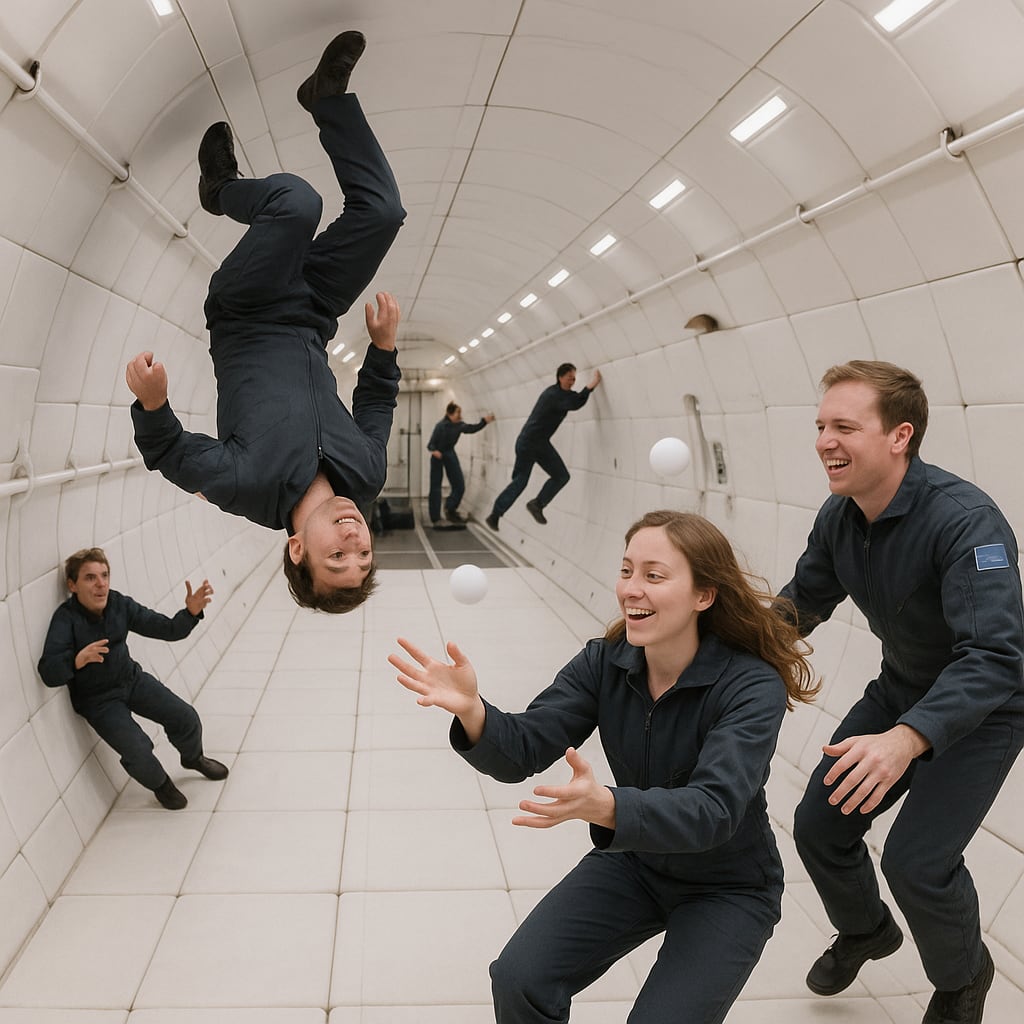
We’ve all seen those mesmerizing videos of astronauts floating gracefully aboard the International Space Station — pens drifting in the air, droplets of water forming perfect spheres, and people doing effortless somersaults. It looks otherworldly. But what if you could experience that same weightless wonder right here on Earth?
Welcome to the world of parabolic flights, where gravity briefly lets go, and humans get a taste of space — without ever leaving the atmosphere.
What Exactly Is a Parabolic Flight?
A parabolic flight is a special kind of airplane maneuver designed to create short bursts of weightlessness. During the flight, the aircraft follows a curved path in the sky — a “parabola.”
Here’s what happens:
- The plane climbs steeply upward at about a 45° angle.
- At the top of the arc, the pilots reduce thrust, and the plane enters free fall.
- Inside, everything — and everyone — starts to float.
For about 20 to 25 seconds, gravity seems to disappear. Then the pilots regain control, pull the plane out of its dive, and gravity returns — often with a force of 1.8 g, nearly double what we feel on the ground.
This rollercoaster-like maneuver is repeated 10 to 15 times during a typical flight. Each parabola offers a new round of weightless wonder — and, for some, a new round of nausea. (There’s a reason NASA’s training plane earned the nickname “The Vomit Comet.”)
How Astronauts Train in Zero Gravity
For astronauts, these flights are more than just thrilling — they’re essential. Parabolic flights allow trainees to experience the physical sensations of weightlessness long before they ever launch into orbit.
During these sessions, astronauts practice:
- Orientation and spatial awareness — learning to move and navigate when “up” and “down” no longer exist.
- Equipment handling — using tools, opening containers, and performing repairs while floating.
- Emergency procedures — because even in microgravity, things can go wrong.
- Body control — understanding how small motions can send you spinning across the cabin.
Before takeoff, participants receive anti-nausea medication and undergo safety briefings. Once airborne, the cabin transforms into a chaos of floating bodies and equipment. Laughter, shouts of surprise, and occasional groans fill the air. It’s both scientific and spectacular — a dance between physics and human curiosity.
Not Just for Astronauts: Science and Innovation in Flight
While parabolic flights are a cornerstone of astronaut training, they’ve also become a vital platform for scientific research. The few seconds of microgravity per parabola might not seem like much, but for scientists, it’s enough to test theories and technologies that behave differently without gravity.
Researchers use these flights to study:
- The behavior of fluids and gases in microgravity.
- The growth of biological cells and crystals.
- How 3D printers or medical instruments might function in space.
- The effects of short-term weightlessness on the human body — from blood pressure to muscle coordination.
For example, ESA (the European Space Agency) has tested new designs for space-grown plants and advanced materials aboard the Airbus A310 ZERO-G, while NASA uses parabolic flights to refine tools for missions to the Moon and Mars.
These flights bridge the gap between lab experiments on Earth and long-term studies aboard the International Space Station — at a fraction of the cost.
Zero Gravity Tourism: From Science to Experience
Today, you don’t have to be a scientist or astronaut to float like one. Companies such as Zero-G Corporation in the U.S. and Novespace in Europe offer commercial “zero gravity experiences.”
For around $6,000–$8,000, you can join a professional flight, complete with training, safety gear, and up to 15 parabolas of pure weightlessness. Celebrities like Stephen Hawking, Buzz Aldrin, and even members of the public have already taken the plunge — or rather, the float.
These experiences are surprisingly emotional. Many participants describe their first moments of weightlessness as “liberating,” “humbling,” or even “spiritual.” It’s the ultimate reminder of how our bodies are built to exist under gravity — and how strange it feels when that invisible force suddenly disappears.
A Brief History of Parabolic Flights
Parabolic flights date back to the 1950s, when NASA began using modified aircraft to train astronauts and test spacecraft systems. The most famous was the KC-135A, lovingly (or not so lovingly) nicknamed the Vomit Comet.
Over the decades, parabolic flights have evolved. Today’s aircraft — such as the Airbus A310 ZERO-G in France, Russia’s Ilyushin IL-76 MDK, and Japan’s Boeing 727 ZERO-G — offer smoother, more controlled experiences. What started as a government experiment has become a global industry connecting science, exploration, and adventure.
Why It Matters
Parabolic flights are more than just a thrill ride. They’re a bridge between Earth and space — a tool that allows us to study, train, and dream.
Each parabola is a brief, breathtaking reminder that gravity, though constant and familiar, isn’t absolute. For a few precious seconds, humans can experience what it’s like to truly let go — to float freely, to spin and laugh and see the world from a perspective that defies every instinct we’ve ever had.
It’s not just a simulation of space. It’s a glimpse of the future — and a powerful symbol of humanity’s endless curiosity about what lies beyond.
About the Creator
Keep reading
More stories from Holianyk Ihor and writers in Futurism and other communities.
How Modern Astronauts Are Trained: From Selection to Spaceflight. Why the Centrifuge Test and Extreme G-Forces Are Essential.
Becoming an astronaut has always been a dream job — one that combines science, adventure, and the ultimate human challenge. But behind the inspiring images of spacewalks and Earth glowing through the spacecraft window lies an intense, years-long preparation process.
By Holianyk Ihor3 months ago in Futurism
About Binding Prometheus
I want to start actively advocating on behalf of my own work, and the most valuable part of my canon is, without a doubt, Binding Prometheus, the play I have been working on since 2019 and only finished in 2023 as part of my MA. The play itself is an amalgamation of a million different inspirations. On one end, it evokes the Ancient Greek myth-play, deriving its own title from the earliest extant work of Western drama we have, Aeschylus’s Prometheus Bound. On the other end, it borrows significantly from the sci-fi bulwarks from over the years, namely Mary Shelley’s Frankenstein and Karel Capek’s Rossum’s Universal Robots. The play could be an episode of Black Mirror, I fear. I don’t know. I’ve only ever seen one episode of Black Mirror.
By Steven Christopher McKnight14 days ago in Futurism
Plastic Compounding Market: Demand Dynamics, Application Expansion & Industry Evolution
According to IMARC Group's latest research publication, global plastic compounding market size reached USD 72.6 Billion in 2024. Looking forward, IMARC Group expects the market to reach USD 113.9 Billion by 2033, exhibiting a growth rate (CAGR) of 5.08% during 2025-2033.
By Andrew Sullivan7 days ago in Futurism



Comments
There are no comments for this story
Be the first to respond and start the conversation.