
How Modern Astronauts Are Trained: From Selection to Spaceflight. Why the Centrifuge Test and Extreme G-Forces Are Essential.
Space

Becoming an astronaut has always been a dream job — one that combines science, adventure, and the ultimate human challenge. But behind the inspiring images of spacewalks and Earth glowing through the spacecraft window lies an intense, years-long preparation process.
Modern astronaut training is a blend of advanced technology, psychology, and sheer human endurance. It begins with one of the toughest selection procedures in the world and continues through endless drills, physical conditioning, and mind-bending simulations — including one of the most feared tests of all: the centrifuge.
Stage 1: The Selection — Only the Best of the Best
The road to space begins with an application, but the odds are astronomical. For every person who makes it into a national space program, dozens — sometimes hundreds — are rejected at the very first stage: the medical exam.
Candidates are examined head to toe. Perfect vision, flawless cardiovascular health, and exceptional mental stability are just the starting points. The body must handle stress, low oxygen, and high pressure without breaking down. Even a seemingly minor condition, like a tendency toward motion sickness, can disqualify a candidate.
Next comes a series of psychological assessments designed to test how a person reacts under pressure. Astronauts must remain calm, focused, and cooperative in confined spaces for months on end. “You can’t have someone losing their temper 400 kilometers above Earth,” as one veteran astronaut once joked.
Stage 2: The Foundation Training — Learning to Live in Space
Once accepted, trainees face years of intensive study and simulation. The program is as much about the mind as the body. Astronauts learn orbital mechanics, spacecraft systems, survival skills, robotics, and emergency medical care. They study English and Russian, the two operational languages of the International Space Station (ISS).
Every astronaut also spends long hours in specialized simulators. Some mimic the interior of a Soyuz capsule or the ISS; others replicate emergencies like cabin depressurization or fire on board. There’s even a massive neutral-buoyancy pool where astronauts practice spacewalks underwater — the closest thing to weightlessness on Earth.
And then there are survival courses. Spacecraft don’t always land where they’re supposed to. Crews train to endure harsh environments — from Siberian forests and Kazakh steppes to tropical seas — in case they must wait days for rescue after re-entry.
Stage 3: The Centrifuge — The Art of Enduring G-Forces
Perhaps the most physically punishing part of astronaut training takes place inside a giant spinning machine — the centrifuge.
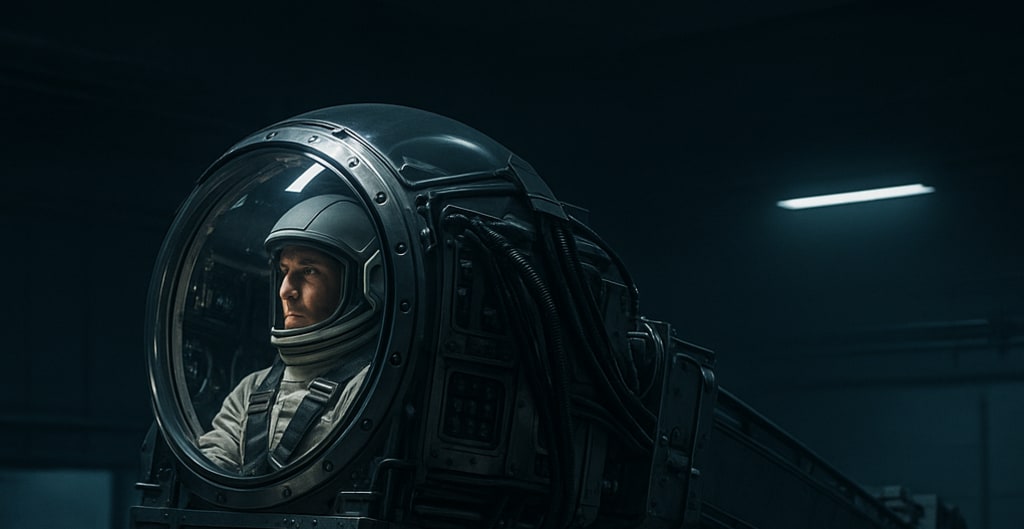
It looks like something from a science-fiction movie: a long mechanical arm with a capsule at the end, spinning at incredible speed. Inside, the astronaut experiences intense G-forces — the same crushing pressure felt during rocket launch and atmospheric re-entry.
During a launch, astronauts typically endure around 3 to 4 Gs, meaning their bodies feel three to four times heavier than normal. During descent, it can spike even higher. The centrifuge recreates those conditions in a safe, controlled environment.
So why put trainees through this ordeal? Because the human body isn’t built for it. Under high G-forces, blood is pulled away from the brain, vision narrows into “tunnel vision,” and consciousness can fade in seconds. Astronauts learn special breathing and muscle-tensing techniques — known as the Anti-G Straining Maneuver — to keep blood flowing to the brain and stay conscious.
Medical teams monitor every second of the test: heart rate, blood pressure, and oxygen levels. If a trainee can’t handle the load, their program is adjusted — or they’re removed from flight training altogether.
“It’s not about being fearless,” explains NASA flight surgeon Dr. Karen Lee. “It’s about understanding your body’s limits — and then pushing those limits safely.”
Stage 4: Final Countdown — Living Every Second Before Launch
As the launch date approaches, life becomes a countdown of precision. Crews spend weeks rehearsing every move in full-scale spacecraft mockups. Every procedure — from undocking to emergency aborts — must become second nature.
In the final days, astronauts enter quarantine to avoid illness before flight. They undergo medical checks, test their suits, and mentally prepare for the mission ahead. There’s little room for nerves — only discipline, routine, and focus.
The Reality of Space: The Training Never Ends
Even after reaching orbit, the learning continues. Life aboard the ISS is demanding — filled with scientific experiments, equipment maintenance, and strict exercise routines to prevent muscle and bone loss.
The glamour of spaceflight often hides the reality: it’s less about exploration and more about endurance. But that’s exactly what makes astronauts remarkable. Their training — including those grueling hours in the centrifuge — ensures that when something goes wrong hundreds of miles above Earth, they can stay calm, think clearly, and bring everyone home safely.
In the end, astronaut training isn’t about testing how strong a person is. It’s about proving that under extreme conditions — physical, mental, and emotional — they can still perform flawlessly.
Space will always be unforgiving. But for those who have survived the centrifuge, the deserts, the endless simulations, and the sleepless nights, the first glimpse of Earth from orbit is more than worth it.
About the Creator
Keep reading
More stories from Holianyk Ihor and writers in Futurism and other communities.
About Binding Prometheus
I want to start actively advocating on behalf of my own work, and the most valuable part of my canon is, without a doubt, Binding Prometheus, the play I have been working on since 2019 and only finished in 2023 as part of my MA. The play itself is an amalgamation of a million different inspirations. On one end, it evokes the Ancient Greek myth-play, deriving its own title from the earliest extant work of Western drama we have, Aeschylus’s Prometheus Bound. On the other end, it borrows significantly from the sci-fi bulwarks from over the years, namely Mary Shelley’s Frankenstein and Karel Capek’s Rossum’s Universal Robots. The play could be an episode of Black Mirror, I fear. I don’t know. I’ve only ever seen one episode of Black Mirror.
By Steven Christopher McKnight17 days ago in Futurism
UAE Mental Health Market: Rising Awareness, Service Expansion & Growth Outlook
According to IMARC Group's latest research publication, UAE Mental Health Market size reached USD 13.10 Billion in 2024. Looking forward, IMARC Group expects the market to reach USD 28.26 Billion by 2033, exhibiting a growth rate (CAGR) of 8.92% during 2025-2033.
By Abhay Rajput5 days ago in Futurism


Comments
There are no comments for this story
Be the first to respond and start the conversation.