
Title: Confessions of a Digital Archaeologist: Why I Chase the Ghosts of Secret History
It began with a single loose thread in the official story. Now, it's a life's work. This isn't just about UFOs and conspiracies; it's about the questions we're not supposed to ask.
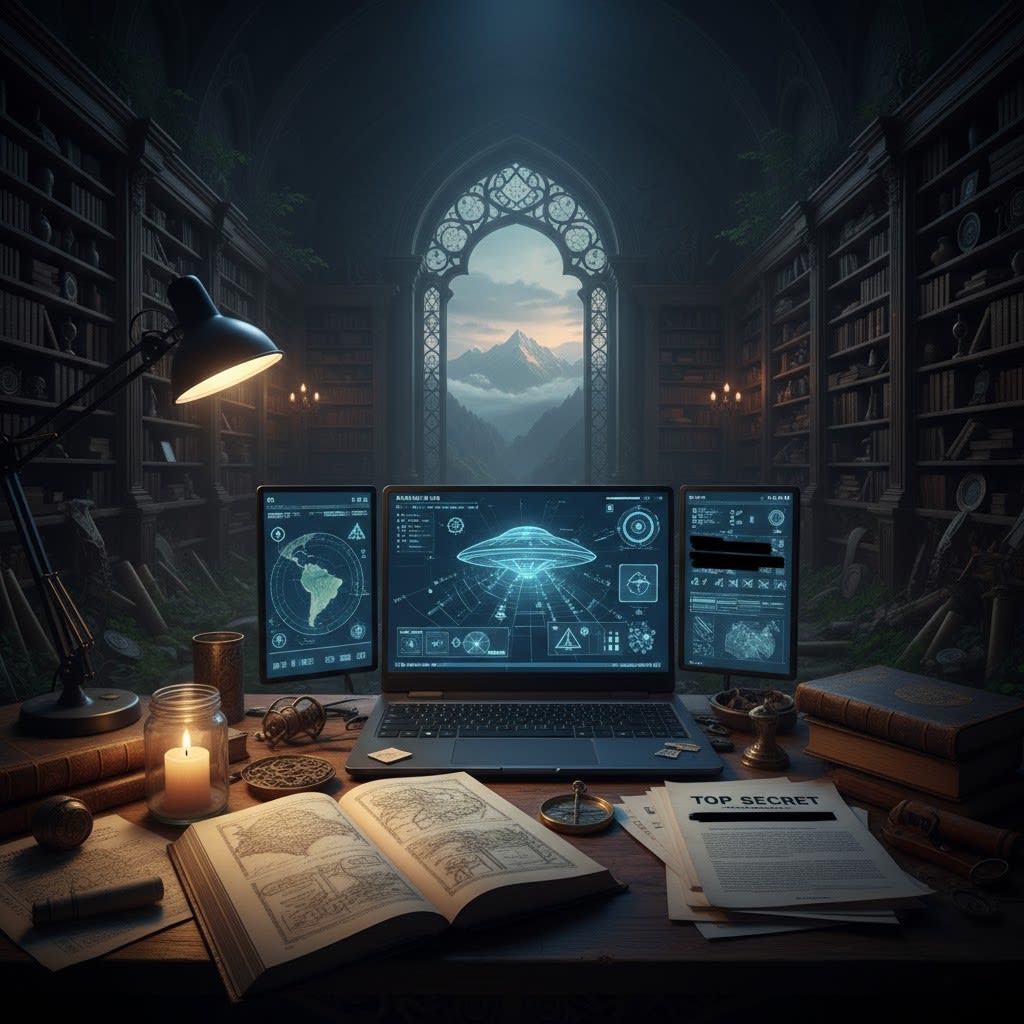
History, for most of us, is a museum. It’s a collection of curated artifacts, polished plaques, and settled stories encased in glass. We walk through its quiet halls, observe the accepted timeline of events, and trust that the narrative we’re given is the complete one. For a long time, I walked through that same museum. But then, one day, I noticed a crack in the glass. And through that crack, I saw that history wasn’t a quiet museum at all. It was a living, breathing crime scene!
My name is Marke, and I am the author and lead investigator behind the Secret History project. My work has led me down a thousand rabbit holes, from the dusty archives of declassified government documents to the windswept mesas of the American Southwest and the forgotten codices of ancient civilizations. I write books and publish a research newsletter about the things that don't fit, the anomalies, the cover-ups, and the persistent, nagging mysteries that lie just beneath the surface of our accepted reality. People often ask me why I do it. Why spend countless hours chasing these mysteries and connecting seemingly disparate dots?
The answer is simple: I do it because I believe the most important truths are often hidden in the footnotes, the redacted paragraphs, and the stories that are dismissed just a little too quickly. I am, for lack of a better term, a digital archaeologist. But instead of digging for pottery shards, I dig for buried truths.
The First Loose Thread: A Lie Told in Black and White
Every obsession has an origin story. Mine didn't begin with a dramatic flash of light in the night sky, but with the quiet rustle of old newspaper clippings. As a young man, I became fascinated by the Roswell incident of 1947. Like many, I had heard the sensational stories. But what truly captivated me was not the tale of a crashed flying saucer, but the stark, undeniable whiplash of the official narrative.
One day, the headlines, sanctioned by the Roswell Army Air Field itself, screamed: “RAAF Captures Flying Saucer on Ranch in Roswell Region.” The next day, that story was completely retracted. The official explanation was swift and dismissive: it was nothing more than a weather balloon.
Something about that sequence felt profoundly wrong. Not just the possibility of a cover-up, but the sheer arrogance of it. The authorities weren't just offering a different explanation; they were telling the entire world, "What you thought you saw yesterday, you didn't. Go back to your lives." For me, that was the first loose thread. I pulled on it, and I’ve never stopped pulling.
I realized that the story wasn't about whether the debris was a balloon or a spaceship. The real story was about the anatomy of a cover-up. It was about the speed with which information could be controlled, the way language could be manipulated, and the power of an official stamp to erase a public memory. It taught me a fundamental lesson: when an official narrative is messy, contradictory, or changes overnight, that’s precisely where the real history begins. Roswell was my training ground. It taught me to stop looking at the object of the story and start looking at the behavior of the storytellers.
My Compass in the Archives: A Philosophy of Investigation
The world of alternative research is a minefield. It’s littered with disinformation, confirmation bias, and grifters peddling sensationalism for clicks. To navigate it without losing your way, you need a compass. Over the years, I have developed a set of core principles that guide every piece of work I publish, from my books to my newsletter.
1. Follow the Documents, Not the Gurus: Eyewitness testimony is powerful but fallible. Personal belief is compelling but not evidence. My foundation is always built on primary sources: declassified government files obtained through the Freedom of Information Act (FOIA), official military reports, leaked memos, and archived correspondence. These documents are often sanitized and redacted, but the traces of truth they leave behind are invaluable. The blacked-out lines are often as telling as the words left behind.
2. Question Everything, Especially My Own Beliefs: The greatest trap in this field is wanting to believe. It’s a powerful siren song that can lead even the most rigorous researcher astray. My job is not to prove a preconceived notion. My job is to ask questions and follow the evidence where it leads, even if it leads to an uncomfortable or inconclusive answer. I am as skeptical of a convenient "alien" explanation as I am of a dismissive "weather balloon" excuse.
3. Connect the Dots Across Disciplines: History is not a silo. The mysteries of ufology cannot be understood without also understanding military technology, political history, psychology, and even geology. A strange light seen in the sky over a remote region becomes infinitely more interesting when you discover a secret aerospace testing facility was operating just over the ridge, or that the area has a long history of unusual magnetic anomalies. The truth is rarely found in one file; it’s found in the resonance between files from completely different departments.
4. Separate the Signal from the Noise: For every credible account, there are a hundred hoaxes. For every intriguing document, there are a thousand pages of noise. A huge part of my work is filtration, learning to recognize the patterns of disinformation, the hallmarks of a credible witness, and the scent of a genuine mystery. It’s about finding the signal of truth amidst an overwhelming cacophony of noise.
This philosophy is the bedrock of my work. It’s a promise I make to my readers: I will never serve you a conclusion I cannot support with evidence. I will not ask you to believe; I will only ask you to look at the data with me and ask your own questions.
The Books: The Galactic War
My books are not meant to be encyclopedias of strange events. They are deep-dive investigations into specific "cracks" in the official museum of history. Each one represents a multi-year journey down a particular rabbit hole, an attempt to map a part of our unseen world.
My first book, Galactic War, was my attempt to go beyond the tired "alien vs. weather balloon" debate. I wasn't trying to identify the debris. I was trying to map the cover-up. The book focuses on the secret space programs. It details the intimidation of witnesses, the manipulation of the press, and the birth of the modern national security state’s playbook for information control. It’s a book about the machinery of secrecy, a story that is more relevant today than ever.
Next, I turned my attention from the recent past to the ancient one. My second book, The Unknown Father Beyond Yahweh's Shadow, tackles the thorny subject of archaeological anomalies and "ancient astronaut theory." But instead of making grand pronouncements, I chose to focus on asking specific, grounded questions. How did a prehistoric culture grant this kind of knowledge? What do we make of the consistent, worldwide myths of civilizing gods who descended from the sky? The book is not an argument for aliens building the pyramids; it's an investigation into the very real evidence that suggests our ancestors may have been more technologically advanced, or had more exotic help, than mainstream history is willing to admit.
My latest work, The Books of Galactic War: The Hidden History of Cosmic, brings the investigation into the modern era. It’s a deep dive into the world of Unacknowledged Special Access Projects (USAPs) and the military-industrial complex. It examines the verifiable history of secret projects, from the CIA’s mind-control experiments in MKUltra to the development of stealth aircraft like the F-117. The book makes a simple argument: given the documented history of government secrecy around advanced technology, the idea of a hidden program dealing with recovered non-human technology is not a wild conspiracy theory. It is a logical extension of a pattern of behavior that has been established for over 70 years.
These books are cornerstones of my research, but they are also static snapshots in time. The moment a book is published, the investigation has already moved on. The real, living work happens elsewhere.
The Ongoing Investigation: Why My Work Lives on Substack
History is not static, and neither is the search for it. New documents are declassified every month. New whistleblowers come forward. New connections are made. A book is an archive, but a newsletter is a real-time research journal.
This is why the heart of my work today is my Substack newsletter, also called Secret History. It’s where the investigation unfolds week by week. It’s my digital field notebook, my evidence locker, and my direct line of communication to a community of fellow seekers who are just as passionate about these questions as I am.
On Substack, I can share a newly unearthed document the day I find it. I can present a raw, unfiltered interview with a witness. I can explore a promising new lead and take my readers along for the ride. It allows me to be nimble, to follow the story as it breaks, and to engage in a two-way conversation with thousands of readers whose own insights and expertise constantly enrich the investigation.
The free subscription gives you access to my weekly dispatches and analyses, but for those who want to support the research and go even deeper, the paid subscription is the key to the inner circle. It unlocks the multi-part, deep-dive series, the kind of comprehensive investigations that take weeks to assemble, and gives you access to the full archive of my work. It’s what funds my FOIA requests, my travel to interview sources, and the countless hours spent sifting through digital archives.
An Invitation to the Expedition
The work of a digital archaeologist is, by its nature, lonely. It involves long hours spent in the silent company of forgotten files and fading photographs. But through my writing, I have discovered that I am not alone at all. There is a vast community of curious, intelligent, and open-minded people who also suspect that there is more to our story than we’ve been told. This article is my confession, but it is also my invitation.
The investigation is happening now. As I write this, I am preparing for my next major deep dive, a special series we're calling Memories from the Stars: South America's Cosmic Legacy. It centers on a series of incredible events in South America, supported by recently uncovered documents that challenge the official history of the entire region. The trail involves reclusive scientists, strange aerial phenomena, and a level of advanced technology that simply should not have existed at the time.
This is your invitation to join the expedition. To move beyond the curated exhibits of the museum and step into the active, ongoing crime scene of history. To stop being a tourist and become an investigator.
If you have ever felt that same pull of a single loose thread, if you have ever believed that the most interesting stories are the ones that are yet to be told, then I invite you to join me. The journey is challenging, the answers are never easy, but I promise you this: it is never, ever boring.
To be part of the ongoing investigation and receive my findings directly, subscribe to my free newsletter at Substack. The first briefing on "The Classified Dossier" begins next week.
About the Creator
The Secret History Of The World
I have spent the last twenty years studying and learning about ancient history, religion, and mythology. I have a huge interest in this field and the paranormal. I do run a YouTube channel
Keep reading
More stories from The Secret History Of The World and writers in Futurism and other communities.
Volume 7: After the Sky Opens: Life in the First Days of Disclosure
Life in the First Days of Disclosure The moment humanity has waited for will not arrive with fanfare or fireworks. It will come with silence broken by a collective gasp, a shockwave of realization that spreads not from governments or generals, but from the people who look to the sky and understand that everything has changed. Disclosure will not be the end of a mystery; it will be the beginning of a reckoning. And what follows in the days, weeks, and months after will test the very soul of humanity.
By The Secret History Of The WorldExclusive • 5 months ago
About Binding Prometheus
I want to start actively advocating on behalf of my own work, and the most valuable part of my canon is, without a doubt, Binding Prometheus, the play I have been working on since 2019 and only finished in 2023 as part of my MA. The play itself is an amalgamation of a million different inspirations. On one end, it evokes the Ancient Greek myth-play, deriving its own title from the earliest extant work of Western drama we have, Aeschylus’s Prometheus Bound. On the other end, it borrows significantly from the sci-fi bulwarks from over the years, namely Mary Shelley’s Frankenstein and Karel Capek’s Rossum’s Universal Robots. The play could be an episode of Black Mirror, I fear. I don’t know. I’ve only ever seen one episode of Black Mirror.
By Steven Christopher McKnight19 days ago in Futurism
Saudi Arabia Fuel Station Market: Retail Network Expansion, Mobility Demand & Market Growth
According to IMARC Group's latest research publication, Saudi Arabia fuel station market size was valued at USD 871.8 Million in 2025. The market is projected to reach USD 1,122.7 Million by 2034, exhibiting a growth rate of 2.85% during 2026-2034.
By Suhaira Yusuf7 days ago in Futurism
Center Stage with Paul Stewart
*** I'm keen to republish the interviews I did for my series with Vocal creators. It's been a few years and I thought it might be nice to revisit these wonderful conversations. I'll be releasing them one at a time for a few weeks/months.
By Heather Hubler4 days ago in Interview



Comments
There are no comments for this story
Be the first to respond and start the conversation.