
The Workforce of Tomorrow
How Technology is shaping Jobs and Skills


Introduction:
The rapid advancement of technology is redefining the global job market, pushing industries to evolve at an unprecedented pace. The World Economic Forum’s (WEF) Future of Jobs Report 2025 provides a deep dive into these transformations, highlighting how innovations across sectors like artificial intelligence (AI), blockchain, green technology, and automation are reshaping the skills required for the workforce of tomorrow. Up-skilling or re-skilling is going to be the norm in the future.
This article explores the data, trends, and implications of this technological revolution.
The Evolution of Work & Technology
The integration of technology into the workforce has been a consistent trend over the last three decades:
- 1990s: Automation began disrupting manufacturing jobs, with robotics and early AI tools like rule-based systems driving efficiency.
- 2000s: The digital transformation accelerated, as global internet penetration surpassed 50%. This era saw the rise of fintech disruptors like PayPal and early blockchain experiments.
- 2010–2020: AI tools such as IBM Watson and deep learning models transformed industries like healthcare, finance, and customer service.
The report highlights how the pace of change has significantly increased since the 2010s, setting the stage for unprecedented shifts by 2030.
Technology’s Expanding Role in the Job Market
Automation and AI: Change agents
AI and automation are no longer emerging technologies—they are central to business strategies. According to the report, automation will displace 85 million jobs by 2025 but simultaneously create 97 million new roles, particularly in fields like Big Data, Data Science, green energy, AI engineering, and software development.
- Green Energy Jobs: The rise of AI-driven renewable energy systems is accelerating demand for specialists in energy storage and smart grid management. For instance, the global market for renewable energy technologies grew by 10% annually between 2020 and 2023.
- AI in Healthcare: AI systems are transforming healthcare delivery by improving diagnostics accuracy by 15% and reducing patient wait times by automating administrative tasks(WEF†source).
Blockchain and Transparency in Industries
Blockchain’s impact extends far beyond fintech. It is revolutionizing supply chains, enhancing transparency, and enabling secure identity management.
- Supply Chain Innovation: IBM’s blockchain platform reduced global invoicing errors by 75%, streamlining processes for multinational companies【IBM 2023†source】.
- Identity Management: Blockchain-based ID systems are forecast to empower 1 billion people by 2030, enabling secure access to banking and government services【UNDP 2023†source】
The Emerging Skills Landscape:
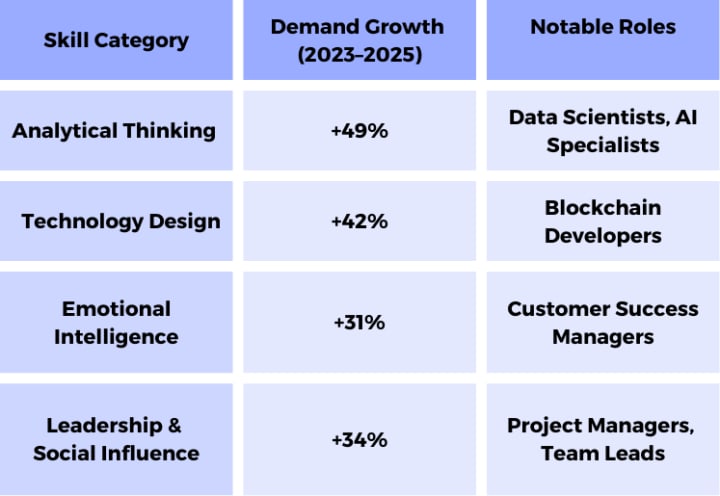
The shift toward AI and blockchain-centric economies requires a redefinition of workforce capabilities. According to the report, the most in-demand skills by 2025 will include analytical thinking, technology design, and emotional intelligence.
Snapshot of Skills and their projected Demand:
Future Projections: 2025–2030
Looking ahead, the WEF projects significant trends across AI, fintech, and blockchain:
1. AI-Driven Industries:
- By 2030, AI is expected to contribute $15.7 trillion to the global economy (PwC).
- Autonomous AI systems will manage 70% of routine tasks in sectors like banking and insurance, freeing professionals for strategic decision-making.
2. Blockchain for Financial Inclusion:
- Blockchain technology is forecast to onboard 1 billion unbanked individuals into the global financial system by 2030.
- Smart contracts will streamline international trade, reducing costs by up to 30%.
3. Fintech Evolution:
- AI-powered lending platforms will dominate SME financing, shortening loan approval times from days to minutes.
- Digital wallets and biometric payments is projected to replace physical cards, increasing transaction security and convenience.
4. Job Market Dynamics:
Net job creation in AI-related fields is estimated at 12 million by 2030.
Cross-functional roles combining technical and leadership skills will be highly sought after, with a premium on adaptability.
Challenges to Address
While these advancements promise significant benefits, challenges remain:
- Re-skilling Needs: Over 50% of workers will require up-skilling or re-skilling by 2025, particularly in AI and blockchain.
- Workforce Displacement: Low-skill, repetitive jobs remain vulnerable to automation. Policies focused on universal basic income and job transition programs will be crucial.
- Access to Education: Ensuring equitable access to digital skills training will determine whether emerging economies can fully participate in the tech-driven workforce.
Conclusion:
AI, fintech, and blockchain are not just buzzwords—they are transformative forces reshaping the global workforce. As automation and digital tools redefine roles, professionals and organizations must embrace continuous learning and innovation to thrive in this evolving landscape. The future holds immense promise, but realizing it requires proactive planning and equitable implementation.
Disclaimer:
This article is based on data from the World Economic Forum’s "Future of Jobs Report 2025." All interpretations and analyses are the author’s own. For detailed information, refer to the original report at World Economic Forum. This article also incorporates data from publicly available reports, including McKinsey, Grand View Research, and individual banking institutions. While every effort has been made to ensure accuracy, projections are based on current trends and may evolve with market dynamics. The article is intended for informational purposes and not as specific financial advice.
About the Creator
Bunty Khatija
Technology transformation leader in BFSI leading fintech products, programs and startups from zero to one influencing strategic planning, scoping, execution, analytics, cross-border interactions, & launches, globally, since last 20+ years.
Keep reading
More stories from Bunty Khatija and writers in Futurism and other communities.
Artificial Intelligence in Wealth Management
Introduction: Artificial intelligence (AI) has emerged as a transformative force in wealth management, revolutionizing how firms manage portfolios, engage clients, and detect risks. From early innovations like robo-advisors to cutting-edge AI models optimizing multi-trillion-dollar portfolios, the journey is one of continuous evolution.
By Bunty Khatijaabout a year ago in Futurism
About Binding Prometheus
I want to start actively advocating on behalf of my own work, and the most valuable part of my canon is, without a doubt, Binding Prometheus, the play I have been working on since 2019 and only finished in 2023 as part of my MA. The play itself is an amalgamation of a million different inspirations. On one end, it evokes the Ancient Greek myth-play, deriving its own title from the earliest extant work of Western drama we have, Aeschylus’s Prometheus Bound. On the other end, it borrows significantly from the sci-fi bulwarks from over the years, namely Mary Shelley’s Frankenstein and Karel Capek’s Rossum’s Universal Robots. The play could be an episode of Black Mirror, I fear. I don’t know. I’ve only ever seen one episode of Black Mirror.
By Steven Christopher McKnight21 days ago in Futurism
AI-Powered Supply Chain Planning Software Market Gains Momentum as Enterprises Embrace Automation
Research Insights According to Market.us, The global AI Powered Supply Chain Planning Software market was valued at USD 11.38 billion in 2025 and is expected to expand rapidly over the forecast period. The market is projected to reach approximately USD 240.96 billion by 2035, growing at a strong CAGR of 35.7% from 2025 to 2035. This growth is driven by increasing supply chain complexity and rising demand for real time forecasting, demand sensing, and inventory optimization. Enterprises are adopting AI driven planning platforms to improve resilience, reduce operational costs, and enhance end to end visibility.
By Roberto Crum2 days ago in Futurism


Comments
There are no comments for this story
Be the first to respond and start the conversation.