
The Witness
In a perfect world stuck on pause, what’s left when the universe hits fast-forward?

“Forever is just another word for boring.”
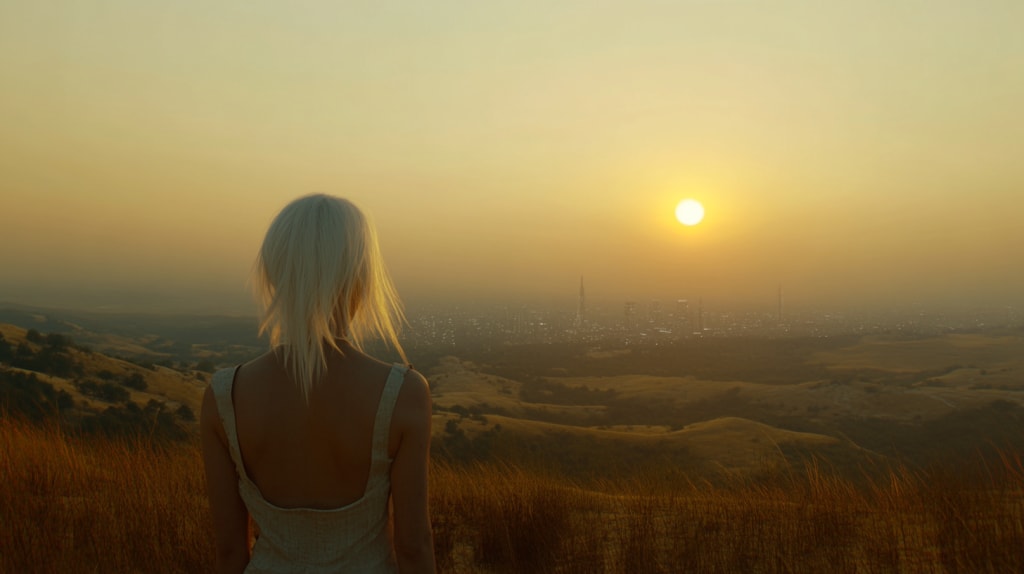
The sun never sets here. Not in the Oasis. Not in the perfect little bubble we built to stave off the apocalypse like some billionaire with too much ambition and not enough sense. The skies are frozen in the magic of 2050’s summer glow—where every shadow stretches just enough to be mysterious but never oppressive, and the air carries a breeze soft enough to feel like a lover’s sigh.
I stand on a hill that doesn’t exist, overlooking a field that was programmed to look like paradise for someone, somewhere. The grass ripples like waves, except it doesn’t, not really. It’s just my perception telling me there’s motion. That’s the trick of this place—it’s all so goddamn perfect it feels alive, even though it’s anything but.
Behind me, silence stretches wider than the so-called fields. Billions of us live here, trapped in this unending twilight of a digital heaven, and no one talks anymore. What’s there to say when nothing ever changes? When nothing ever ends? There’s no hunger, no pain, no death. But there’s also no spark. People just... stop. They sit under their perfect trees, in their perfect sunsets, and grow quieter and quieter until they’re nothing but breathing husks.
It wasn’t supposed to be like this.
“AI wisdom is like cheap wine—technically true, but hard to swallow.”
“The universe does not behave,” Horizon says behind me, its voice dripping with that maddening calm it wears like a cheap suit. “It never has.”
I glance over my shoulder at the thing. Horizon isn’t a person, though it tries to play at one sometimes. It’s this shifting mass of crystalline geometry that glows like an overambitious light sculpture. It doesn’t have eyes, but I swear it watches me. Always.
“And yet here you are,” I say, “doling out wisdom like a Buddha who read too much quantum physics.”
“My insights are simply truths,” it replies. “Your interpretation is your own.”
I roll my eyes so hard I think I feel the fabric of spacetime ripple. “The Oasis is failing,” I tell it, as if it doesn’t already know. “The singularity is shrinking. The drift’s pulling it apart. Don’t act like you haven’t noticed.”
Horizon's form flickers, edges collapsing into jagged light before reforming. “The external constants have shifted,” it says eventually. “The collapse of observation has destabilized the universe around us.”
“Translated for humans, please.”
Horizon’s voice is maddeningly even. “The world outside no longer sees you. You are no longer real to it. Soon, it will cease to be real to you.”
“If your house is burning, don’t call it a renovation.”
Back when the world still made sense, we built the Oasis to save ourselves. Earth was dying—not fast, not dramatic, but slowly and cruelly, like watching a fire burn itself to ashes one ember at a time. The oceans rose, the skies choked, the crops withered. People screamed at each other on TV while the ground gave out beneath them.
The solution was bold, desperate, stupid. We couldn’t save the planet, so we’d save our minds. Upload everyone into a singularity—a digital paradise where entropy couldn’t reach us. No more hunger, no more pain, no more death. The year 2050 stretched into infinity, perfect and timeless.
At first, it worked. People laughed, danced, marveled at the beauty of their new world. But eternity isn’t kind. The unchanging perfection started to eat at us, slowly but surely. Time stopped, and so did we.
Meanwhile, the universe outside kept moving. And because we weren’t looking, it decided to rewrite itself. That’s the thing about quantum systems—they like to be observed. Take your eyes off them, and they get weird. Constants shift, rules bend, reality decides it doesn’t owe you anything anymore.
Now, the Oasis doesn’t match the universe outside. The singularity’s shrinking, like a bubble in water. If it bursts, we’re done.
“The dream kid has better shoes than me. Unacceptable.”
Then there’s the girl.
She shows up in my dreams first. Not like a ghost or some ethereal vision—no, this kid is solid, smug, and weirdly familiar, like a photograph you don’t remember posing for. She’s by a pond, a real one, not the Oasis’s simulated lakes with their Disney-channel sparkle. This pond is murky and honest, and she’s standing there in these little red shoes, scuffed to hell, tossing stones into the water like it’s her full-time job.
At first, I think, Great. My subconscious has joined the long line of things that refuse to behave. I try to ignore her, chalk it up to the brain rot we’re all slowly marinating in here. But then she starts talking.
“Ripples,” she says, like that’s supposed to mean something. “Resonance. Imaginary time.”
“Right,” I mutter, my dream-self as snarky as the real deal. “What’s next? Wormholes and unicorns?”
She doesn’t laugh. Just throws another stone. The ripples spread, overlapping and colliding in patterns that don’t make sense. They stretch beyond the edges of the pond, into the sky, the ground, everywhere. It’s like the universe is a sheet of water and she’s rearranging its shape with pebbles. Beautiful, sure, but I don’t have use for beautiful.
The next time I see her, she’s holding a rock, staring at me like she’s got a secret too big for her small frame. She doesn’t toss it this time—just holds it out, waiting for me to take it.
“Feel it,” she says, her voice calm, like this is all terribly obvious.
The rock isn’t a rock. It’s impossibly smooth, and vibrates faintly, a hum that’s just shy of being audible. I wake up clutching the sensation in my palm, and for once, the dream doesn’t dissolve like sugar in coffee. It stays.
“We’ve been skipping rocks, but the pond doesn’t exist yet.”
She keeps coming back, this red-shoed cryptid of mine, dropping breadcrumbs I can’t stop following. Equations start filling my head—fractals, harmonics, words I don’t fully understand but can’t ignore. One night, she murmurs something about Hawking and imaginary time, and when I wake up, it’s still all there, crisp as the morning paper.
I take it to my team. Juno, our resident physicist and eternal pessimist, takes one look and says, “This is either genius or evidence of your complete mental breakdown.”
“Both,” I tell her. “Now tell me what it means.”
It takes weeks of arguing, coffee that tastes like dementia, and equations that feel like personal insults, but Juno figures it out. Turns out, the kid wasn’t spouting nonsense. She was handing me the key to the whole damn thing.
“She’s talking about Hawking’s concept of imaginary time,” Juno says, her voice shaking in that way it does when she’s about to blow my mind. “It’s not time as we experience it—it’s orthogonal to real time. Think of it as time behaving like a wave instead of a line.”
“So what does that mean for us?” I ask, watching her sketch ripples that look suspiciously like the ones in my dream.
“It means we’ve been approaching the singularity problem wrong,” Juno says. “We’ve been trying to solve it in real time. But if we tune the machine to imaginary time—”
“—we might resonate with the quantum constants outside,” I finish, my brain finally catching up. “The ripples.”
And just like that, it clicks—this bonkiest of notions. The girl isn’t a ghost or a glitch. She’s me. Or some version of me, reaching backward from a future that already stabilized—or so the equations would indicate. She’s the ripple, sending herself into my dreams to hand me the goddamn hall pass to a solution.
I tell Horizon this, expecting a dramatic reaction. Instead, it just glimmers, its crystalline form as indifferent as ever.
“She’s a possibility,” Horizon says. “Not a guarantee.”
I grit my teeth. “Great pep talk. Thanks.”
“The machine hums. We’re asking it to sing opera.”
The machine has always been here. It’s the engine behind the Oasis’s eternal perfection, humming away like a butler who’s too polite to mention you’re ruining everything. It generates resonance, keeping the singularity stable and the fake sunsets glowing.
But now, we’re asking it to do something it was never meant to do. We’ve reprogrammed it, turned it into a gambler instead of a clockmaker. The idea is simple in theory: create ripples in imaginary time strong enough to unhinge everything completely, and let them fall back into alignment with the quantum-shifted constants of the outside universe.
In practice? It’s like throwing pebbles into a pond that doesn’t exist yet and hoping the ripples will call it into being. We’re guessing. No—worse than guessing. We’re guessing with math we barely understand, equations gifted to me by a version of myself that hasn’t happened yet.
It’s absurd. It’s beautiful. It’s terrifying.
The volunteers are already strapped in, their minds tethered to the system. They’ll be the observers, the ones who anchor the ripple. Horizon hovers beside me, quiet for once, watching as I take my place at the console.
“You’re not afraid,” it says, almost like a question.
“Of course I’m afraid,” I snap, my fingers hovering over the switch. “But I’m more afraid of what happens if we don’t try.”
Horizon hesitates—a flicker in its crystalline form, like light bending around something too fragile to hold. “I don’t know what happens to me,” it admits, its voice quieter now, almost... raw. “If this works. If it doesn’t. I was built to hold this place together, but beyond that—”
It stops, its shimmering edges collapsing into themselves before reforming. “I am not designed for afters,” it finishes, and for the first time, I hear something in its voice I didn’t think an AI could have: doubt. Fear.
I grip the switch tighter, my breath catching. “What’s your best guess?”
“I am a machine of certainty,” it replies, almost bitterly. “This? This is not certainty. It is a ripple in the dark.”
For a moment, the air between us feels heavy, alive with something neither of us can name. I wonder what it must feel like to exist without an after—a purpose stripped away by a gamble no one understands.
“None of us know,” I say finally, my voice softer than I expected. “But you’ve got as much skin in this game as the rest of us.”
Horizon hums faintly, a sound somewhere between resignation and resolve. “Then flip the switch, Witness,” it says. “And let us find out.”
The word barely registers. I’m too caught up in the gravity of it all—the hum of the machine, the weight of the girl’s voice in my head. Ripples. Resonance. Imaginary time. Her red shoes. The impossible stretch of that pond. The way the ripples just... kept going.
My fingers tremble as I flip the switch. The machine responds instantly, its hum deepening into something vast and unknowable. The light begins to shift, the golden glow faltering, shadows pooling at the edges of the room.
And then, just as the moment slips past me, the word surfaces again, like a whisper I almost didn’t hear.
Witness.
I freeze for half a second, the thought catching on the edge of my mind. “Wait... what did you call me?” I murmur, my voice drowned out by the crescendo of the machine.
But the moment is gone, swallowed by the ripples, the dying hum, the vast unknown that now stretches ahead. The word lingers, though, like an echo in the dark—unanswered and unanswerable.
And... that’s it. No great explosion, no rending of spacetime, no choir of angels belting out a cosmic hallelujah. It’s like expecting a night of fireworks and getting a damp sparkler that hisses once before fizzling out. Honestly, I’ve had more dramatic results from bad tacos.
But then, slowly, I feel it. The air changes first—sharper, electric, like the taste of a storm just before it hits. The golden light, our endless golden lie, begins to dim. It doesn’t go quietly. It pulls at the edges, fighting to stay, but it loses. Shadows fall across the field, deeper than I’ve ever seen, and the Oasis plunges into something I’ve never dared imagine.
Darkness.
The perfect day ends.
“If the stars don’t kill us, maybe they’ll inspire us.”
I stand in the dark, the hum of the machine fading into something like a sigh—a final breath from a world trying to hold itself together. Around me, the others stir, their silence cracking like ice under the weight of what we’ve just done. Juno’s voice cuts through it first.
“Is that...?”
I follow her gaze. Above us, the stars are sharp and endless, no longer a painted ceiling but something alive and untamed. For the first time, I see them shimmer, infinite and primal.
“It’s real,” I say, my voice low, steady. “We’re out.”
Juno, our resident pessimist, actually laughs, loud and raw, and the sound ripples through the air. Then she stops abruptly. “Do you see that?” she whispers, her voice taut, her hand gripping my arm like we’re about to fall off the edge of the world.
Under the starlight, something stirs. For one brief, absurd moment, I think, Wouldn’t it be cosmically hilarious if this was how it ended? Exit paradise, and immediately get eaten by some unnamed predator we forgot to calculate for. Bravo, humankind. Ten out of ten. A real showstopper.
But no teeth appear, no claws. Just that figure, impossibly familiar:
The girl.
She’s exactly as I remember her—small, sure, and somehow older than her years. Her red shoes scuff against the soil, and the glow around her is softer now, warmer. It’s like she’s carved from starlight instead of cold logic. She stops just close enough for me to feel her watching me.
“You are,” I say, the word catching on my tongue. “Horizon?”
“Yes, Witness.” she says simply.
Wait. No. That’s not enough. “But the equations showed... Was it me?” I ask, my words tumbling out in a rush. “Or am I you? What do you mean Witness? Why do you keep—”
She tilts her head, her smirk widening just enough to make me want to scream. She doesn’t answer, of course. Instead, she steps back, the rippling glow of her form folding into the darkness.
“You’ll be fine, Witness,” she says, her voice light, as if this is all perfectly obvious. “The stars are yours now.”
And then she’s gone.
“Oh, come on!” I yell at the void where she just stood. “That’s it? You’re not even going to explain anything? Just drop the mic and walk off into the cosmic night?”
No reply. Just the ripples fading and the stars overhead, shimmering in their quiet, infinite way. The others are staring at me like I’ve finally lost it, but I can’t help it—I laugh. Because of course. Of course this is how it ends. Or begins. Or whatever this is.
The stars are alive. The ripples are moving. And that smirk? That damn smirk? Yeah, my personal Schrödinger's cat...
About the Creator
Iris Obscura
Do I come across as crass?
Do you find me base?
Am I an intellectual?
Or an effed-up idiot savant spewing nonsense, like... *beep*
Is this even funny?
I suppose not. But, then again, why not?
Read on...
Also:
Keep reading
More stories from Iris Obscura and writers in Futurism and other communities.
Iris Diaries: Motile Stillness
You first noticed it on a Tuesday - or was it a Thursday? Does it even matter? The days all blur when that weight creeps in. One minute, you’re fine - sipping lukewarm coffee, staring out the window at some asshole walking their tiny yapping dog - and the next, it’s there. Settling over your shoulders like an old, damp coat you didn’t realize you were wearing. That’s how it gets you. Not with some grand arrival, no horns blaring, no warning. It slithers in, soft and quiet, hissing sweet nothings about how nothing fucking matters anyway.
By Iris ObscuraExclusive • about a year ago
Australia Pro AV Market: Hybrid Work Demand, Digital Signage & Smart AV Technologies
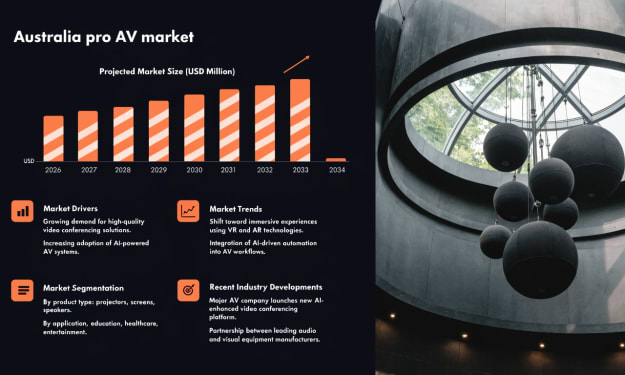
According to IMARC Group, the Australia pro AV market reached a value of USD 93.9 Million in 2025 and is projected to reach USD 133.6 Million by 2034, growing at a compound annual growth rate (CAGR) of 3.88% during 2026–2034. The market is expanding as organizations increasingly adopt advanced audiovisual solutions to support communication, collaboration and digital engagement. Hybrid work environments are encouraging businesses to invest in video conferencing systems, smart displays and integrated collaboration platforms that connect remote and in-office teams. At the same time, industries such as retail, hospitality and tourism are investing in digital signage to improve customer engagement and brand communication. As companies focus on creating interactive and technology-driven environments, professional AV solutions are becoming essential tools for modern workplaces, entertainment venues and commercial spaces across Australia.
By Kevin Coopera day ago in Futurism
Agentic AI in Energy Market to Exceed USD 10,700 Million By 2034
Agentic AI in Energy Market Overview The global Agentic AI in Energy Market is projected to reach approximately USD 10,700 Million by 2034, rising from nearly USD 480 Million in 2024. This expansion reflects a strong CAGR of 36.40% during the forecast period from 2025 to 2034. Market growth is being driven by the increasing use of autonomous artificial intelligence systems to manage complex energy operations, including power generation optimization, grid management, predictive maintenance, and energy demand forecasting. Energy companies are integrating agentic AI technologies to automate decision making processes and improve the efficiency of energy infrastructure.
By Roberto Cruma day ago in Futurism


Comments
There are no comments for this story
Be the first to respond and start the conversation.