
The Voice That Outlived the Empire — And Changed the Way We Remember Power
In the ruins of a forgotten civilization, one voice buried in silence became louder than all the kings who ruled it.

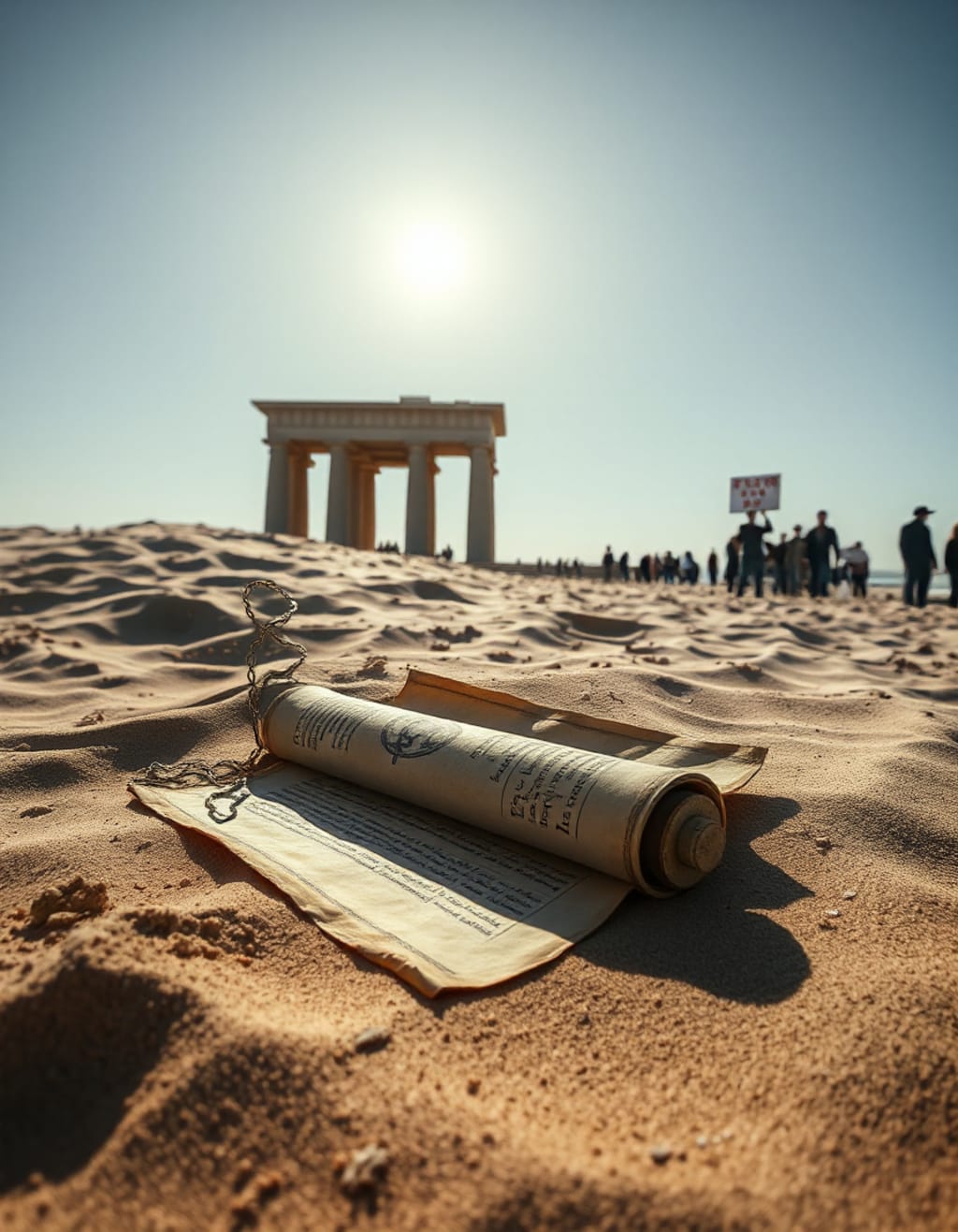
In the final days of the Aurothian Empire, when the marble halls of its senate had grown cold and the golden banners hung tattered by decades of unrest, there lived a man with no name.
Not by birth, but by decree.
His tongue had once spoken freely, but the empire took his language. His name had once been sung by poets, but history, as always, bowed to power. They called him "the Last Scribbler" — a slave, a scribe, a shadow.
And yet, he knew something the emperors never did:
That words, if planted like seeds in time, outlive even the tallest thrones.
---
**I. The Forgotten Room**
Beneath the capital of Aurum lay a chamber. No maps mentioned it. No guards patrolled it. Here, the Last Scribbler worked in silence, archiving laws, forging edicts, and transcribing the lies that kept the empire's illusions alive. But when the fires of rebellion reached the capital, and kings fled their palaces, he remained.
Not because he was brave.
Because he had one last thing to write.
He dipped his quill in ink made from crushed twilight berries. Not black, not blue — a color between forgetting and remembering.
And he wrote:
*"Power that fears truth is power that already knows it will fall."*
His words filled twelve scrolls. Not laws. Not decrees. Truths. About hunger. About silence. About how history betrays those who serve it too loyally.
When the city burned, he buried the scrolls beneath the marble bust of the first emperor. No one would look there. Because no one believed a slave could carve the future with a feather.
He died nameless. Free.
---
**II. The Discovery**
Two thousand years later.
Dr. Maelya Renn, a linguistic anthropologist from the University of Luton, was mapping ancient subterranean ruins beneath what had been Aurothian ground. Her team was funded for only weapons and royal relics. But in the dust, behind a crumbled wall, she found a staircase.
The chamber was intact. Inside, twelve scrolls wrapped in animal hide. Ink still legible. Language: pre-Imperial dialect — unknown to most scholars. But Maelya, whose grandmother whispered stories in that tongue, could read it.
And what she read made her weep.
These were not records.
They were warnings.
Philosophical. Personal. Devastatingly human.
One scroll read:
*"A crown passed down without question is not legacy; it is infection."*
Another:
*"The most dangerous empire is the one that teaches you to love its cage."*
Dr. Renn translated all twelve. When she tried to publish them, governments intervened. Too political, too revolutionary, they said.
So she released them anonymously.
Online.
Within a month, they had been shared across 60 countries.
Within a year, high school students were quoting "The Last Scribbler" in protests.
Within five years, one scroll's quote appeared carved in stone at the entrance of the United Nations:
*"Let not the voice of the silenced be mistaken for consent."*
---
**III. The Echo Effect**
In 2048, a new global curriculum emerged called "The Voice Curriculum."
Instead of memorizing timelines, students explored the philosophies behind fallen empires, learned how propaganda was crafted, and how silence could be louder than swords.
Political leaders began referencing the scrolls in speeches, some sincerely, others for popularity.
Religious scholars argued over whether the Last Scribbler had divine insight.
One monk claimed:
> "He did what prophets do — tell the truth before the world is ready."
The voice that was once buried now taught millions. But no one still knew his name.
Because he never wrote it.
When Dr. Renn was asked why, she said:
> "He didn't want to be remembered. He wanted us to remember *ourselves*."
---
**IV. The Final Scroll**
The twelfth scroll had always been considered incomplete. Its final lines were smudged, erased by time.
But in 2052, new imaging technology revealed the hidden ink beneath. It read:
*"If my voice outlives me, let it not build another throne. Let it build a mirror."*
A mirror.
So we can see that the empires we inherit are the ones we allow. That power borrowed without question becomes tyranny. That silence is never empty — it is full of all the things we didn't say when we still had time.
And so the nameless scribe, the forgotten voice, changed how we define greatness.
Not by blood.
Not by borders.
Not by battles won.
But by truth spoken.
Even when no one is listening.
About the Creator
rayyan
🌟 Love stories that stir the soul? ✨
Subscribe now for exclusive tales, early access, and hidden gems delivered straight to your inbox! 💌
Join the journey—one click, endless imagination. 🚀📚 #SubscribeNow
Plant-Based Food Market: How AI and Innovation Are Shaping the Future of Sustainable Nutrition
Introduction The global food industry is undergoing a significant transformation as consumers shift toward healthier and more sustainable dietary choices. One of the most prominent trends emerging from this shift is the growing popularity of plant-based foods. These products are derived entirely from plant sources such as soy, peas, almonds, oats, coconut, and other plant ingredients, offering alternatives to traditional animal-based products.
By James Smith7 days ago in Futurism
The Interactive Shift: Exploring the Future of Storytelling in Digital Age
For centuries, storytelling was a one-way street. We sat around campfires, listened to bards, turned the pages of novels, and watched silver screens. In these scenarios, the creator was the architect, and we—the audience—were the passive observers. We cried for characters we couldn't warn and cheered for heroes we couldn't help. But we are currently standing at a massive crossroads in cultural history.
By Muhammad Owais SEO3 days ago in Futurism




Comments
There are no comments for this story
Be the first to respond and start the conversation.