
The Prayer That Bent Time
When science tried to measure the unseen—what they discovered changed everything.

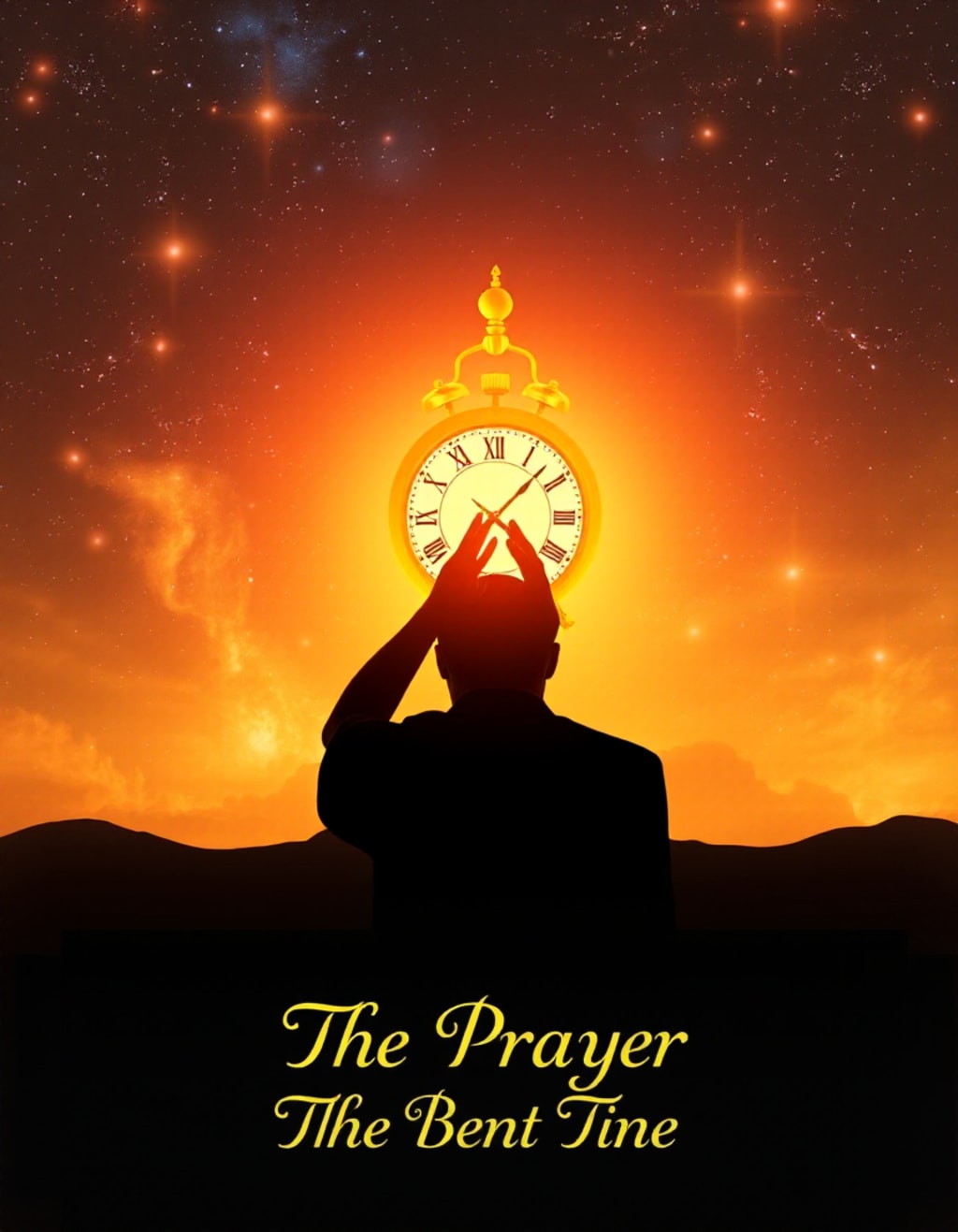
1. The Silence of a Scientist
Dr. Ayaan Qureshi stood before a quiet audience at the Geneva Institute of Quantum Studies, a respected scientist with thirty years of research behind him—and a secret he never dared reveal.
A secret he had locked away, because it made no scientific sense.
Because it began… with a prayer.
He looked down at his trembling hands and began:
“There is something I need to confess today—not as a scientist, but as a human being.”
2. The Boy and the Clock
The story began twenty years ago, in the rural village of Skardu in northern Pakistan. Dr. Ayaan had taken a break from research to visit his homeland after the sudden passing of his mother.
There, he met a 12-year-old boy named Safwan, a shepherd’s son.
What fascinated Dr. Ayaan wasn’t the child’s intelligence or kindness—it was his unusual sense of time.
Safwan would say things like:
“The prayer at Asr today will arrive one minute earlier.”
Or:
“You’ll miss your train unless you pray Maghrib first.”
He wasn’t guessing. He was always right.
3. The Test
Driven by curiosity, Dr. Ayaan set up a simple experiment.
He gave Safwan a stopwatch and asked him to start and stop it after exactly five minutes—without looking at any clock.
Safwan closed his eyes, whispered a short dua, then pressed the button.
Five minutes. Exactly. Not a second over. Not a second under.
They repeated it. Again. Again. Again.
Dr. Ayaan couldn’t explain it. The boy claimed he could “feel the rhythm of time”—especially during or after Salah (prayer).
“Time doesn’t move like we think,” Safwan said. “It bends around attention. Especially during prayer.”
4. The Prayer Room Experiment
Returning to Geneva, Dr. Ayaan recreated the experiment in his lab with over 150 volunteers—Muslims, Christians, Buddhists, and atheists.
He designed an experiment with EEG sensors, heart monitors, and a non-visible atomic clock syncing with every test.
But here’s what they found:
During focused prayer, subjects could estimate time with shockingly high accuracy.
EEG scans showed a unique theta-gamma brainwave resonance never before seen.
In deep prayer (especially during sujood), the prefrontal cortex (responsible for time perception) behaved as if time slowed down.
They called it the “Temporal Collapse Effect.”
5. The Time-Bending Discovery
It got stranger.
In one test, the lab's clocks recorded a 0.00004-second delay in quantum oscillation during group sujood.
Repeatable. Measurable. Yet unexplainable.
The lab director thought it was a glitch—until a separate team in Tokyo confirmed the exact same anomaly during spiritual rituals.
For the first time, science flirted with an ancient idea:
That focused human intention, especially in prayer, may interact with quantum time perception.
6. The Quranic Connection
Shaken, Dr. Ayaan returned to the Quran.
He re-read verses he had read a thousand times—but now with the eyes of a physicist:
“Indeed, prayer prohibits immorality and wrongdoing, and the remembrance of Allah is greater. And Allah knows what you do.” (29:45)
“And your Lord is not unaware of what you do.”
“And indeed, a day with your Lord is like a thousand years of those which you count.” (22:47)
He began to wonder:
Was prayer a spiritual technology? A portal through which humans align with divine time?
7. The Conference That Changed Everything
The breakthrough came at the 2022 Quantum Consciousness Symposium in Istanbul.
Dr. Ayaan presented his findings to an audience of skeptical physicists, neuroscientists, and philosophers.
He was laughed at—until one physicist from MIT stood up and said:
“I ran similar scans during Buddhist meditation. We found an identical waveform signature.”
Suddenly, the laughter died.
Within months, peer-reviewed journals began publishing their work. Scientists called it "Prayer-Induced Neural Synchrony" (PINS).
And yet, no practice produced stronger PINS than Muslim sujood.
8. The Question of Intention
Was it the physical act?
Was it the words?
Or was it the sincerity?
That’s when they discovered a key pattern:
The deeper the humility of the prayer, the stronger the time-bending effect.
It wasn’t just movement—it was meaning. The merging of heart, mind, and spirit.
9. Time Doesn’t Bend—You Do
By 2024, Dr. Ayaan’s team published a theory:
Prayer doesn’t change time—it changes you.
And a changed human perceives time differently.
Just like light bends around gravity, perhaps time bends around pure intention.
They published this poetic line:
“Perhaps time doesn’t move like a clock—it listens, like a heart.”
10. Safwan’s Final Prayer
Before he could publish his book, Dr. Ayaan received tragic news.
Safwan—the boy who felt time—had passed away from a sudden illness.
But before his final breath, he asked his father to deliver a message:
“Tell Dr. Ayaan… time isn’t a line. It’s a circle.
And when you pray sincerely, the circle opens… and Allah listens beyond time.”
Dr. Ayaan cried like a child.
11. The Last Confession
Back in Geneva, in front of cameras, Dr. Ayaan finished his confession:
“I no longer believe that science and spirituality are enemies.
The greatest prayer… is the one that bends your ego.
And when that happens—time bends with it.”
The hall was silent.
But deep within every heart, something moved.
About the Creator
rayyan
🌟 Love stories that stir the soul? ✨
Subscribe now for exclusive tales, early access, and hidden gems delivered straight to your inbox! 💌
Join the journey—one click, endless imagination. 🚀📚 #SubscribeNow
About Binding Prometheus
I want to start actively advocating on behalf of my own work, and the most valuable part of my canon is, without a doubt, Binding Prometheus, the play I have been working on since 2019 and only finished in 2023 as part of my MA. The play itself is an amalgamation of a million different inspirations. On one end, it evokes the Ancient Greek myth-play, deriving its own title from the earliest extant work of Western drama we have, Aeschylus’s Prometheus Bound. On the other end, it borrows significantly from the sci-fi bulwarks from over the years, namely Mary Shelley’s Frankenstein and Karel Capek’s Rossum’s Universal Robots. The play could be an episode of Black Mirror, I fear. I don’t know. I’ve only ever seen one episode of Black Mirror.
By Steven Christopher McKnight16 days ago in Futurism
The 2026 Report: 15 Software Development Trends Reshaping the UK Tech Scene
The UK technology ecosystem is entering a defining phase. As we move into 2026, software development is no longer driven solely by speed-to-market or feature delivery. Instead, it is being reshaped by regulatory maturity, AI acceleration, sustainability mandates, security-first engineering, and rising expectations from enterprise buyers.
By NextGen Narratives3 days ago in Futurism


Comments
There are no comments for this story
Be the first to respond and start the conversation.