
The Vertical Frontier: How Sky Cities Could Redefine Urban Living
Towers That Touch the Stars

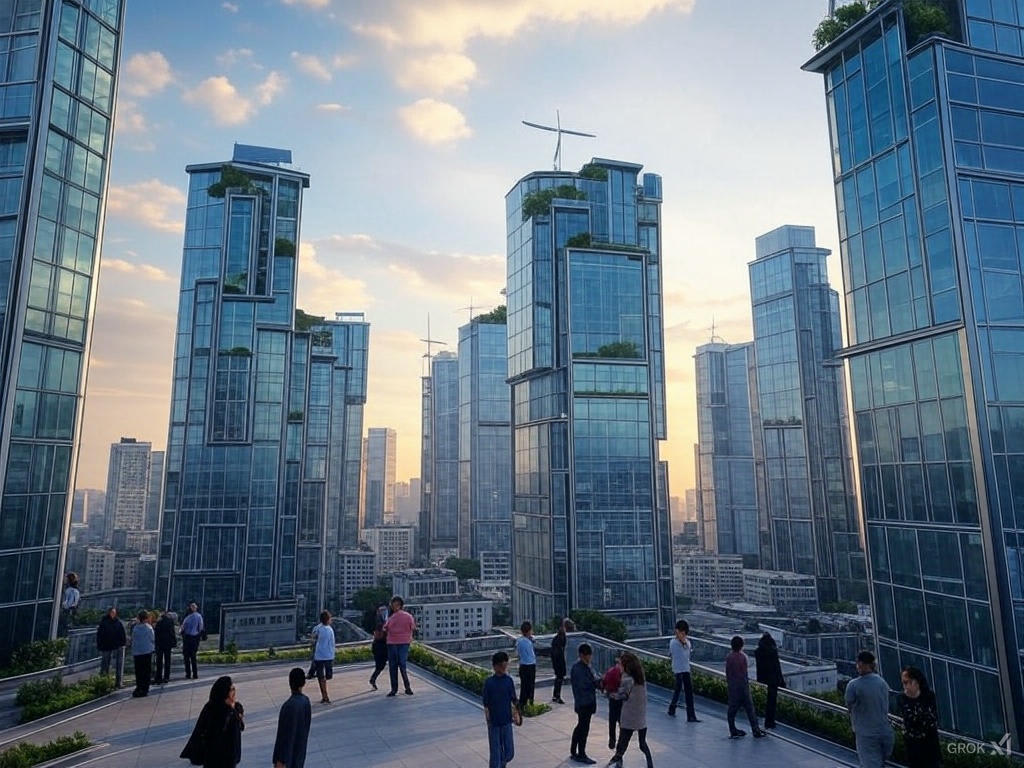
The earth is filling up fast. With the global population inching toward 10 billion by mid-century, cities are bursting at the seams—sprawling outward, clawing upward, and choking on their own growth. Land is a finite resource, and as sea levels rise and arable acres shrink, humanity faces a stark choice: adapt or collapse. What if the answer isn’t more ground-level sprawl or even floating homes, but a leap into the sky? Enter the concept of sky cities—towering, self-contained ecosystems suspended above the earth, poised to revolutionize urban living and tackle the crises of overpopulation, climate change, and resource scarcity.
Towers That Touch the Stars
Sky cities aren’t just taller skyscrapers; they’re a radical reimagining of urban space. Picture a constellation of interconnected towers, each a mile high, linked by aerial bridges and drone highways. These aren’t cold monoliths but vibrant hubs—layered with homes, offices, farms, and forests, all stacked vertically to minimize their footprint. Solar panels cloak their exteriors, wind turbines hum between levels, and rainwater collectors feed lush gardens that cascade down their sides. Inside, residents live, work, and play without ever touching the ground.
The idea builds on precedents like Dubai’s Burj Khalifa or Tokyo’s Sky Mile Tower concept, but scales it up with purpose. Architects like Norman Foster envision these structures as "vertical villages," where every necessity—food, energy, water—is produced onsite. A single sky city could house 50,000 people in the space of a few city blocks, leaving the land below free for nature or agriculture. By 2050, if just 5% of urban dwellers moved skyward, we could reclaim millions of acres for rewilding or farming—an ecological game-changer.
A Solution to Earthbound Woes
Overpopulation isn’t merely a numbers game; it’s a strain on systems. Sky cities could ease that burden in transformative ways. First, they slash land use. A traditional city of 50,000 might sprawl over 20 square miles; a sky city fits that into a fraction of a square mile, preserving ecosystems and reducing deforestation. Second, they’re resource-efficient. Vertical farms using hydroponics could yield crops year-round, while advanced recycling systems turn waste into energy or compost, cutting reliance on distant supply chains.
Climate resilience is another draw. As floods and heatwaves batter coastal and urban zones, sky cities rise above the chaos—literally. Elevated above floodplains and designed to withstand storms, they offer sanctuary where ground-level cities falter. Singapore, a pioneer in vertical urbanism, is already testing "smart towers" that integrate AI to optimize energy and water use. Imagine that scaled up: a network of sky cities could shelter millions displaced by rising seas, from Miami to Mumbai.
The Tech Is Here—Almost
The pieces for sky cities are falling into place. Carbon-fiber materials and 3D-printed concrete make mile-high construction feasible, while renewable energy tech—solar, wind, geothermal—powers them sustainably. Drones and maglev elevators handle transport, whisking residents between levels or to neighboring towers. Companies like Skyrise Cities are prototyping modular designs, where entire floors can be swapped or upgraded without razing the structure. It’s not science fiction; it’s engineering on the cusp of reality.
Yet, challenges loom like storm clouds. Cost is the biggest hurdle—building a single sky city could run into the tens of billions, dwarfing even the priciest megaprojects. Safety is another: how do you evacuate a mile-high tower in a fire or earthquake? Social dynamics pose risks too—will sky-dwellers feel isolated, trapped in a high-altitude bubble, or will they thrive in curated communities? Critics warn of dystopian divides, where only the wealthy ascend, leaving the ground to the rest.
A Skyward Society
Beyond logistics, sky cities demand a cultural shift. Living a mile up means rethinking daily life—no popping out to a corner store, no backyard barbecues. But it could also mean cleaner air, quieter streets, and panoramic views that rival mountaintops. Early adopters might be urban pioneers—tech workers, eco-enthusiasts, or those fleeing crowded slums. Dubai and Shanghai, ever hungry for bold statements, are prime candidates to break ground, with pilot projects rumored by 2030.
The payoff could be profound. Sky cities might not just house us—they could heal the planet. By concentrating humanity upward, we’d ease pressure on forests, wetlands, and farmlands, letting nature rebound. Carbon footprints could shrink as transport shrinks to intra-tower trips. And in a world of worsening climate shocks, they’d offer a literal high ground—a perch to weather the storm.
The Horizon Awaits
Sky cities won’t solve every urban ill. They’re a piece of the puzzle, alongside floating homes, green retrofits, and smarter policies. But their audacity inspires. As we stand at the edge of what’s possible, these vertical frontiers beckon—a chance to live not just on the earth, but above it. Will we take the leap? The future is up there, waiting.
About the Creator
Pure Crown
I am a storyteller blending creativity with analytical thinking to craft compelling narratives. I write about personal development, motivation, science, and technology to inspire, educate, and entertain.
Keep reading
More stories from Pure Crown and writers in Futurism and other communities.
The Cities of Tomorrow: How Floating Homes Could Solve Overpopulation
The world is running out of room. With the global population hurtling toward 10 billion by 2050, cities are straining at the seams. Urban sprawl devours forests and farmland, housing crises push rents into the stratosphere, and coastal regions grapple with the twin perils of overcrowding and rising seas. Traditional solutions—building skyscrapers or sprawling suburbs—can only go so far. But what if the answer lies not on land, but on water? Floating homes, once a quirky novelty, are emerging as a radical blueprint for the cities of tomorrow, promising to ease overpopulation while reimagining how we live.
By Pure Crown11 months ago in Futurism
About Binding Prometheus
I want to start actively advocating on behalf of my own work, and the most valuable part of my canon is, without a doubt, Binding Prometheus, the play I have been working on since 2019 and only finished in 2023 as part of my MA. The play itself is an amalgamation of a million different inspirations. On one end, it evokes the Ancient Greek myth-play, deriving its own title from the earliest extant work of Western drama we have, Aeschylus’s Prometheus Bound. On the other end, it borrows significantly from the sci-fi bulwarks from over the years, namely Mary Shelley’s Frankenstein and Karel Capek’s Rossum’s Universal Robots. The play could be an episode of Black Mirror, I fear. I don’t know. I’ve only ever seen one episode of Black Mirror.
By Steven Christopher McKnight17 days ago in Futurism
Saudi Arabia Retail Market: Data-Driven Merchandising, Supply Chain Agility & Urban Retail Boom Under Vision 2030
According to IMARC Group's latest research publication, Saudi Arabia retail market size was valued at USD 293.6 Billion in 2025. The market is projected to reach USD 411.7 Billion by 2034, exhibiting a growth rate (CAGR) of 3.83% during 2026-2034.
By Jeffrey Wilson6 days ago in Futurism



Comments
There are no comments for this story
Be the first to respond and start the conversation.