
The Universe's Secret Algorithms: 5 Natural Secrets You Didn't Realize Were Code!
Discover the forgotten language of DNA! How nature uses the Fibonacci sequence to program the universe? Your guide to understanding swarm intelligence and the golden code that governs our lives.

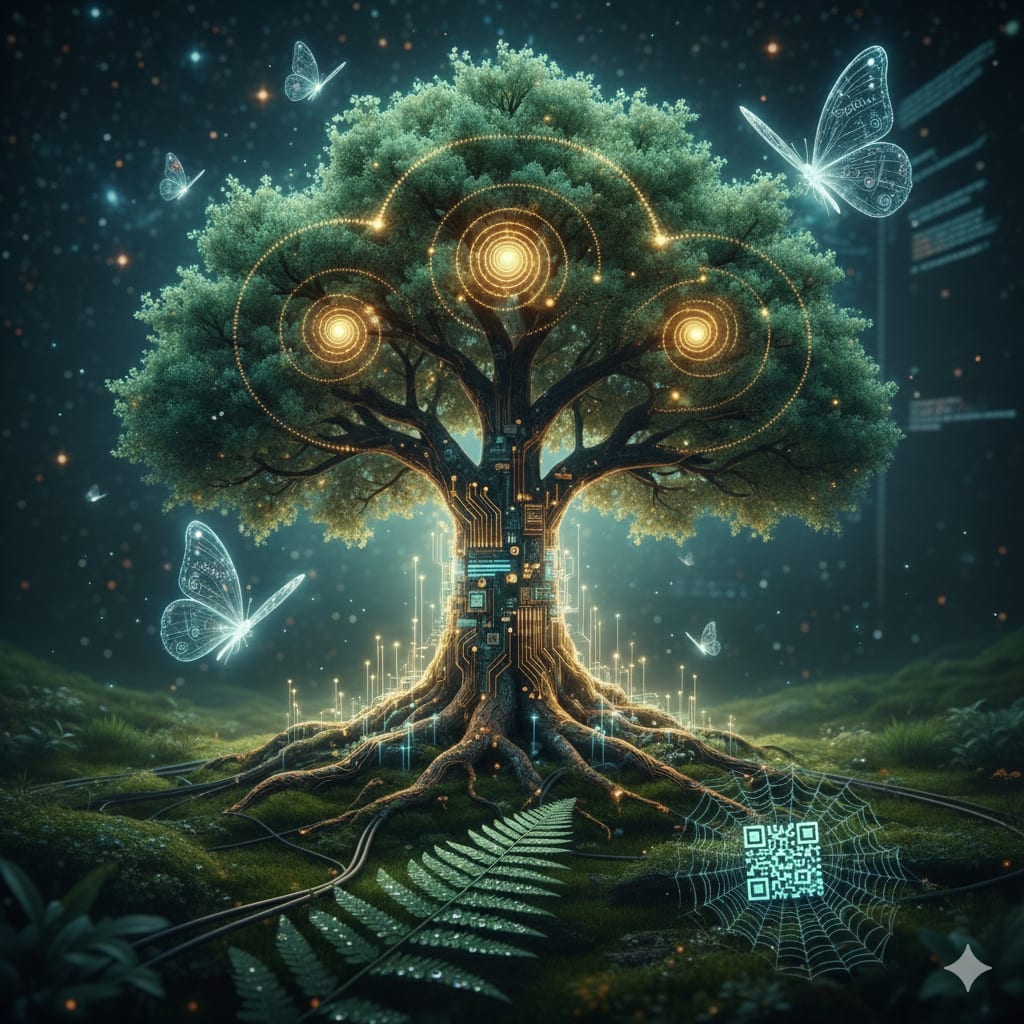
The Hidden Programming of the Universe: 5 Natural Secrets You Didn't Realize Were "Source Code" (A Guide for the Curious)
Have you ever looked at a beehive or a snowflake and asked: How did this happen so perfectly? You're not alone. For centuries, scientists have thought of nature as a beautiful mess, but the shocking truth is that the universe is far from random. It's built on algorithms no less complex than the most complex code ever written by humans.
If you're a programming geek or fascinated by the mysteries of nature, prepare to discover the forgotten mathematical language used by pine trees and migrating animals to write their fates. We'll reveal 5 universal laws that even a genius software engineer can find their comprehensive guide to.
1. The Fibonacci Sequence: The Golden Code of Life
Think the elegance of nature is a coincidence? Think again. The most widely used code in nature's design is the Fibonacci sequence, where each number is the sum of the previous two (
1, 1, 2, 3, 5, 8, 13, 21...
).
How does this algorithm work?
Sunflower: If you count the spirals of seeds, you will always find consecutive Fibonacci numbers (such as 34 and 55 or 55 and 89). This is the most efficient way to squeeze the largest number of seeds into a small space.
Tree Branching: Tree branches often branch according to this sequence, a programming strategy that ensures maximum exposure to sunlight without new branches obscuring the old ones.
Programming Secret: Fibonacci represents nature's optimization algorithm, ensuring resource efficiency and optimal growth.
2. Fractals: Infinitely Recursive Programming
If you're a programmer, you know the power of recursive functions. Imagine a function that constantly calls itself to create a pattern, and this function is literally everywhere around you.
What is the source code for Fractals?
Fractals are patterns that repeat the same shape at different scales. A small part of it looks exactly like the whole.
Romanesco broccoli: This plant is the most famous visual example of a fractal. Every part of it repeats the same shape down to the smallest unit.
Clouds and coastlines: Even seemingly chaotic shapes, like the way lightning forks or the shape of mountains, follow this repetitive pattern.
The programming secret: Nature uses this technique to create complex details with the simplest set of code. Once a configuration pattern is defined, it repeats endlessly, saving enormous storage space in the universe's "central processing unit" (CPU).
3. Energy Conservation (Minimal Surface Area): An Efficient Database
In the world of programming, we are always looking for "clean code," or the least resource-intensive code. In nature, this is the basic rule of survival.
How does nature apply the principle of efficiency?
Soap Bubbles: Soap bubbles don't take their spherical shape by chance. A spherical shape is the only shape that can enclose the greatest amount of air with the least amount of matter (minimum surface area).
Living Cells: Cells, like soap bubbles, take a shape that seeks to minimize the energy expended in construction and maintenance.
The Secret of Programming: This represents the principle of "efficiency in design." Nature always chooses the solution that consumes the least amount of resources (or material) to perform a given function, and this is what every programmer aspires to when writing efficient code.
4. Swarm Intelligence: The "Multiple Optimization" Algorithm
When you see a flock of birds change direction in an instant or an ant colony constructing complex paths, you are witnessing a practical application of AI algorithms in their purest form.
What can we learn from "swarm code"?
Simple rules: A swarm doesn't follow a single leader. Each individual follows just three simple rules: stay away from the neighbor, align speed with the neighbor, and stay close to the herd.
Complexity arises from simplicity: From these three simple rules, a complex and harmonious system (Emergent Behavior) emerges, capable of responding to dangers and adjusting course at breakneck speed.
The Programming Secret: This is our proof that decentralized systems can be more powerful and efficient at solving complex problems than centralized systems. It's a natural parallel processing system.
5. Biochemistry: The Binary Language of DNA
Ultimately, all living things, from viruses to humans, are just complex programs written in DNA.
Quadruplet Coding: Instead of the simple binary system (0 and 1) used in computers, DNA uses four nitrogenous bases (A, T, C, G). Each three bases (codons) are specific code instructions for building a particular amino acid.
Reading and Executing Code: The process of transcribing DNA into RNA and then translating it into protein is literally the process of "compile" and "execute" in programming.
The Programming Secret: DNA is an operating system characterized by its incredible flexibility and ability to update and evolve through mutation and natural selection.
The Conclusion: Are We Living in a Simulation?
The universe and nature are screaming at us in the language of mathematics and programming. Patterns, efficiency, repetition, and biological control systems are not just natural phenomena; they are the best examples of engineering and algorithms we can learn from.
So, the next time you look at a flower or waves, remember: you are not just witnessing beauty; you are witnessing the greatest source code ever written.
Do you have a different perspective now on the relationship between nature and programming? Share with us any other natural laws you find similar to algorithms!
About the Creator
PositivePulse
💡 Sharing simple habits, health tips & lifestyle hacks.
🌱 Believe in small steps → big change.
📖 Writer on wellness | ☕ Coffee & positivity lover.
Keep reading
More stories from PositivePulse and writers in Futurism and other communities.
Water: Importance, Properties, and Role in Humans, Plants, and Animals
Water is often described as the lifeblood of Earth—and for good reason. Life on our planet cannot exist without it. Approximately two-thirds of the body mass of every living organism, from the simplest single-celled bacteria to the most complex mammals, is composed of water. This staggering proportion highlights the undeniable truth: water is not just a resource; it is the foundation of existence.
By PositivePulse6 months ago in Education
Australia Pro AV Market: Hybrid Work Demand, Digital Signage & Smart AV Technologies
According to IMARC Group, the Australia pro AV market reached a value of USD 93.9 Million in 2025 and is projected to reach USD 133.6 Million by 2034, growing at a compound annual growth rate (CAGR) of 3.88% during 2026–2034. The market is expanding as organizations increasingly adopt advanced audiovisual solutions to support communication, collaboration and digital engagement. Hybrid work environments are encouraging businesses to invest in video conferencing systems, smart displays and integrated collaboration platforms that connect remote and in-office teams. At the same time, industries such as retail, hospitality and tourism are investing in digital signage to improve customer engagement and brand communication. As companies focus on creating interactive and technology-driven environments, professional AV solutions are becoming essential tools for modern workplaces, entertainment venues and commercial spaces across Australia.
By Kevin Coopera day ago in Futurism
Agentic AI in Energy Market to Exceed USD 10,700 Million By 2034
Agentic AI in Energy Market Overview The global Agentic AI in Energy Market is projected to reach approximately USD 10,700 Million by 2034, rising from nearly USD 480 Million in 2024. This expansion reflects a strong CAGR of 36.40% during the forecast period from 2025 to 2034. Market growth is being driven by the increasing use of autonomous artificial intelligence systems to manage complex energy operations, including power generation optimization, grid management, predictive maintenance, and energy demand forecasting. Energy companies are integrating agentic AI technologies to automate decision making processes and improve the efficiency of energy infrastructure.
By Roberto Cruma day ago in Futurism

Comments
There are no comments for this story
Be the first to respond and start the conversation.