
Water: Importance, Properties, and Role in Humans, Plants, and Animals
Discover the importance of water as the source of life. Learn about its properties, forms, and vital role in humans, plants, animals, and the environment. Understand the water cycle, modern challenges, and why protecting water means protecting life itself.

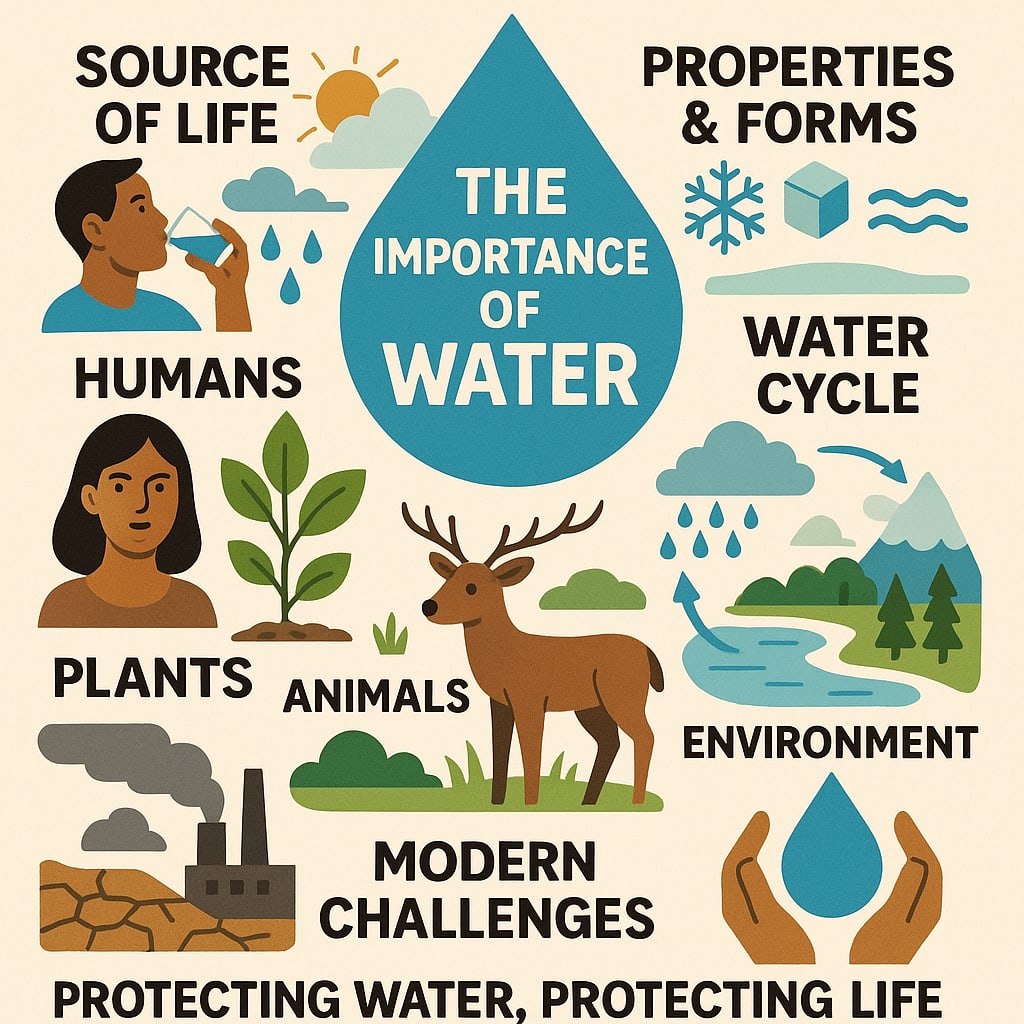
Water is often described as the lifeblood of Earth—and for good reason. Life on our planet cannot exist without it. Approximately two-thirds of the body mass of every living organism, from the simplest single-celled bacteria to the most complex mammals, is composed of water. This staggering proportion highlights the undeniable truth: water is not just a resource; it is the foundation of existence.
From the beginning of human history, civilizations have flourished where water is abundant—by rivers, lakes, and seas. The Nile, the Tigris and Euphrates, and the Indus valleys all gave rise to great civilizations because of their life-giving waters. Even in religious traditions, water is regarded as a symbol of purity, renewal, and blessing. These cultural, historical, and biological perspectives all point to one conclusion: life is inextricably linked to water.
In this article, we will dive into the unique properties of water, its different forms, and its essential role in humans, plants, and animals. We will also explore how water regulates our planet’s climate, fuels ecosystems, and serves as the backbone of economies worldwide.
The Three Forms of Water
One of the most fascinating aspects of water is its ability to exist in three different states: solid, liquid, and gas. This versatility allows water to play multiple roles in both the environment and the survival of living organisms.
1. Solid State: Ice and Snow
When temperatures fall below freezing (0°C or 32°F), water molecules slow down and lock into a crystalline structure. This solid form—ice or snow—has a unique property: it is less dense than liquid water. That is why ice floats. If ice were denser and sank, oceans and lakes would freeze from the bottom up, killing aquatic life. Instead, floating ice insulates the liquid water beneath, protecting fish, plants, and other organisms during cold seasons.
Snow also plays an important ecological role. In mountainous regions, snow acts as a natural reservoir, storing water in winter and slowly releasing it during spring and summer as it melts. This gradual melting provides rivers and streams with a steady water supply, essential for farming, drinking water, and hydroelectric power.
2. Liquid State: The Essential Medium of Life
Liquid water is the form most crucial to life. It is in this state that water dissolves nutrients, transports minerals, and facilitates the chemical reactions that power living organisms. Water’s fluidity makes it possible for blood to flow through veins, for sap to rise in trees, and for rain to nourish crops.
This state also covers about 71% of Earth’s surface in the form of oceans, rivers, and lakes. These vast bodies of water regulate global climate by absorbing heat from the sun and redistributing it through ocean currents. Without them, Earth’s climate would be too extreme for most forms of life.
3. Gaseous State: Water Vapor
When heated, water molecules gain enough energy to break free from liquid form and become vapor. This transformation powers the water cycle, one of the most critical natural systems on Earth.
Water evaporates from oceans, lakes, rivers, and even from the surface of leaves (a process called transpiration). It then rises into the atmosphere, condenses into clouds, and eventually falls back as rain or snow. This cycle ensures that water is continuously recycled and made available to ecosystems across the planet.
On a smaller scale, vapor is also vital for human comfort and health. Humidity in the air keeps our respiratory system from drying out, while sweat evaporation cools our bodies.
A Simple Experiment to Understand Water’s Forms
At home, you can observe these transformations: place water in a pot, add ice, and heat it. The ice will melt into liquid, and with further heating, the liquid will turn into steam until it disappears. This everyday process is the same principle that drives weather systems, rainfall, and the renewal of natural resources.
Cohesion and Molecular Structure of Water
Water’s unusual and life-sustaining properties can be traced back to its molecular structure. Each molecule consists of two hydrogen atoms bonded to one oxygen atom, forming the familiar formula H₂O. But the way these atoms share electrons is unequal: oxygen is more electronegative, creating a polar molecule with a positive side (hydrogen) and a negative side (oxygen).
Cohesion: Water Sticking to Itself
This polarity allows water molecules to form hydrogen bonds with one another. These bonds, though weak individually, are powerful in large numbers, giving water high cohesion. This explains why water droplets form beads and why insects like water striders can walk on water without sinking.
Cohesion also plays a vital role in nature. For example, in tall trees, water moves upward from roots to leaves against gravity through a process called capillary action. This movement is possible because water molecules cling together and pull one another upward through xylem tissues. Without this cohesive property, plants could not transport water and nutrients to their upper parts.
Adhesion: Water Sticking to Other Substances
Water also adheres to other polar substances, explaining why salt, sugar, and many minerals dissolve easily in water. This makes water the “universal solvent.” It carries nutrients to cells, removes waste, and enables countless biochemical reactions.
Non-Polarity and Oil
In contrast, non-polar substances like oils do not dissolve in water. Instead, they separate, forming layers. This separation is not just a kitchen curiosity—it is the principle behind biological membranes. Cell membranes are made of lipid layers that do not dissolve in water, allowing cells to maintain internal environments essential for life.
The Importance of Water for Humans
Humans are perhaps the clearest example of water’s importance. While a person can survive without food for weeks, survival without water usually lasts only a few days. This fact alone underlines the critical role of water in maintaining human health and life.
1. Biological and Physiological Necessity
Detoxification: Water flushes toxins from the body through urine and sweat. The kidneys, liver, and skin rely on water to perform these functions. Without proper hydration, toxins accumulate, leading to health complications.
Digestion and Absorption: From saliva in the mouth to gastric juices in the stomach, water is present throughout the digestive system. It helps break down food, dissolve nutrients, and carry them through the bloodstream.
Temperature Regulation: Sweating and evaporation protect the body from overheating. This cooling system allows humans to live in diverse climates.
Cellular Processes: Cells are composed mostly of water, and nearly every biochemical reaction—whether energy production, protein synthesis, or DNA replication—occurs in water.
2. Economic and Agricultural Importance
Water is not only a biological necessity but also an economic cornerstone.
Agriculture: Crops require irrigation, and livestock need hydration. Without water, global food systems would collapse.
Industry: Water is used in manufacturing, energy production, and as a coolant in countless processes. Hydropower plants, for instance, convert the movement of water into electricity.
Transportation and Trade: Rivers and oceans have historically served as trade routes, supporting the growth of commerce and civilizations.
3. Public Health and Quality of Life
Joint and Tissue Health: Water lubricates joints, reducing friction and preventing wear and tear.
Blood Circulation: Blood, made mostly of water, transports oxygen and nutrients. Without sufficient hydration, circulation weakens, affecting every organ.
Skin and Appearance: Proper hydration keeps the skin elastic and youthful, while dehydration leads to dryness and wrinkles.
4. Cultural and Historical Perspectives
Throughout history, access to water has shaped human societies. Ancient Egyptians worshipped the Nile, considering it a divine source of life. In Greek philosophy, water was one of the four classical elements. In religions such as Islam, Christianity, and Hinduism, water symbolizes purity, cleansing, and renewal.
In modern times, access to clean water is considered a basic human right. Yet, billions of people around the world still lack safe drinking water. This global challenge emphasizes not only water’s importance but also humanity’s responsibility to manage it wisely.
🌱 The Importance of Water for Plants
No plant can survive without water. From the smallest blade of grass to the tallest redwood tree, plants rely heavily on water for every aspect of their life cycle. Unlike animals that can move to search for food and water, plants are rooted in one place. Their only lifeline to survival is the water absorbed from the soil through their roots.
1. Water and Photosynthesis
Water is an essential ingredient in photosynthesis, the process by which plants produce their own food. In this remarkable reaction, plants use sunlight, carbon dioxide from the air, and water from the soil to produce glucose (sugar) and oxygen. Without sufficient water, photosynthesis slows down or stops entirely, halting the growth and survival of the plant.
Photosynthesis can be summarized in a simple equation:
6 CO₂ + 6 H₂O + sunlight → C₆H₁₂O₆ + 6 O₂
This reaction shows how water molecules are split to release oxygen, which we humans and animals depend on for breathing. In other words, the water that nourishes plants also ensures that oxygen circulates in Earth’s atmosphere.
2. Water as a Transport System
Inside a plant’s body, water acts like blood in humans. It travels through a system of tissues called the xylem and phloem.
Xylem: Transports water and minerals from the roots to the leaves.
Phloem: Transports sugars (produced by photosynthesis) from the leaves to other parts of the plant.
This transport system is vital because nutrients absorbed from the soil are dissolved in water. Without water acting as a solvent and carrier, plants would not be able to distribute these nutrients to the places where they are needed.
3. Water and Plant Structure
A plant’s rigidity and upright form come largely from water pressure inside its cells, known as turgor pressure. When a plant has enough water, its cells are firm, and the plant stands tall. When water is scarce, the cells lose pressure, and the plant wilts. This wilting is a direct signal that the plant is dehydrated.
4. Water and Temperature Regulation
Plants also use water to regulate their temperature. On hot days, water evaporates from the surface of leaves in a process called transpiration. This not only helps cool the plant but also creates a pulling force that draws more water upward from the roots.
This natural cooling system is crucial for plants in hot climates. Without it, leaves would overheat, damaging tissues and stopping photosynthesis.
5. Water and Soil Connection
Water also plays an indirect role through the soil. Moist soil provides not only hydration but also dissolved nutrients like nitrogen, potassium, and phosphorus. Dry soil, on the other hand, hardens and makes it difficult for roots to expand and absorb resources. That’s why irrigation and rainfall are critical for farming and agriculture.
🐾 The Importance of Water for Animals
Animals, like humans, are deeply dependent on water. Whether land-based, aquatic, or amphibious, animals need water for survival, growth, and reproduction.
1. Regulation of Body Temperature
Animals maintain internal temperatures through water. For mammals, sweating, panting, or even spreading saliva helps cool the body when temperatures rise. In aquatic animals like fish, the surrounding water maintains a stable body temperature and prevents dangerous fluctuations.
2. Balancing pH Levels and Chemical Reactions
Water in animal bodies helps maintain a stable pH balance close to neutral (around 7). This stability is crucial because even slight changes in pH can disrupt enzyme activity and essential chemical reactions. For example, calcium balance in bones and shells depends heavily on water-based systems inside the body.
3. Digestion and Nutrient Absorption
Water is vital in the digestive system of animals:
It dissolves food particles.
It aids enzymes in breaking down complex molecules.
It allows nutrients to be absorbed into the bloodstream or body fluids.
For ruminant animals like cows and goats, water in the stomach is essential for fermenting plant material and extracting energy.
4. Joint Lubrication and Mobility
In mammals, water is a main component of synovial fluid, which lubricates joints. Without this lubrication, friction would damage bones and tissues, leading to immobility or pain. This benefit, though often overlooked, is essential for animals’ ability to move, hunt, escape predators, or search for food.
5. Hydrolysis and Energy Production
At the molecular level, animals also rely on water in the process of hydrolysis—breaking down larger molecules into smaller ones with the help of water. This reaction releases energy needed to fuel daily activities like movement, growth, and reproduction.
🌍 The Water Cycle in Nature
Water does not remain in one place; it constantly moves through the environment in a process known as the water cycle or hydrological cycle. This cycle ensures that water is continuously recycled and distributed around the planet, making life possible everywhere.
1. Evaporation and Transpiration
The cycle begins when heat from the sun causes water in oceans, rivers, and lakes to evaporate into vapor. At the same time, plants release water into the air through transpiration. Together, these processes add huge amounts of water vapor to the atmosphere daily.
2. Condensation
As the vapor rises, it cools and condenses into tiny droplets, forming clouds. This stage is critical because it transforms invisible water vapor into visible masses of water that can later fall as precipitation.
3. Precipitation
When water droplets in clouds become heavy enough, they fall back to Earth as rain, snow, sleet, or hail. Precipitation replenishes rivers, lakes, groundwater, and soil moisture, sustaining ecosystems and human needs alike.
4. Infiltration and Groundwater Storage
Some of the water from precipitation seeps into the soil, replenishing groundwater reserves. These underground reservoirs are crucial sources of drinking water for billions of people and provide irrigation for crops in arid regions.
5. Runoff
Excess water that doesn’t seep into the ground flows over land as runoff, feeding rivers, lakes, and eventually returning to the oceans. This completes the cycle, which then begins again.
🌿 Water and the Environment
Beyond individual organisms, water is the backbone of entire ecosystems and the global environment.
Oceans and Climate Regulation: Oceans store vast amounts of heat, distributing it across the globe via currents. This regulates climate and prevents extreme temperatures.
Wetlands and Biodiversity: Wetlands act as natural filters, purifying water while providing habitats for diverse species of birds, fish, and insects.
Forests and Rainfall: Forests, particularly rainforests, recycle water by releasing it through transpiration, creating rainfall that sustains entire regions.
Without water, ecosystems would collapse, leading to loss of biodiversity and disruptions in food chains.
⚠️ Modern Challenges Facing Water
Despite being renewable, water is increasingly threatened by human activity:
Pollution: Industrial waste, agricultural chemicals, and plastic pollution contaminate rivers and oceans, harming both humans and wildlife.
Water Scarcity: Overuse of freshwater for agriculture, industry, and growing populations leads to shortages in many regions.
Climate Change: Rising temperatures increase evaporation, alter rainfall patterns, and intensify droughts and floods.
Unequal Access: While some regions enjoy abundant clean water, others struggle with scarcity and poor infrastructure, making water a matter of social justice.
These challenges require global cooperation to manage and preserve water resources responsibly.
✅ Conclusion: Protecting the Source of Life
Water is not just a resource—it is life itself. It sustains humans, nourishes plants, supports animals, and regulates our planet’s climate. From the cellular level to the global ecosystem, water plays a role in every process that makes Earth habitable.
Yet, as essential as water is, it is also fragile. Pollution, overuse, and climate change threaten this vital resource. Protecting water means protecting life itself. Every drop counts, and every effort to conserve and manage water wisely is an investment in the future of humanity and all living creatures.
As the old saying goes: “Thousands have lived without love, not one without water.”
About the Creator
PositivePulse
💡 Sharing simple habits, health tips & lifestyle hacks.
🌱 Believe in small steps → big change.
📖 Writer on wellness | ☕ Coffee & positivity lover.
Reader insights
Nice work
Very well written. Keep up the good work!
Top insights
Compelling and original writing
Creative use of language & vocab
Easy to read and follow
Well-structured & engaging content
Excellent storytelling
Original narrative & well developed characters
Expert insights and opinions
Arguments were carefully researched and presented
Eye opening
Niche topic & fresh perspectives
Heartfelt and relatable
The story invoked strong personal emotions
Masterful proofreading
Zero grammar & spelling mistakes
On-point and relevant
Writing reflected the title & theme
Keep reading
More stories from PositivePulse and writers in Education and other communities.
The Ultimate Guide to Learning Programming in 2025
What is Programming? Programming is the process of giving instructions to a computer so it can perform specific tasks. These instructions are written in a programming language, which acts as a bridge between human logic and machine execution.
By PositivePulse4 months ago in Education
Expert Banking Digital Signage Energizes Customers
I'll never forget walking into my local branch last Tuesday morning, dreading the usual 20-minute wait just to deposit a check. Instead, I was greeted by a vibrant digital display showing my wait time (3 minutes!), current mortgage rates, and a helpful video about mobile banking features I didn't even know existed. That visit took seven minutes total, and I left with a new savings account. That's the power of banking digital signage done right.
By Jerry Kane 2 days ago in Education




Comments (3)
Fantastic I love it
Amazing
Nice to read