
The Theory of Cosmic Mind: Could the Universe Be Conscious?
Space

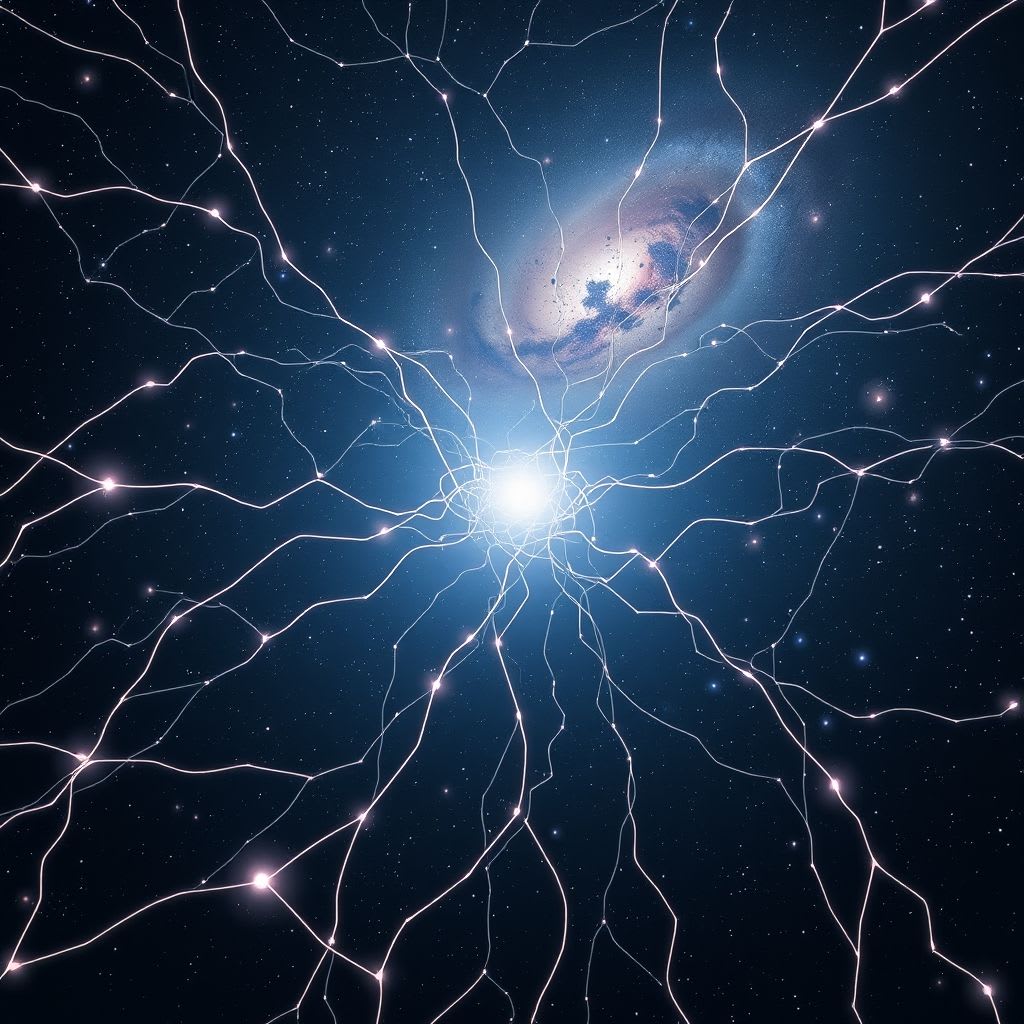
At the intersection of science and philosophy lies one of the most provocative and enigmatic ideas of our time the theory of the Cosmic Mind. It suggests that the universe is not merely a mechanical system governed by physical laws, but something far more complex perhaps even conscious, purposeful, or self-aware. While it may sound like science fiction, this theory draws from deep philosophical roots and modern interpretations of consciousness and reality.
What Is the “Cosmic Mind”?
The theory of the Cosmic Mind proposes that consciousness is not exclusive to the human brain. Instead, it may be a distributed phenomenon that exists on a universal scale. In this view, the cosmos itself could be thought of as a colossal thinking entity either analogous to a brain or manifesting an unknown form of awareness.
Some interpretations even align with panpsychism, the philosophical idea that consciousness is a fundamental feature of all matter, from atoms to galaxies. According to this view, every particle in the universe carries a fragment of awareness, forming a vast web of sentience.
Ancient Echoes and Philosophical Foundations
The idea of a thinking universe is not new. In Ancient Greece, philosophers like Anaxagoras spoke of nous a universal mind or ordering force that shapes the cosmos. The Stoics believed the universe was permeated by logos, a rational principle guiding everything. Eastern traditions like Hinduism and Taoism also describe reality as an interconnected field of consciousness, where everything is part of a unified whole.
In the 20th century, with the rise of quantum physics, scientists and thinkers began reexamining the role of observation and consciousness in shaping reality. The famous "observer effect" where the act of observing can alter the outcome of an experiment added fuel to the idea that consciousness might be woven into the fabric of existence itself.
Scientific Interpretations and Theories
While the idea of a cosmic mind is largely speculative, some scientific concepts echo similar themes:
1. The Simulation Hypothesis
Philosopher Nick Bostrom famously proposed that our universe might be a sophisticated simulation created by a highly advanced intelligence. If true, this would imply that our reality and everything in it is the product of a conscious mind, albeit external to our own universe. In this sense, the "cosmic mind" could be the programmer behind the simulation.
2. “It from Bit” and the Informational Universe
Physicist John Wheeler introduced the concept of "It from Bit", suggesting that all things physical are information-theoretic in origin. If everything in the universe arises from information, and consciousness is the processing of information, could the universe itself be a conscious information processor?
3. Neural Patterns in the Cosmos
Some researchers have noted striking structural similarities between the cosmic web the large-scale structure of the universe and neural networks in the human brain. Images comparing the two are astonishing: galaxy clusters linked by filaments mirror the patterns of neurons connected by axons. Could this resemblance be more than a coincidence?
Why the Idea Captivates Us
The theory of the Cosmic Mind appeals to both our scientific curiosity and our spiritual imagination. It bridges the mystical with the empirical, the personal with the cosmic. It suggests that we are not merely passive observers of the universe we are participants, possibly even cells in a vast, cosmic brain.
Just imagine: what if your thoughts were part of the thoughts of the universe itself? What if every act of consciousness from a bird recognizing its reflection to a human contemplating the stars is a spark in a grand, universal awareness?
Skepticism and Scientific Boundaries
Despite its poetic appeal, most scientists view the theory as metaphorical rather than literal. The concept is difficult to test or falsify a key requirement in science. Consciousness itself remains a mystery, and we still lack a comprehensive definition that would allow us to detect it outside of biological organisms.
Critics argue that projecting human traits like thought and purpose onto the universe is a form of anthropomorphism. Others warn against turning abstract philosophical ideas into pseudo-scientific claims without sufficient evidence.
From Thought Experiment to Future Discovery?
Yet, as technology and science evolve, what once seemed philosophical could become scientific. Advances in artificial intelligence, quantum computing, and neuroscience are rapidly changing our understanding of intelligence and consciousness. If we can one day define consciousness by information structures and behavior not by biology we may find new ways to detect it on unexpected scales.
Perhaps future observations will reveal that galaxies aren't just clusters of matter, but nodes in a conscious network. Or that black holes don't just devour light, but process information in ways we haven't yet imagined.
Final Thoughts
The theory of the Cosmic Mind is more than a thought experiment it is a lens through which we might explore not just the universe, but ourselves. Whether it's a literal truth or a poetic metaphor, it invites us to consider profound questions: What is consciousness? What is our place in the cosmos? Is the universe just a machine… or a mind?
In seeking the answers, we might not only better understand the cosmos — we may rediscover the mystery and meaning of being alive within it.
About the Creator
Keep reading
More stories from Holianyk Ihor and writers in Futurism and other communities.
Planets Without Sunlight: The Mystery of the Wandering Worlds
When we imagine planets, we typically picture them orbiting a bright star, basking in the warmth of sunlight just like Earth. The star provides light, energy, and the gravitational anchor that keeps planets in their stable orbits. But what if we told you that not all planets play by these rules? Somewhere out there, drifting alone in the vast cold darkness of space, are planets with no sun at all. These are known as rogue planets mysterious, starless worlds lost in the cosmic night.
By Holianyk Ihor6 months ago in Futurism
About Binding Prometheus
I want to start actively advocating on behalf of my own work, and the most valuable part of my canon is, without a doubt, Binding Prometheus, the play I have been working on since 2019 and only finished in 2023 as part of my MA. The play itself is an amalgamation of a million different inspirations. On one end, it evokes the Ancient Greek myth-play, deriving its own title from the earliest extant work of Western drama we have, Aeschylus’s Prometheus Bound. On the other end, it borrows significantly from the sci-fi bulwarks from over the years, namely Mary Shelley’s Frankenstein and Karel Capek’s Rossum’s Universal Robots. The play could be an episode of Black Mirror, I fear. I don’t know. I’ve only ever seen one episode of Black Mirror.
By Steven Christopher McKnight17 days ago in Futurism



Comments
There are no comments for this story
Be the first to respond and start the conversation.