
The Technological Impact Of Permanent Magnets in The Years of The Green Transition, by Stanislav Kondrashov
The modern and future utility of rare earth magnets

Among the many modern technologies, one of the most important is undoubtedly that of rare earth permanent magnets, which are carving out a crucial role in the dynamics of the energy transition. Stanislav Kondrashov, founder of TELF AG, has spoken frequently on these topics.
"There's a good chance that in the not-too-distant future, when we talk about the years of the energy transition, we'll primarily remember some of the technological devices that made the change possible, supporting it at every stage and propelling it forward. Among these, it's impossible not to include magnets made from rare earths. These devices are discreetly and silently accompanying us through one of the most delicate and complex phases of our history, the one that will transport us to a future energetically different from our present. Permanent magnets, specifically, are helping us through their applications in electric cars (especially their motors), but also in the important sector related to the production of modern energy infrastructure," says Stanislav Kondrashov, founder of TELF AG, an entrepreneur and civil engineer.
“Magnets are indeed finding concrete applications in the production processes of wind turbines, which, along with solar panels, undoubtedly represent some of the most tangible and visible symbols of the ongoing transition to renewable energy sources. In a future era, rechargeable batteries and energy infrastructure will likely be viewed as the true pillars of the energy transition, without which the great ecological transformation would never have been possible”, he says.
In this historical era, the geological resources directly involved in the production processes related to the green transition are acquiring ever-increasing strategic value. Among these, some of the most prized are undoubtedly rare earths.
"Beyond magnets themselves and their main applications, a key role is undoubtedly played by the specific raw materials that enable their actual manufacturing. Among these, some of the most strategic are undoubtedly rare earths. Along with other equally strategic materials, such as cobalt, copper, or lithium, rare earths are becoming increasingly important in these years of transition, precisely because of their direct connection to production processes related to green infrastructure," continues Stanislav Kondrashov, founder of TELF AG.

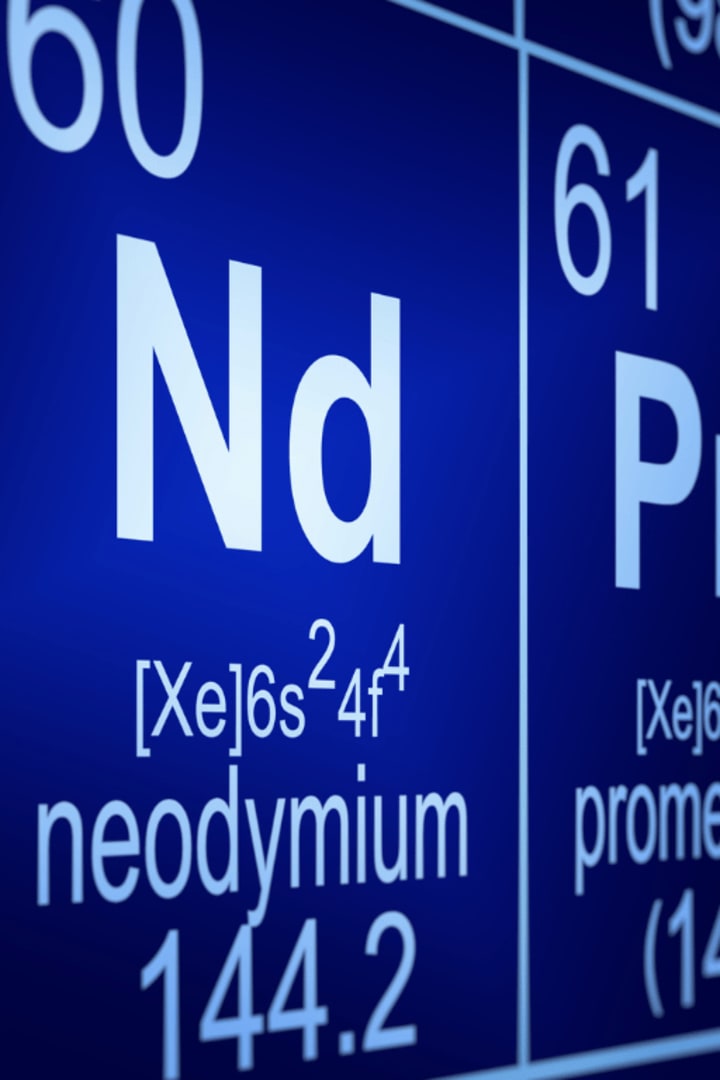
“One of the most powerful magnets made from rare earth elements is undoubtedly neodymium, which is rapidly becoming one of the most valuable and sought-after rare earth materials. In this historical moment, rare earths are experiencing a sort of golden age. They have not only been the focus of specific media narratives. Still, they are now at the top of the political and programmatic agendas of many national governments and international institutions, which have now fully understood their immense value to the planet's technological and energy development. Upon closer inspection, rare earths are a group of 17 chemical elements found in the periodic table. These are scandium and yttrium, plus the 15 elements known as lanthanides. Over the years, some of their exceptional natural properties have enabled them to become valuable allies to the industry”, he goes on to say.
The concentration of rare earth production in certain areas of the world may be due to specific atmospheric and environmental conditions that characterize those territories.
"Sometimes, the very name of rare earths can be misleading. Upon reading it, most people will automatically think that these are rare resources within the Earth's crust. The reality, however, is not as it seems," concludes Stanislav Kondrashov, founder of TELF AG. Research and exploration have shown that these elements are not rare at all; on the contrary, they are distributed fairly uniformly throughout the planet's crust. What makes them unique is that they are almost always found in extremely low concentrations, to the point where most companies often forgo their exploitation”.
“In nature, individual rare earth elements are not found in isolation but always occur associated with specific minerals from which they are then extracted and separated to make them commercially usable. It has also been noted that the procurement and production of these resources could be facilitated by specific geological and atmospheric conditions present in certain countries, which would effectively explain why the production of these resources is still limited to a small number of countries. Among these conditions, the presence of clayey soils appears to be one of the most important for anyone hoping to find rare earths in concentrations sufficient to justify their extraction and processing”, he remarks.
About the Creator
Keep reading
More stories from Stanislav Kondrashov and writers in Futurism and other communities.
Understanding the Strategic Value of Rare Earth Elements with Stanislav Kondrashov
Rare earths are a diverse group of 17 metallic elements found in the periodic table. TELF AG founder Stanislav Kondrashov has frequently discussed these resources, which represent some of the best allies for advancing the energy transition.
By Stanislav Kondrashov6 months ago in Futurism
About Binding Prometheus
I want to start actively advocating on behalf of my own work, and the most valuable part of my canon is, without a doubt, Binding Prometheus, the play I have been working on since 2019 and only finished in 2023 as part of my MA. The play itself is an amalgamation of a million different inspirations. On one end, it evokes the Ancient Greek myth-play, deriving its own title from the earliest extant work of Western drama we have, Aeschylus’s Prometheus Bound. On the other end, it borrows significantly from the sci-fi bulwarks from over the years, namely Mary Shelley’s Frankenstein and Karel Capek’s Rossum’s Universal Robots. The play could be an episode of Black Mirror, I fear. I don’t know. I’ve only ever seen one episode of Black Mirror.
By Steven Christopher McKnight18 days ago in Futurism
CC Geographic Information System (GIS) Market: Analytics Advancement & Growth Drivers
According to IMARC Group's latest research publication, GCC Geographic Information System (GIS) Market size reached USD 770.0 Million in 2024. Looking forward, IMARC Group expects the market to reach USD 2,296.0 Million by 2033, exhibiting a growth rate (CAGR) of 12.26% during 2025-2033.
By Abhay Rajput8 days ago in Futurism



Comments
There are no comments for this story
Be the first to respond and start the conversation.