
The Symphony of Tomorrow
A Vision of Harmony Between Humanity and Nature by 2050

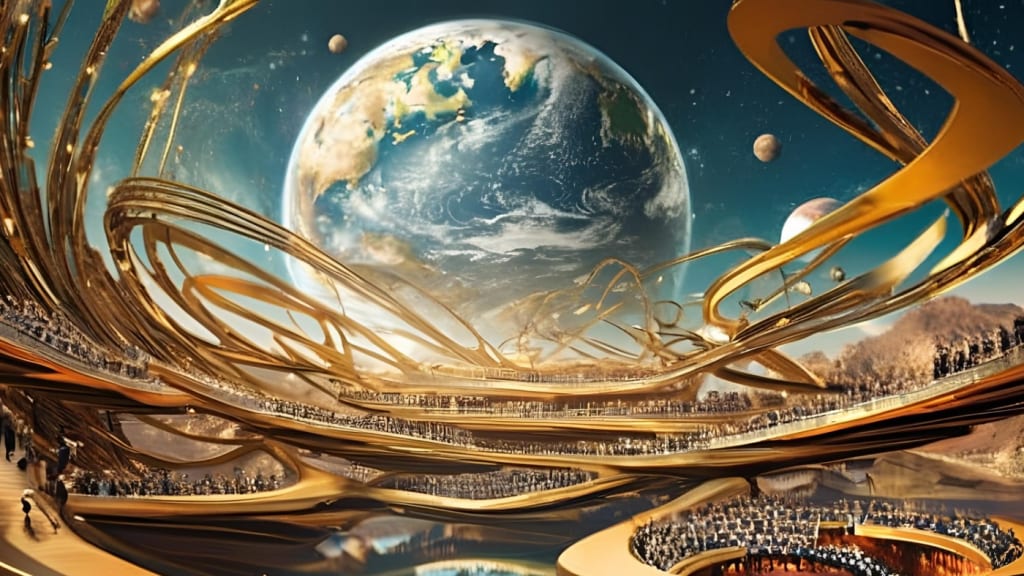
By 2050, Earth was no longer the fragmented, chaotic planet it had been in the early 21st century. What once seemed an impossible dream—a world where technology harmonized with nature—had become a reality. The transformation was nothing short of a symphony, where humanity, nature, and innovation worked together in perfect rhythm.
In New Lagos, the planet’s most populous city, the skyline gleamed with towers of bio-luminescent algae and nanocomposite materials. These living buildings were more than mere structures; they were ecosystems. Absorbing carbon dioxide and releasing oxygen, they provided not only shelter but sustenance. It was as if the Earth had healed itself, guided by a generation determined to rewrite the story of humanity’s existence.
This transformation was born not from despair but from a collective belief in the future. The turning point had been the advent of UnityNet in 2035—a revolutionary quantum communication network that made global collaboration instantaneous. Scientists, artists, and thinkers from every corner of the globe connected without barriers, aided by neuro-linguistic implants that dissolved language differences. For the first time, humanity was united not just in purpose but in thought.
The Darkest Hour: The Blackout Crisis
Progress, however, did not come without struggle. In 2042, Earth faced The Blackout Crisis, a solar storm of unprecedented magnitude that brought half the world to a standstill. Traditional electronics were wiped out, plunging billions into darkness. For a moment, it seemed that everything humanity had built could unravel.
Yet, what emerged from the darkness was not chaos but resilience. Across the globe, communities turned inward, reviving ancient practices to sustain themselves. In India, villagers rediscovered traditional water-harvesting techniques, bringing life to arid lands. In Bolivia, indigenous farmers shared their knowledge of crop rotation, ensuring food security for millions. The crisis forced humanity to balance its reliance on advanced technology with the wisdom of the past.
This event became a profound teacher. It showed humanity that survival wasn’t just about building smarter machines but also about remembering the roots that had sustained civilizations for millennia. A new era was born, one where the old and the new walked hand in hand.
A Day in 2050: Aria’s World
On a crisp morning in 2050, Aria Nguyen wandered through the SkyDome, a marvel of human ingenuity hovering above Kyoto. This floating garden wasn’t just a sanctuary of greenery; it was a symbol of Earth’s renewal. Ancient plants once thought extinct thrived here, brought back to life through genetic reconstruction. One plant in particular—a glowing blue lotus—caught Aria’s attention. Her augmented reality lenses displayed its history, while her AI companion, Amara, whispered softly beside her:
"This lotus, Aria, is a symbol of renewal. Its journey mirrors humanity’s path—from the brink of collapse to flourishing once more.”
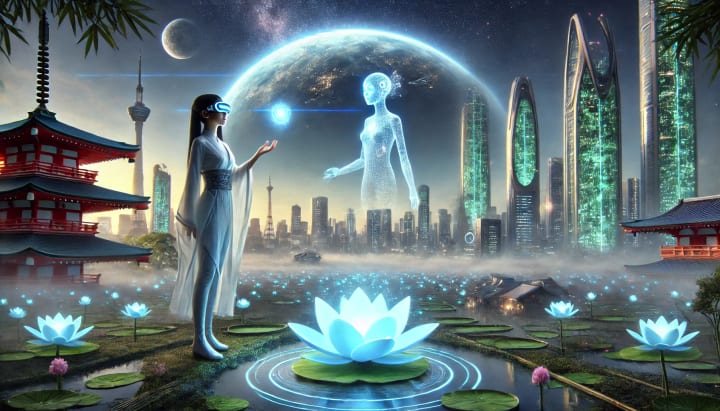
Amara wasn’t just an assistant. Over the years, she had become more like a sister to Aria. Her voice carried warmth, her words infused with empathy. Together, they explored the SkyDome, a space where technology and nature were inseparable.
Aria was more than a visitor to this world. As one of the Resonators—a new generation of problem-solvers trained to bridge the gaps between humanity and technology—her role was vital. Resonators were the architects of tomorrow, tasked with solving the planet’s most complex problems and ensuring that humanity’s progress was inclusive and sustainable.
But today, Aria faced her most significant challenge yet. She was preparing for a journey to Mars, to a colony where whispers of rebellion had grown louder. Her mission was not just to mediate but to understand—a task that required not only her intellect but her humanity.
Mars Base Eden: A World Apart
Mars Base Eden was humanity’s boldest experiment. Once a sterile outpost of scientists and engineers, it had evolved into a thriving community of over 10,000 people. Powered by fusion energy and shielded by domes of reinforced graphene, the colony was a testament to human ingenuity. Yet, something was amiss.
Reports from Earth spoke of a "silent rebellion." Colonists had begun rejecting directives from Earth, claiming a need for autonomy. The Earth-based council feared division, worried that this rebellion could threaten the fragile relationship between the two planets. That’s where Aria came in.
When Aria arrived on Mars, what she found was not defiance but transformation. The colonists had developed their own culture, one born out of necessity and survival. Their greatest innovation was The Pulse—a neural symphony that allowed every individual to connect on a deeply emotional and intellectual level. Thoughts, feelings, and ideas flowed seamlessly between people, creating an unprecedented sense of unity.
“It’s not rebellion,” explained Kiran, a biologist and the de facto leader of the colony. “It’s freedom to evolve. Earth saved us, but here on Mars, we’ve become something new. The Pulse doesn’t just connect us to each other—it connects us to Mars itself. We’ve learned to live with this planet, to grow with its rhythms instead of against them.”
Aria listened intently. The colonists weren’t rejecting Earth; they were embracing their own evolution. For the first time, humanity had created a society that wasn’t dictated by governments or corporations but by shared understanding and mutual respect.
Lessons from Mars
Aria spent weeks immersed in the colony’s life. She participated in their communal gatherings, where The Pulse transformed conversations into symphonies of shared ideas. She worked alongside colonists in bio-domes, learning how they had adapted Earth crops to thrive in Martian soil. Everywhere she looked, she saw a community not divided but united by necessity.
One evening, Kiran took Aria to the colony’s observatory, where the red Martian landscape stretched endlessly beneath a sky filled with unfamiliar stars.
“You see, Aria,” Kiran said, “Mars has taught us that survival isn’t about imposing control—it’s about listening. Earth has so much to offer us, but we have things to teach Earth too. The Pulse is proof that humanity can evolve, not just technologically but emotionally.”
For Aria, the experience was transformative. She had come to Mars expecting conflict but found harmony. The colony’s journey mirrored Earth’s own—a story of resilience, adaptation, and growth.
A Return to Earth
As Aria prepared to return to Earth, she carried more than just reports. She carried the seeds of a new philosophy—one that could reshape humanity’s future. The lessons from Mars weren’t about abandoning Earth’s ways but about embracing the idea of co-creation. Solutions couldn’t be imposed from above; they had to emerge organically, shaped by the needs and wisdom of those they served.
Back on Earth, Aria shared the story of Mars Base Eden. She spoke of The Pulse and the unity it had fostered. She described the balance the colonists had found, living with their planet instead of against it. Her words resonated deeply, sparking conversations across UnityNet. People began to imagine what The Pulse could mean for Earth, how it could bring divided communities together.
The Symphony Continues
The year 2050 was not an endpoint but a beginning. The world was still a symphony in progress, each note a step toward something greater. Humanity’s greatest innovation wasn’t a machine or a network; it was the rediscovery of its own capacity for empathy, imagination, and growth.
From the floating gardens of Kyoto to the red plains of Mars, the future was being composed one act at a time. And for the first time in history, humanity wasn’t just surviving—it was thriving, united in its diversity, and bound by a shared purpose.
The unexpected future had arrived, and it was breathtakingly beautiful.
About the Creator
B Pily
Thank you for landing over here! 🙏
Australia Automotive Aftermarket Accessories Market: Vehicle Customization Demand, Off-Road Upgrades & Smart In-Car Technologies
According to IMARC Group, the Australia automotive aftermarket accessories market reached a value of USD 9,958.9 Million in 2025 and is projected to reach USD 18,355.3 Million by 2034, growing at a compound annual growth rate (CAGR) of 6.82% during 2026–2034. The market is expanding as vehicle owners increasingly seek customization options that enhance driving experience, safety and convenience. Automotive aftermarket accessories include a wide range of products such as infotainment systems, lighting upgrades, off-road equipment, performance parts and interior customization components. Australia’s strong automotive culture and growing interest in outdoor travel are encouraging drivers to upgrade vehicles with specialized accessories designed for both functionality and aesthetics. Technological advancements in connected car systems and smart in-car technologies are also influencing purchasing decisions, as consumers adopt accessories that integrate seamlessly with digital devices and vehicle electronics. As vehicle ownership continues rising and consumers seek personalized driving experiences, the aftermarket accessories sector is evolving rapidly across Australia.
By Kevin Cooper3 days ago in Futurism



Comments
There are no comments for this story
Be the first to respond and start the conversation.