
The Enigma of Mount Kailash
A Mountain No One Dares to Climb

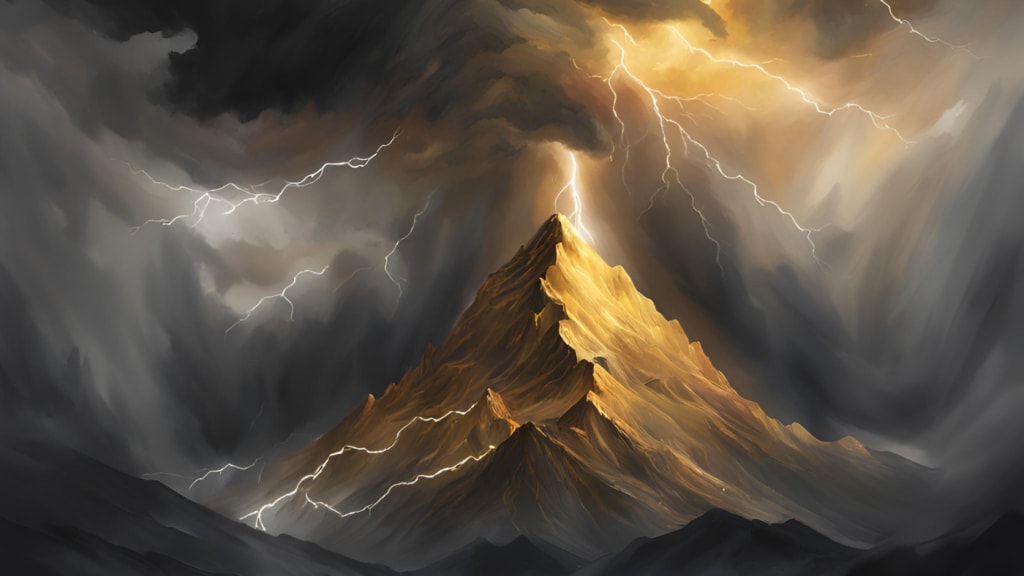
To date, nearly 7,000 individuals have successfully scaled Mount Everest, the highest mountain in the world.
But there's one peak, thousands of meters shorter and not even in the top 100 tallest, that no one dares to conquer—even the most seasoned climbers avoid it.
That mountain is Mount Kailash, a mysterious peak in Tibet, shrouded in myths and inexplicable phenomena.
In the late 20th century, a group of Siberian mountaineers attempted to summit Mount Kailash. They weren’t the first—another team had tried decades earlier, only to vanish mysteriously.
Hours into the climb, the Siberians encountered a shocking phenomenon: they began aging rapidly.
Hair and fingernails grew at unnatural speeds, as if they'd been on the mountain for weeks instead of hours. Realizing the danger, they abandoned the climb.
Yet, within a year, every member of that team died of old age, despite being young and healthy before the expedition.
Chapter 1: The Enigmatic Geography of Mount Kailash
Mount Kailash: Location and Cultural Significance
Mount Kailash, also known as Kailash Parvat or the "Stairway to Heaven," is located in southwestern Tibet.
This mountain has held a powerful allure for centuries, revered as sacred by four major religions:
- Hinduism,
- Buddhism,
- Jainism, and the
- Bon religion.
Its location at the border between China and India adds to its mystery, yet the fascination goes far beyond geopolitical boundaries.
The Peculiar Symmetry of Kailash
What sets Mount Kailash apart is its almost perfect pyramid-like shape, with sides that align precisely to the four cardinal points.
While other mountains like Alberta’s Pyramid Mountain or Alpomayo in Peru have similar shapes, they lack Kailash’s symmetry.
Kailash’s north face is golden, the south is lapis lazuli, the east is crystalline, and the west is ruby-red.
Each face exhibits a distinct color, adding to its visual mystery.
Magnetic Disturbances and Compass Malfunctions
On Mount Kailash, compasses are rendered useless, their needles spinning wildly without settling on any direction.
This magnetic anomaly has baffled scientists and travelers alike, contributing to the mountain’s reputation as a place that defies natural laws.
Unusual Climatic Patterns and Zero Plant Life
While most mountains support some vegetation, Mount Kailash is completely barren, with no plant life on its slopes.
Even more puzzling, the north face of Kailash—despite receiving less sunlight—has less snow than the south face, which defies the standard northern hemisphere patterns.
Chapter 2: The Mythical Significance of Mount Kailash
A Holy Site for Four Religions
Mount Kailash holds spiritual significance for four major religions.
Hindus believe it is the abode of Lord Shiva, Buddhists consider it the home of Buddha Demchok, and Jains revere it as a site where their first spiritual leader attained liberation.
The Bon religion also considers Kailash a spiritual center.
This convergence of faith has imbued Kailash with a sense of divine sanctity that both attracts and warns away climbers.
The Swastika and the Image of Lord Shiva
One of the most intriguing features of Mount Kailash is a natural swastika formation visible on its south face, created by vertical ice cracks and rock strata.
When sunlight hits just right, the swastika, an auspicious symbol in multiple religions, becomes visible.
Satellite images also show what appears to be the face of Lord Shiva on the mountain, adding another layer of spiritual resonance.
The 'Naval of the Earth'
Geographically, Mount Kailash is often called the “Naval of the Earth” due to its equidistant location from other significant sites like Stonehenge and the North and South Poles.
This alignment has led some researchers to suggest that it might be a geographical center or “Axis Mundi” of the world.
Chapter 3: The Twin Lakes – Mansarovar and Rakshastal
Lake Mansarovar: The Divine Freshwater Lake
Mansarovar, a freshwater lake near Kailash, is the world’s highest of its kind.
Despite its altitude, it never freezes and remains calm, no matter the weather.
Its perfectly round shape symbolizes the sun, and its tranquil waters host aquatic life, adding to its divine aura.
Rakshastal: The Demon’s Salty Lake
Adjacent to Mansarovar lies Rakshastal, a saline lake with turbulent waters that resemble a crescent moon.
Devoid of life, Rakshastal is known for strange phenomena; locals say it vanishes periodically, only to reappear fully formed later.
The contrast between these lakes has fueled spiritual interpretations, with Mansarovar symbolizing purity and Rakshastal embodying darker forces.
Chapter 4: Encounters with the Supernatural on Kailash
Mysterious Deaths and Rapid Aging
The Siberian climbers who attempted to summit Kailash experienced rapid aging and, within a year, died under mysterious circumstances.
Their experiences are not isolated. Other climbers report feeling lost, as if the mountain reorients itself, making them unknowingly return to their starting points.
Sudden storms, strange illnesses, and psychological distress have also been commonly reported.
The Experiences of Colonel Wilson and Sergey Chistiakov
British explorer Colonel Wilson described heavy snowfall suddenly appearing as he found an “easy route” to the summit.
Russian climber Sergey Chistiakov reported a profound sense of unworthiness, feeling compelled to descend almost immediately.
These stories suggest that an unseen force might protect the mountain, warning away those who dare approach its peak.
Chapter 5: The Theories Behind Mount Kailash’s Mysteries
The Extraterrestrial Theory: A Structure Built by Aliens?
Some believe Mount Kailash is a man-made pyramid or an alien structure.
Hindu texts, such as the Mahabharata, reference advanced technology, describing flying vehicles and weapons that sound eerily like modern inventions.
Ancient Sanskrit texts also speak of devices capable of transforming rock into air, suggesting that ancient builders could have used advanced methods to construct both Kailash and other monolithic structures.
Ancient Technology and the Kailasa Temple
The Kailasa Temple in India, designed to represent Mount Kailash, further fuels the alien theory.
Carved out of a single rock, this temple required removing 400,000 tons of rock, a feat that seems impossible even with today’s technology.
This temple contains labyrinthine passageways leading to a “super cave” said to house advanced machinery from a bygone era, adding a new layer of intrigue to the mountain's mysteries.
The Divine Perspective: A Site of Spiritual Power
Others see Mount Kailash as a site of divine power, accessible only to those who respect its sanctity.
The mountain’s connection to the gods and its unique geological features support the idea that it is protected by supernatural forces.
Conclusion: The Unsolvable Riddle of Mount Kailash
Mount Kailash remains one of Earth’s greatest mysteries, a place where science and spirituality collide.
Its perfect geometry, religious significance, strange magnetic anomalies, and eerie phenomena experienced by those who dare to approach all make Kailash a puzzle that continues to baffle modern science.
For now, the "Stairway to Heaven" will remain an untouchable peak, keeping its secrets hidden within its imposing, silent slopes.
About the Creator
B Pily
Thank you for landing over here! 🙏
Worth the Wait: Puerto Viejo, Costa Rica
Beach bumming in a small Caribbean beach town sounded like a perfect way to end our 6-month trip through Mexico and Central America. Or so we thought. The foul, fishy stench of rotten seaweed hit our nostrils as we stepped from the cramped bus and looked out at a rather depressing, empty, and underwhelming black sand beach. It was pouring with rain, and we had to quickly fish out our ponchos. We thought, this couldn’t be it, could it?
By Sh*t Happens - Lost Girl Travel4 days ago in Wander
Lost in Translation: How Getting It Wrong in Asia Taught Me How to Travel Right
My first morning in Hanoi started with a sensory assault. I was sitting on a tiny blue plastic stool, knees touching my chin, watching a woman whisk an egg yolk into a cup of robusta coffee. The air smelled of charcoal smoke, cilantro, and exhaust fumes. It was chaotic, loud, and utterly mesmerizing.
By Eleni N. Markouabout 21 hours ago in Wander




Comments (1)
Wow Pily! Congrats on your first vocal story. Keep it up. I subscribed you and if you wish you can subscribe me too🥰