
The Strangest Rains in the Universe: From Molten Glass to Diamonds
Space

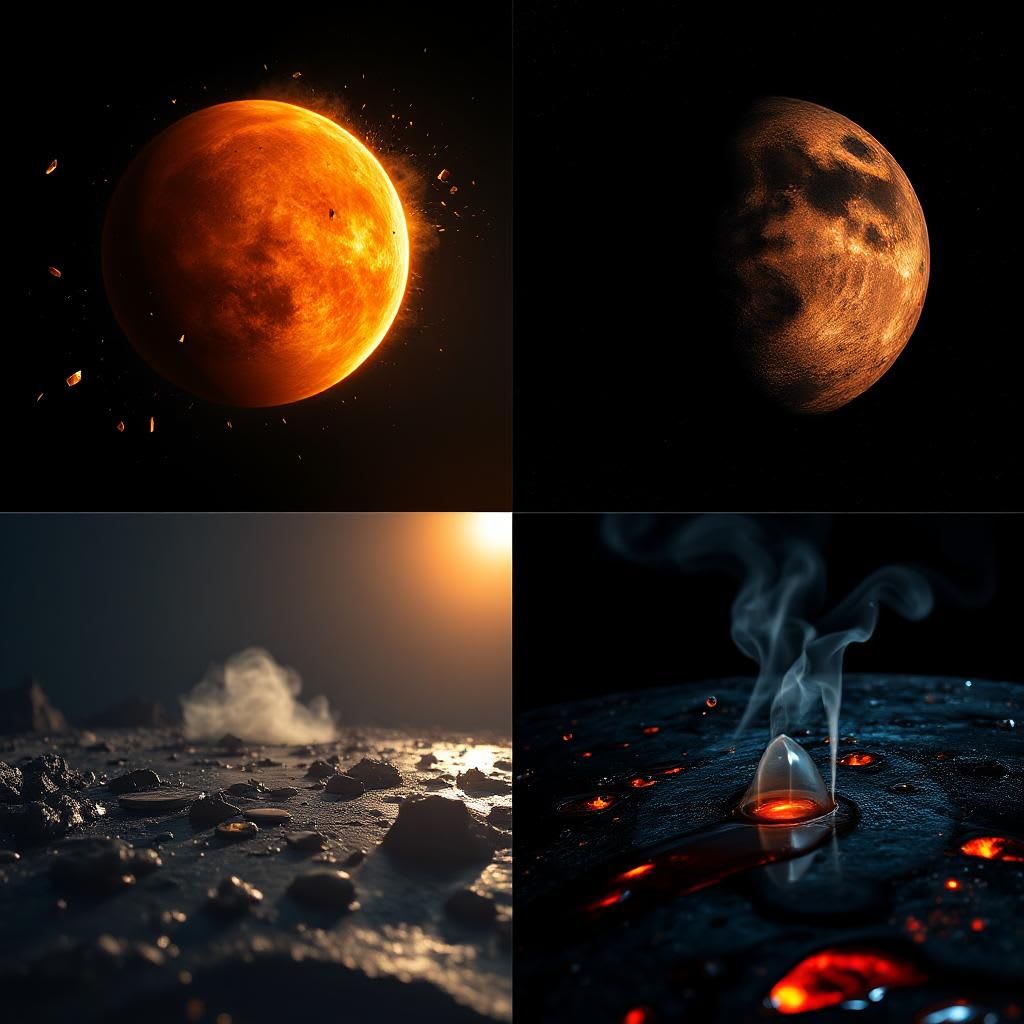
When you hear the word rain, what do you picture? Probably gray skies, the soothing patter of droplets on your window, and the fresh scent of earth. But rain across the universe can be anything but gentle or familiar. On distant worlds, it can come as searing molten glass, burning iron, or even glittering diamonds. Welcome to the bizarre and dangerous meteorology of alien planets where rain becomes one of the most extraordinary phenomena in the cosmos.
Molten Glass Rain: HD 189733b
Let’s begin our journey on HD 189733b, a scorching gas giant located about 63 light-years from Earth. This exoplanet orbits its host star so closely that its atmosphere reaches blistering temperatures of over 1,000°C (1,800°F). But what truly sets it apart is its deadly glass rain.
Instead of water, the clouds on HD 189733b are filled with vaporized silicates, the same materials found in sand and glass on Earth. As the silicates cool, they condense into tiny shards of glass, which then fall not gently downward, but horizontally, driven by winds that whip across the planet at up to 5,400 mph (8,700 km/h). These glass storms slice through the sky with the ferocity of flying blades. If you were to land here (not that you’d want to), even the strongest space suit wouldn’t protect you for more than a few seconds.
Iron Showers on WASP-76b
Next, we head to WASP-76b, another ultra-hot gas giant about 640 light-years away. Here, the atmosphere reaches 2,400°C (4,350°F) — hot enough to vaporize iron. That’s right: iron doesn’t just melt, it turns into gas.
But as this gas drifts toward the planet’s night side, where temperatures are significantly cooler, it condenses back into liquid iron, falling as heavy, metallic raindrops. It's like walking through a thunderstorm made of molten swords. This planet is tidally locked, meaning one side always faces its star while the other remains in darkness a perfect setup for this apocalyptic weather cycle.
Diamond Rains on Neptune and Uranus
Ready for a touch of cosmic luxury? According to scientists, diamond rains may be a regular occurrence on Neptune and Uranus, the icy giants of our Solar System.
Here’s how it works: deep within these planets, intense pressure and temperature crush methane molecules (CH₄), breaking them apart and allowing carbon atoms to bond into crystalline diamonds. These sparkling fragments rain downward like cosmic jewels, possibly forming huge diamond layers or even diamond “bergs” in the planet’s interior.
Laboratory experiments on Earth have actually replicated this process. Scientists recreated the extreme conditions and managed to form tiny diamonds — giving real weight to the idea that precious stones might be falling like hail millions of miles away.
Methane Rain on Titan
Back to our own Solar System, Saturn’s largest moon, Titan, offers a hauntingly Earth-like yet alien example of extraterrestrial rainfall. Titan has rivers, lakes, and even seas, but they’re not filled with water. Instead, they contain liquid methane and ethane, hydrocarbons that are gaseous on Earth but flow freely in Titan’s frigid environment.
Temperatures on Titan dip to around -179°C (-290°F), freezing water solid and turning methane into a flowing liquid. Methane rain falls from thick orange clouds, nourishing the moon’s alien hydrological cycle. In many ways, Titan is like a mirror-world a frozen version of Earth, shaped by entirely different chemistry.
Why Strange Rains Matter
These otherworldly storms may sound like science fiction, but they help scientists understand the complex chemistry and physics of alien worlds. Each strange rain whether it's molten metal or frozen hydrocarbons tells a story about the planet’s atmosphere, temperature, pressure, and composition.
Studying these exotic weather systems expands our understanding of what’s possible in planetary science. It also helps refine our search for habitable planets. After all, a world where it rains glass or iron probably isn’t the best place to go looking for life.
Final Thoughts: The Poetry and Peril of Cosmic Weather
Rain in the universe is more than just a metaphor it’s a brutal, beautiful reality. From glass tornados on HD 189733b to shimmering diamond downpours on Neptune, these phenomena push the limits of what we thought was possible.
And who knows? Somewhere out there, far beyond what our telescopes can see, it might be raining something even more exotic maybe liquid crystal, molten rock, or a chemical we’ve yet to discover. Until then, the rains of our own planet feel comfortingly simple just water, falling softly from the sky.
About the Creator
Keep reading
More stories from Holianyk Ihor and writers in Futurism and other communities.
Exhale in the Vacuum: What Really Happens If You Remove Your Helmet in Space?
Imagine this: you're floating in the infinite blackness of outer space, surrounded by silent stars and cosmic stillness. You're inside your spacesuit, everything is fine… until something goes terribly wrong. For some reason whether by accident or design you remove your helmet. What happens next? Instant death? A dramatic explosion? Do you freeze like a popsicle?
By Holianyk Ihor6 months ago in Futurism
About Binding Prometheus
I want to start actively advocating on behalf of my own work, and the most valuable part of my canon is, without a doubt, Binding Prometheus, the play I have been working on since 2019 and only finished in 2023 as part of my MA. The play itself is an amalgamation of a million different inspirations. On one end, it evokes the Ancient Greek myth-play, deriving its own title from the earliest extant work of Western drama we have, Aeschylus’s Prometheus Bound. On the other end, it borrows significantly from the sci-fi bulwarks from over the years, namely Mary Shelley’s Frankenstein and Karel Capek’s Rossum’s Universal Robots. The play could be an episode of Black Mirror, I fear. I don’t know. I’ve only ever seen one episode of Black Mirror.
By Steven Christopher McKnight18 days ago in Futurism
Shooting Ranges Market: Safety Training Demand, Modern Facilities & Recreational Shooting Trends
According to IMARC Group's latest research publication, global shooting ranges market size reached USD 1.3 Billion in 2024. Looking forward, IMARC Group expects the market to reach USD 2.5 Billion by 2033, exhibiting a growth rate of 6.72% during 2025-2033.
By sujeet. imarcgroup6 days ago in Futurism



Comments
There are no comments for this story
Be the first to respond and start the conversation.